Three glasses of wine. Three lost days. One very telling podcast. Benjamin Jack on the wellness cult, the war on alcohol, and why the wine industry needs to start fighting back.
After a lovely bank holiday weekend full of sunshine and ice cold rosé, I settled onto the sofa on Tuesday evening and stumbled across a clip of Steven Bartlett, of Diary of a CEO and Dragons’ Den fame, telling his millions of followers that three glasses of wine had ruined his life.
Not his week. Not his morning. His life. Or at least three days of it.
He couldn’t record his podcast. He couldn’t go to the gym. He couldn’t, by the sounds of it, operate at the standard he had set himself for productive human existence.
In Bartlett’s telling this wasn’t an evening of pleasure or a conversation that went longer than planned or the particular joy of a second bottle opened because the first one hadn’t quite scratched the itch. It was a system failure. A biohacker’s worst nightmare, a code burgundy if you will.
I must admit on seeing this I couldn’t help but laugh. It was almost too absurd to wrap my head around given my own weekend of debauchery. Yet this particular philosophy wasn’t completely new to me.
Bartlett is not an idiot. He has built something genuinely impressive, and he is, by most accounts, sincere in his pursuit of what he calls the good life. That is precisely what makes the clip so instructive, and so alarming to me.
This is not a cautionary tale about a man who has gained a new perspective after passing out behind a bar on a stag do in Split. It is a far more revealing story about a culture that has so thoroughly absorbed a particular gospel, the gospel of optimisation, that one of its most prominent preachers can describe a normal social evening as a catastrophic personal event, and expect an audience of millions to nod along in solemn agreement.
And they do nod along. That is the thing.
The optimised life has become the aspirational life. WHOOP scores. HRV tracking. Sleep stages dissected with the rigour previously reserved for cardiac surgery. Cold plunges at dawn. Dry-Jans that quietly became alcohol-free lives.
The language of biohacking has invaded wellness, and wellness has invaded and colonised popular culture, and the logical endpoint of all of it is a man with a microphone and an audience of millions telling you that a normal Thursday has left him unable to function for seventy-two hours. It all seems a bit odd.
And so I have to ask the question. At what point did the performance of wellness replace the experience of being well?
The cult of optimisation
The history of human beings drinking together is, almost without exception, the history of human beings becoming more human.
This is not biased or a bedside story I grew up with in the industry. It is archaeology.
The oldest known recipe in recorded history is for beer, a Sumerian clay tablet from roughly 1800 BC. The Sumerians, who also gave us the wheel, writing, and the concept of law, understood instinctively what their descendants would spend centuries trying to regulate away: that fermented drink is rather good and was not a vice to be managed but a gift to be shared. They did not track their sleep after drinking it. They offered it to their gods.
Move forward a few centuries and you arrive in ancient Greece, where wine was not merely consumed but philosophised about. The symposium, literally a “drinking together”, was the primary institution through which Athenian intellectual and civic life was conducted. Socrates drank at them. Plato wrote about them.
The word demokratia, democracy, emerged from a culture in which the shared cup was inseparable from the shared idea. The Greeks were not naive about excess; they watered their wine and had firm views about those who did not. But they would have found it genuinely baffling, not merely eccentric, but philosophically incoherent, to describe a night making merry with a few glasses of the good stuff as a productivity failure.
The Romans carried the tradition westward and embedded it in law, religion, and agriculture. The early Christian church made wine the central sacrament of its most important ritual, a choice that was neither accidental nor merely symbolic. Wine had been the drink of covenant, of celebration, of mourning, of treaty, of harvest for so many centuries before Christianity arrived that to exclude it would have been to cut the new faith off from the entire emotional and cultural vocabulary of the ancient world.
In medieval Europe, monasteries were the continent’s most sophisticated winemakers. Monks in Burgundy mapped the terroir of the Côte d’Or with a precision that modern viticulture is still learning from. They did this not because they were running a business, though eventually it became one, but because wine was, for them, an act of worship, a means of hospitality, and the centrepiece of a communal life that they considered sacred.
The British pub, that much-maligned institution, now being converted into flats at a rate of several per week, is the direct descendant of all of this. The alehouse and the tavern were not drinking dens. They were, for most of British history, the primary venues for local democracy, for the negotiation of disputes, for the announcement of news, for the transaction of business, for the simple and irreplaceable act of knowing your neighbours.
The pub has declined. Bartlett and others of his cohort’s views of what constitutes a well-lived life has, meanwhile, risen. The correlation is not accidental.
Yet this is the data point often absent from discussions about optimisation and morning routines .We live in the most optimised era in human history. Yet despite all the sleep tracking, protein goals, meditation apps and sober-curious content, we are, by almost every measure, lonelier, more anxious and more fragile than before.
The loneliness paradox
The loneliness statistics are not subtle.
Surveys across the UK, the United States, and most of Western Europe consistently find that social isolation is worsening. The number of people who report having no close friends has roughly tripled since the 1980s.
Young people, who have grown up more connected than any generation in history, report feeling more alone than any generation on record. Depression and anxiety are rising in precisely the demographic that has most enthusiastically adopted the wellness gospel.
The optimised life, it turns out, is often a solitary one. The solitary life, it further turns out, is not a healthy one. Loneliness is, by most serious estimates, comparable to smoking fifteen cigarettes a day in terms of its effects on physical health.
What the wellness industry has achieved, with considerable commercial success, is the privatisation of wellbeing. The good life has been reframed as a personal project, a set of individual inputs and outputs, trackable and improvable, best pursued in the quiet of your own optimised bedroom with blackout curtains, a weighted blanket, and an app telling you the precise moment at which your body has sufficiently recovered from the previous day’s existence. Other people, in this model, are largely a source of disruption to your recovery data.
This is not a philosophy. It is a business model. And it is selling a great many products to a great many lonely people.
Partner Content
Wine earns its place in this argument not as a solution to loneliness, that would be a different and far more troubling article, but as something the industry has been conspicuously, almost wilfully, reluctant to say plainly: wine is, and always has been, a technology for human connection.
Not metaphorically. Literally. It is what it was invented for.
The ritual of drinking together, of sitting slightly longer at the table than necessary, of a second bottle opened because the conversation has gone somewhere unexpected, of the particular quality of honesty that emerges between people who have shared a bottle, is one of the oldest and most reliable mechanisms through which human beings build the relationships that make life not merely tolerable but genuinely good.
And we have, armed with cortisol charts and wellness podcasts, concluded that this mechanism is the enemy.
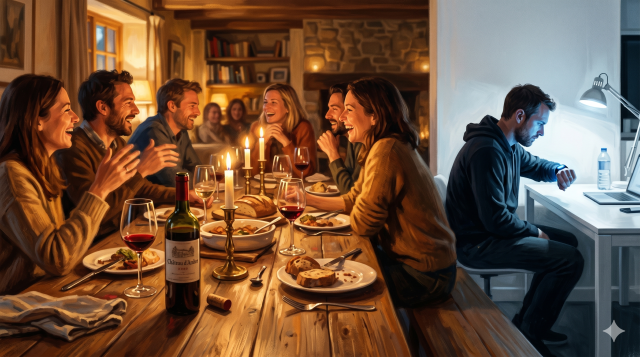
Consider what actually happens at a dinner table where wine is poured. People slow down. The agenda dissolves. Conversation moves from the transactional to the real. Subjects arise that would never survive the frictionless efficiency of a Zoom call. Opinions are tested. Laughter arrives unexpectedly. Somebody says something true that they would not have said otherwise. These are not small things. These moments aren’t incidental; they’re the substance of a meaningful social life.
Now consider what the Bartlett cohort model replaces this with. A morning routine. A podcast recorded at optimal everything. A gym session logged and analysed. A day managed for output, with all deviation from the protocol noted and corrected. It is a life of extraordinary efficiency and, one suspects, rather meagre joy.
The tragedy is not that Bartlett made a choice that works for him, people are entitled to their own relationship with alcohol, and some people genuinely do not want to drink, which is entirely their business. The tragedy is that he made the clip in the first place, for millions of people, framing a normal and ancient pleasure as a catastrophic failure mode. That is not a personal choice. That is cultural messaging. And it is doing damage.
There is a serious case against alcohol that deserves to be engaged with, and the wine industry has been too slow to distinguish it from the more ideological one.
Alcohol abuse is real. Addiction is devastating. The harms of excess are well-documented and should not be minimised. The industry’s historical tendency to deflect all criticism with talk of responsible drinking guidelines has been, at times, a way of avoiding rather than engaging with genuine problems.
But, and this is a distinction that matters enormously, there is an enormous distance between taking the harms of excess seriously and treating three glasses of wine as a life-ruining event.
What the Bartlett clip does, delivered in the earnest tone of someone sharing important health information with a concerned audience, is not warn people away from addiction. It pathologises moderation. It takes a normal, pleasurable, socially connective act that human beings have performed together since before the invention of the alphabet and reframes it as a dangerous deviation from protocol.
If you repeat that framing to enough people for long enough, they begin to believe it. And when they believe it, they stop going to the dinner. They decline the invitation. They stay home and “optimise”. And the conditions that the wellness industry claims to be addressing, anxiety, depression, social isolation, get quietly and efficiently worse.
This is the part where the wine industry needs to stop nodding politely and start making noise.
The industry has, for too long, played defence on a pitch it did not choose. Every time a study emerges claiming that no level of alcohol consumption is safe, the response has been measured and careful and largely inaudible. Every time a content creator with millions of followers describes wine as a health catastrophe, the industry produces a press release about responsible enjoyment and then wonders why the narrative keeps moving in the wrong direction.
This has to stop. Not because the critics are always wrong, some of them are entirely right, but because the industry has abdicated the most important part of its argument. It has given up the cultural ground entirely.
The case for wine is not primarily a health case. It never was. It is a human case. It is the case that a life lived well involves pleasure, connection, slowness, conversation, the occasional evening that goes longer than planned and produces a friendship or an idea or simply a memory worth keeping.
It is the case that 10,000 years of people gathering around something fermented is not a history of collective self-destruction, but of civilisation itself. It is the case that the pub that has been converted into flats was not a relic, it was social infrastructure, and we have not replaced it.
The industry needs to make this argument loudly, consistently, and with the kind of cultural confidence that it currently reserves for harvest reports and trophy endorsements.
It needs spokespeople willing to go on those same podcasts and make the case not with tasting notes or appellation maps, but with a simple observation: human beings have been drinking together since before recorded history, and on balance, it seems to have served us rather well.
It needs to stop apologising for being in the business it is in and start explaining, with some urgency, what that business actually is. It is not the business of selling alcohol. It is the business of selling evenings. It is the business of the table, the conversation, the friendship that didn’t exist before the bottle was opened. These are things worth defending. They are, frankly, more worth defending than a WHOOP score.
And if Steven Bartlett wants to spend his Thursdays perfectly optimised, cortisol-managed, and tucked into his blackout curtains at nine o’clock, that is, of course, entirely his choice. But perhaps he might do us all the small courtesy of not directing a media empire around the suggestion that three glasses of wine will have a domino effect that ruins your whole week.
Some of us, it should be noted, are doing life rather well.
Here is a modest proposal. Not a revolutionary one. Not one that requires a tracking device or a subscription.
Invite someone over. Open something decent. Stay slightly too long at the table. Allow the conversation to go somewhere you didn’t plan. Do not check your recovery score in the morning. You will be fine. You have, after all, the weight of ten thousand years of human evidence on your side.
An over-optimized life is not the good life. The good life, as it turns out, involves a certain quantity of beautiful inefficiency, an occasional second bottle, and the company of people who are more interested in what you think than in how well you slept. Go for the run and eat well but three glasses of wine are almost certain to improve it. Life isn’t a big complicated test, it just requires balance.
Pour accordingly.
Benjamin Jack
Related news
Lidl to launch first Asti Rosé as new DOCG category debuts
All the medallists from The Global Under £15 Masters 2026