A writer who I like a lot sends me a pitch for a story that he would like to report on for Monocle. But there’s something off about it. A funny smell. His usual quirky tone has been replaced by sentences that appear to be saying something big but, on closer scrutiny, are oddly hollow. I wonder, could it be?
I copy and paste the pitch into an artificial-intelligence checker, which suggests that 70 per cent of it was generated by AI. I mention this to a colleague, who tells me that he has also become suspicious and sent a reminder to this established writer about our policy on this topic.
Now, perhaps the AI checker is off or this writer has read so much AI-generated nonsense that he now sounds like a machine. But there are other tells in the spelling, the punctuation. Like a bungling burglar, AI has left fingerprints all over his email.
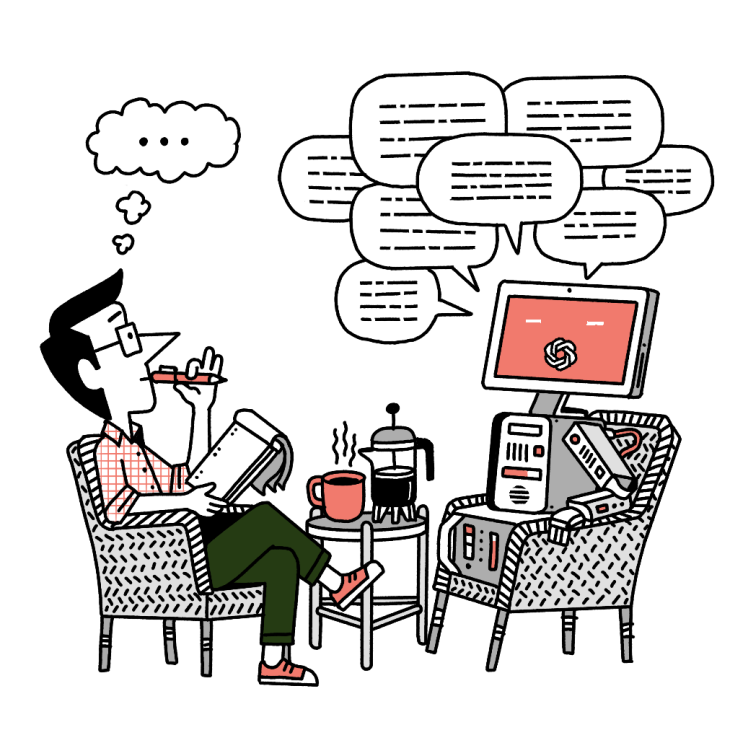
Yesterday morning, as on every Friday morning, I got up at 05.30, made coffee, found a quiet place to perch – today on our apartment’s terrace overlooking the Palma Sport & Tennis Club – and waited. Sometimes it takes seconds, sometimes an hour. But, so far, every week an idea for a column has dropped into my mental inbox. Then I get a few words down, then some more and I’m away. But that initial organising of my thoughts is the stressful bit – there have been a few weeks when I have thought, well, that I have no thoughts. A third coffee usually does the trick.
A couple of weeks ago, I was sitting next to the editor of a well-known magazine at a dinner and he asked about this column; he too files a personal dispatch to his readers. “I used to really struggle,” he said. “But to be honest, I now use AI to organise my initial thoughts, give me some prompts. Then I start writing. I never use AI to write my copy, just to get me going.” For him, AI is akin to Viagra for writers.
I promise that this will all come together nicely in a minute – I know where we are headed, even if you are getting sceptical of my meandering path. But I’d like to tell you one other thing about this column. It has been “subbed”.
Once I have finished writing, I send my copy to Blake, or sometimes Chloé, and they wheedle out unnecessary words, correct linguistic slips. Nothing too intrusive: jokes are sacrosanct but by the time that I get to see the edited preview of this newsletter, my words have had a nice polish. It’s like going to the dental hygienist – you leave with all your teeth intact but any annoying verbal plaque has been blasted away.
With their help, I get to publish something that mostly makes sense and, hopefully, lets readers know that there’s a real person behind these words. A real person whose ideas don’t always cascade in the logical, sequential style served up by AI.
Look, it’s going to be a battle to stop journalism from buckling under the weight of AI slop when even respected writers and editors are succumbing to its siren call, even if to “just” organise their thoughts. The only way to defend the trade is for journalists, writers, designers and creatives to trust the process. To know that there are some days when ideas will be hard to find, when thoughts are reluctant to move along in an orderly fashion. Sometimes nascent thoughts need the help of an editor to develop a story, sharpen copy.
In short, don’t just reach for the AI Botox; show your writerly wrinkles.
See? I told you. I trusted that – with a little help – I could pull this together.
For more of Andrew’s columns, click here.