It is not easy for Nauru to get on the news. The Pacific island microstate is the world’s third-smallest country by area, ahead of the Vatican and Monaco, and, by population, ahead of the Vatican and Tuvalu. Nauru is in the middle, approximately, of nowhere: an hour and a bit by air from Kiribati, three hours and change from Fiji, four and a half from Brisbane.
The island’s diminutive size and remote location have historically made it difficult for the country to make any kind of soft-power splash. Nauru had a go during the 1970s and 1980s, when deposits of phosphate-rich calcified guano made it possibly the world’s wealthiest country per capita. During its brief, high-rolling run as the Saudi Arabia of bird crap, Nauru built the tallest building in Melbourne, subsidised a national airline, bankrolled a West End musical and didn’t collect taxes. One Nauruan police officer bought a Lamborghini, a debatable purchase considering that the island had 19 kilometres of paved road.
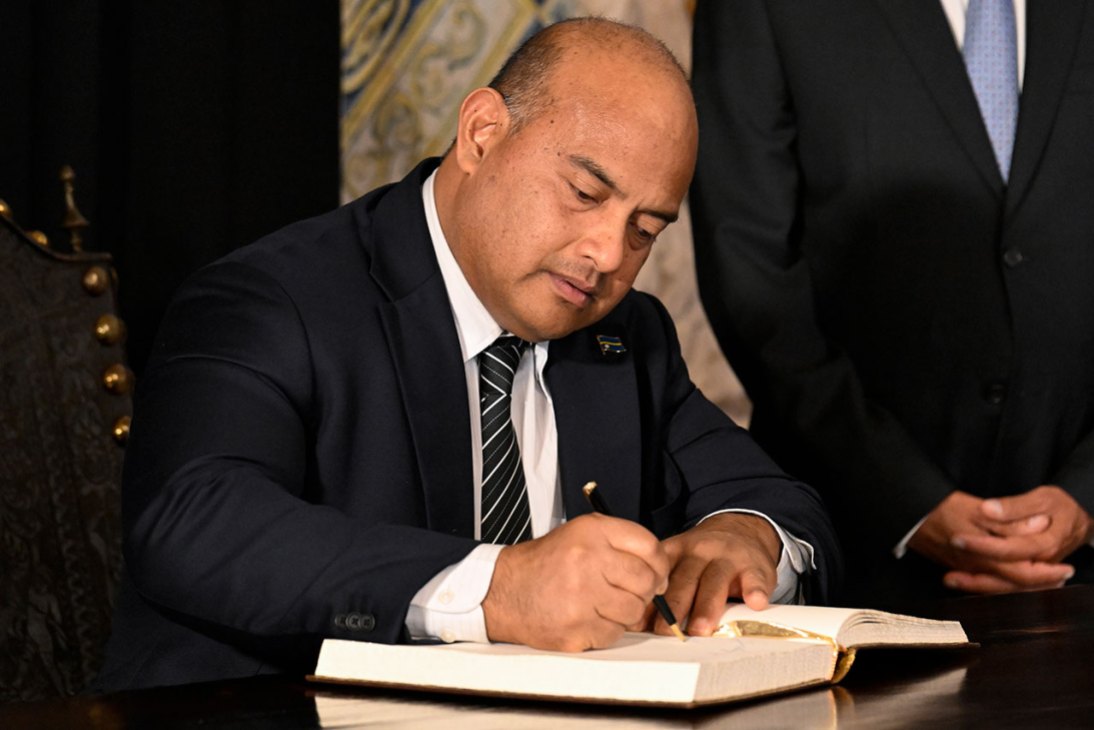
For Nauru, having since mismanaged itself into penury, making headlines now requires bold thinking and there are few manoeuvres more audacious than changing names. Nauru is now the Republic of Naoero and Nauruans are henceforth dei-Naoero. The alteration restores primacy to the Indigenous, traditional nomenclature that had been anglicised in deference to foreigners who struggled to pronounce it (Naoero is Now-ero, give or take, which isn’t that complicated, and certainly less deceptive than Kiribati, which, despite appearances, is pronounced Kiri-bass). When Naoero’s president, David Adeang, pitched the switch earlier this year, he said that it would “more faithfully honour our nation’s heritage, our language and our identity”.
Naoero has not been the only country in recent years to have furnished work for cartographers by making a decision of this kind. Swaziland became Eswatini in 2018, partly as an assertion of national identity, and partly – so King Mswati III claimed – because it was tired of being mistaken for Switzerland. Turkey announced in 2022 that it would prefer to be known as Türkiye, partly as an assertion of national identity, partly because it was tired of its association with an ungainly bird that is synonymous with stupidity and failure.
Some of the 21st century’s other national name changers have acted out of convenience. In 2019, Macedonia added the prefix “North” to finally – if grudgingly – end an interminable and inane diplomatic row with Greece, which staked an exclusive claim to the name. In 2016, the Czech Republic announced it would rather be known as Czechia, much as the French Republic is the official name of France: it’s shorter, snappier and easier to chant at football games.
Mostly, however, national name changes have been undertaken for the same reason as any corporate rebrand: to signal that the enterprise is under new management. This is, in general, perfectly fair enough. Upon gaining independence in 1964 and 1980, Zambia and Zimbabwe no longer wished to be called Northern or Southern Rhodesia, after the CEO of the British mining company that had occupied and exploited their land. Names such as Malawi, Mali, Benin, Botswana and Burkina Faso are also indisputably cooler than whatever those countries were once saddled with by some pith-helmeted European.
There will likely be more reasons not to invest in a new globe just yet. The big one to watch is India. Several Indian cities (Bombay/Mumbai, Madras/Chennai, Calcutta/Kolkata, et al) have already reverted to traditional names, and the prime minister, Narendra Modi, has intermittently flirted with the nation’s official Sanskrit name, Bharat. Georgia might also be worth keeping an eye on. It awkwardly shares a name with an American state and Georgians themselves call their country Sakartvelo, which is pleasingly evocative of some mythical mediaeval realm of mountaintop castles.
In 2021 one New Zealand party – Te Pāti Māori, which held two seats in the House of Representatives – gathered more than 70,000 signatures on a petition to formally rename the country Aotearoa, an Indigenous word translating as “the land of the long white cloud”. Whatever inconvenience might be occasioned by rewriting the national anthem (“God Defend New Zealand”), Aotearoa is way prettier than any bequest of homesick Dutchmen. In the end, maps are not carved into marble.
Andrew Mueller is a regular Monocle contributor and host of ‘The Foreign Desk’. For more opinion, analysis and insight, subscribe to Monocle today.