db’s Bordeaux correspondent Colin Hay dissects the latest edition of the Crus Bourgeois and the principle of competitive classification in the wake of a major en primeur tasting from this famous classification system.
Longstanding readers of the drinks business will know that I am something of an advocate of competitive systems of classification – yet fully aware of the challenges associated with maintaining their relevance whilst insulating them from legal challenge.
So it was then with some enthusiasm that I received, and ultimately accepted, the invitation of L’Alliance des Crus Bourgeois du Médoc to taste through a selection of their en primeur samples and, in the process, to reflect on the recently unveiled 2025 edition of the cru bourgeois classification.
That classification, in its new incarnation, sifts very many of the leading wines of the Médoc (and, today, over 20 per cent of its total production) into three, competitively-determined and hierarchically-ordered tiers – cru bourgeois, cru bourgeois supérieur and cru bourgeois exceptionnel.
170 wines meet the stringent criteria for inclusion in the new classification, amongst them 36 classified as crus bourgeois supérieurs and 14 crus bourgeois exceptionnels.
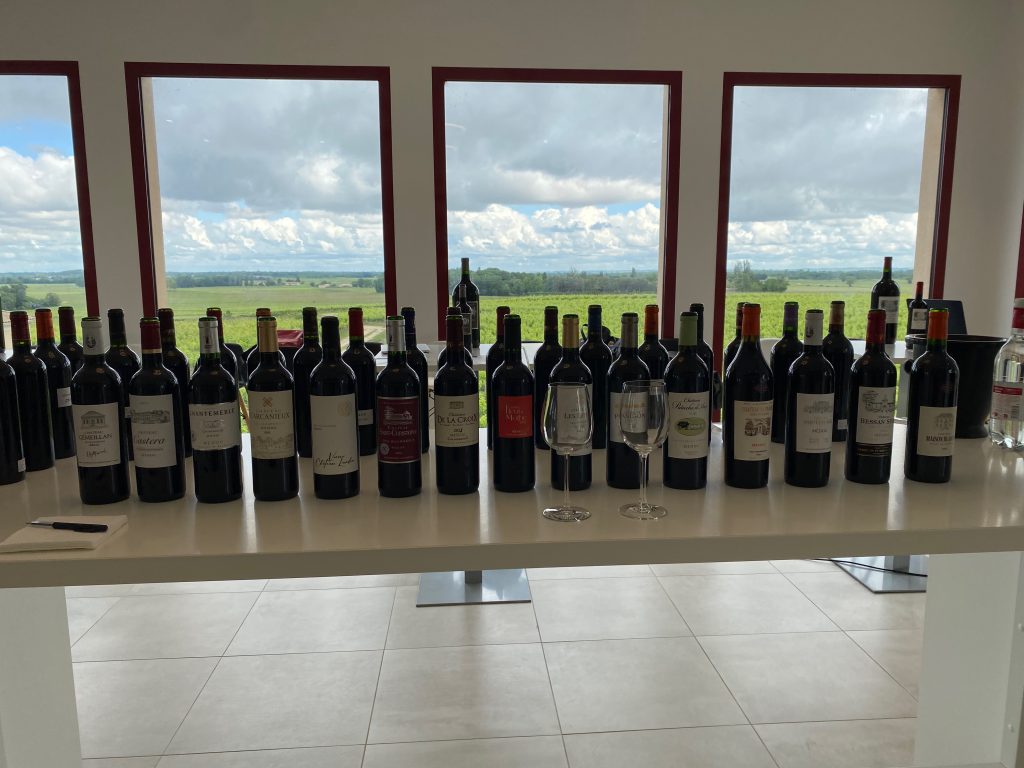
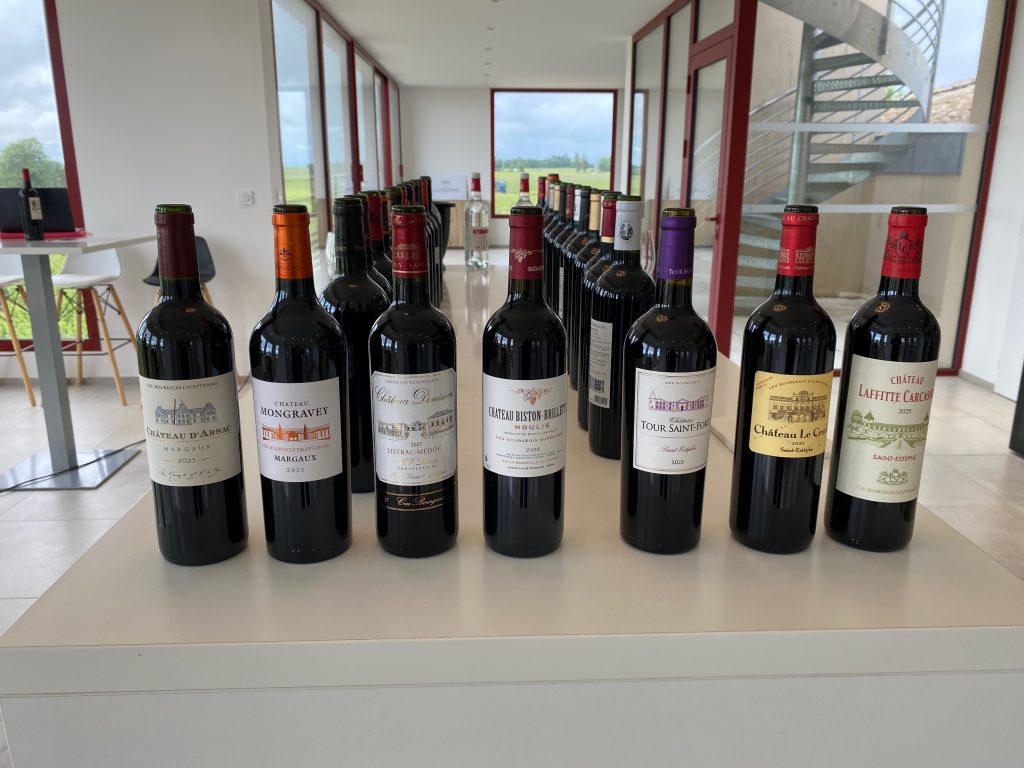
The tasting – of a selection of 55 wines at each level and from each appellation – took place at Château La Cardonne, the only property in the Médoc to serve haggis for lunch! It gave me a chance to assess for myself the quality of these wines and classification process itself.
I am extremely grateful to Andrew McInnes and to Marie Angliviel from Ozco Bordeaux for their hospitality and the organisation of the tasting and to L’Alliance des Crus Bourgeois du Médoc for the selection of the wines presented.
My detailed tasting notes appear here, but before we get to the wines themselves, it is perhaps useful to offer a little context – historical, first, then a little more contemporary.
The history of the Cru Bourgeoisie
The very idea of a tier of wines of the Médoc, sitting between the more aristocratic wines of the nobility (those that would later feature in the 1855 classification) and the ‘artisan’ wines of the traditional vigneron-fermier (winemaker-farmer) is almost as old as the rural class structure that it reflects. It certainly long predates any official system of classification.
But with the arrival and subsequent consolidation of the official 1855 classification of the nobility of the Médoc it became more important, with the term ‘crus bourgeois’ coming to denote a wine of quality and (terroir) specificity that was neither classified officially nor merely a cru artisan.
Yet it was not until 1932 that any of this was codified. In that year the first cru bourgeois classification was introduced, with the négociants of Bordeaux, acting under the authority of the Bordeaux Chamber of Commerce, designating 444 estates as Crus Bourgeois. At this stage, however, no ministerial approval was sought – so the classification remained informal.
In 1962 a Cru Bourgeois Syndicat was established making the classification essentially self-governing and in 1979 the European Community itself approved for the first time the use of the term Cru Bourgeois on wine labels (under the regulation and authority of French law).
Appropriately enough, then, the next significant step in the evolution of the Cru Bourgeois system came from the French state. In November 2000, a three-tier system of classification (renewable ever 12 years) was introduced by ministerial decree. This established the parameters and criteria of a new competitive evaluation, introducing for the first time the categories Cru Bourgeois Supérieur and Cru Bourgeois Exceptionnel. It took almost a further three years before, in 2003, the 18-member jury’s deliberations were enshrined in the ministerial order by which the first official classification of the Cru Bourgeoisie of the Médoc was established. 490 estates had submitted applications (and samples from the vintages 1994 to 1999 inclusive); a mere 247 were classified. Only nine were designated Crus Bourgeois Exceptionnels, a further 87 Crus Bourgeois Supérieurs.
Predictably enough, not everyone was best pleased (notably the 77 members of the 1932 Cru Bourgeoisie that had, in effect, been declassified). Anticipating more recent developments in Saint-Émilion, a flurry of legal processes were launched. These questioned, above all, the integrity and genuine independence of certain members of the jury (notably their links to four of the properties awarded Cru Bourgeois Exceptionnel status).
The often-gory details need not concern us here. Suffice it to note that the Bordeaux Court of Appeal annulled the entire classification in 2007, with the office for fraud banning shortly thereafter the use of the term Cru Bourgeois altogether.
Post annulment resurgence
But, just when it seemed that the Cru Bourgeoisie had finally been consigned to history, a mini revolution saw it rise again from the ashes. For in 2009, L’Alliance des Crus Bourgeois (the body established to oversee the classification) sought to recast the label Cru Bourgeois as a mark of quality rather than a classificatory system per se.
So was born a relatively short-lived annual evaluation, judging the wines of each successive vintage against a simple quality threshold. By 2016, just under a third of the Médoc’s total production, some 270 estates, were judged to meet the necessary standard.
The one-tier system worked well and was better than nothing. But it had the inadvertent, if hardly surprising, effect of intensifying price competition. That, in turn, produced a downward convergence in prices amongst the new Cru Bourgeoisie. It served, above all, to reduce the price dispersion between the former Crus Bourgeois Exceptionnels and their new peers. Those who suffered most were, of course, those who had previously gained most from the existence of a multi-tier and competitive system; and some of them (those who hadn’t already left) wanted it restored.
It should then come as no great surprise that, in 2018, under the direction of its new President, Olivier Cuvelier (of Chateau Le Crock in St-Estèphe), L’Alliance proposed a restoration of the three-tier system. This was to come into effect in 2020 and to be renewed, competitively, on a much shorter five year cycle.
So was born, or more precisely re-born, the competitive Cru Bourgeois system of classification that we have today. The recent publication of the outcome of the 2025 reclassification exercise allows us to see how it is faring, above all in market conditions more taxing that at any point since the approval by the European Commission of the label itself in 1979.
Today’s Cru Bourgeoisie
We are now able to see the results of the new deliberations of its panel of experts with the publication of the newly revised 2025 classification. It makes for fascinating reading, above all when compared with its predecessors, the classifications of 2020 and 2003 respectively.
But before we get to that it is perhaps useful to describe the internal working and functioning of the new classification.
The classification is for the vintages 2023-2027 inclusive – in other words, classification confers the right to use the labels Cru Bourgeois, Cru Bourgeois Supérieur or Cru Bourgeois Exceptionnel on a wine’s labels for these five vintages. Like its predecessor it ranges over three quality levels and across eight appellations (Haut-Médoc; Listrac-Médoc; Margaux; Médoc; Moulis-en-Médoc; Pauillac; Saint-Estéphe; Saint Julien).
The competitive evaluation process is based on the submission of a written dossier, establishing a basic set of prerequisites confirmed in a site visit. If met, this allows the property to enter a second and more qualitative assessment. This involves the tasting of five consecutive vintages (2017-2021) by one of two parallel tasting panels working in tandem and, for those seeking either supérieur or exceptionnel designation, a detailed evaluation by an expert jury of the terroir, vinification, commercialisation and investment strategies of the property.
In addition, all Crus Bourgeois need to be able to demonstrate that they have already attained HVE2 (haut valeur environmental) accreditation; and all those seeking the two higher echelons must demonstrate, additionally, that are certified at the HVE3 level.
The process was oversell by a ten-member panel of experts, with a six-member jury led by Philippe Faure-Brac, 1992 World’s Best Sommelier, proposing the final classification.
Discrete withdrawal rather than demotion
In a stroke of genius introduced in 2020 that has almost certainly drastically reduced the likelihood of legal challenges, properties that do not receive the classification level they seek are not obliged to remain within the classification at all – and guaranteed confidentiality if they choose not to do so. This improves the likelihood of a former Cru Bourgeois Exceptionnel, say, entering the competition; but crucially, it also improves the likelihood that if its former status is not restored it will simply withdraw to lick its wounds rather than draw attention to the fact with a legal challenge.
This is a very clever piece of institutional design that those contemplating the reform of other competitive systems of classification might be well-advised to reflect on. But here, at least, it has not entirely achieved the intended effect. For there are notable absences from the 2025 classification when compared to its predecessor, just as there were in turn from the 2020 classification when compared to that of 2003.
Strikingly, not a single wine classified Cru Bourgeois Exceptionnel in 2003 was present in the 2020 classification and none are present in the 2025 edition – at any of the three levels. That is a shame. Of course, it is possible that this is because these wines were entered into the competition and were not judged to reach the quality level required to regain the Cru Bourgeois Exceptionnel status they sought. But much more likely is that they simply didn’t enter the competition in the first place.
Partner Content
We should, of course, not be terribly surprised by this. For there are at least three clear and credible reasons why properties classified at the highest levels in 2003 might not have chosen to submit a dossier for reclassification in 2020 or 2025:
- The risk and associated reputational damage of failing to have one’s former status restored (however much that risk is reduced by the option of leaving the classification discretely should this arise).
- The negative association of the classification in the minds of these properties – notably the painful reminders of the legal challenge that led ultimately to it being annulled in 2007. Put simply, why seek reclassification now when seeking classification the last time brought only legal contestation and the potential for reputational damage? Once bitten; twice shy.
- The simple fact that each of these properties now commands a stable or rising price-point in the market well above the typical range of prices of those attaining the cru bourgeois quality level after its restoration in 2009 – and above the price level of at least some classed growths.
For these properties, the same logic applied in 2025.
Defections
But what is perhaps more alarming is that defection from the upper echelons of the classification continues, with eight of those classified Crus Bourgeois Exceptionnels in 2020 having left the classification altogether. They are quite an impressive bunch: Châteaux Agassac, Arnauld, Belle-Vue, Cambon La Pelouse and Charmail in the Haut-Médoc, Château Lestage in Listrac-Médoc and Châteaux Le Boscq and Lilian Ladouys in Saint-Estèphe).
It is difficult not to draw the conclusion that, having benefitted from being promoted to Cru Bourgeois Exceptionnel level in 2020, at least some of these properties no longer need (or belief themselves to need) the classification to retain their price position in the market. That said, it is important to emphasise that each could have submitted a dossier and chosen to leave the classification rather than accept a demotion.
The result is a classificatory schema whose evolution between editions now seems characterised by quite a few promotions (with eight from Cru Bourgeois Supérieur to Exceptionnel and nine from Cru Bourgeois to Cru Bourgeois Supérieur in 2025), quite a few defections or departures, above all from the top (with eight former Crus Bourgeois Exceptionnels no longer present in 2025), and very few demotions. Of the 56 properties classified crus bourgeois supérieurs in 2020 only two now find themselves amongst the ranks of the crus bourgeois (Châteaux Bibian in Haut-Médoc and Lousteauneuf in Médoc). An element in this is, of course, that the incentive for those who might be demoted is simply to leave the classification altogether. But one suspects, too, a classification system that works something like a board of snakes and ladders from which the serpents have been removed.
Either way, and as this suggests, the 170 châteaux classified in 2025 are a rather different bunch to the 249 classified in 2020 and the 247 classified in 2003. How so?
Less representative
First, and as Figure 1 shows clearly, they are far less representative of the eight eligible appellations of the Médoc.
Indeed, 144 of the 170 classified properties in 2025 come from just two appellations – Haut-Médoc and Médoc itself. This compares to 203 of the 249 in 2020. The appellation of Médoc alone accounts for just over half of the properties classified; and the two together represent 85 per cent of the renewed cru bourgeoisie (up from 82% in 2020).
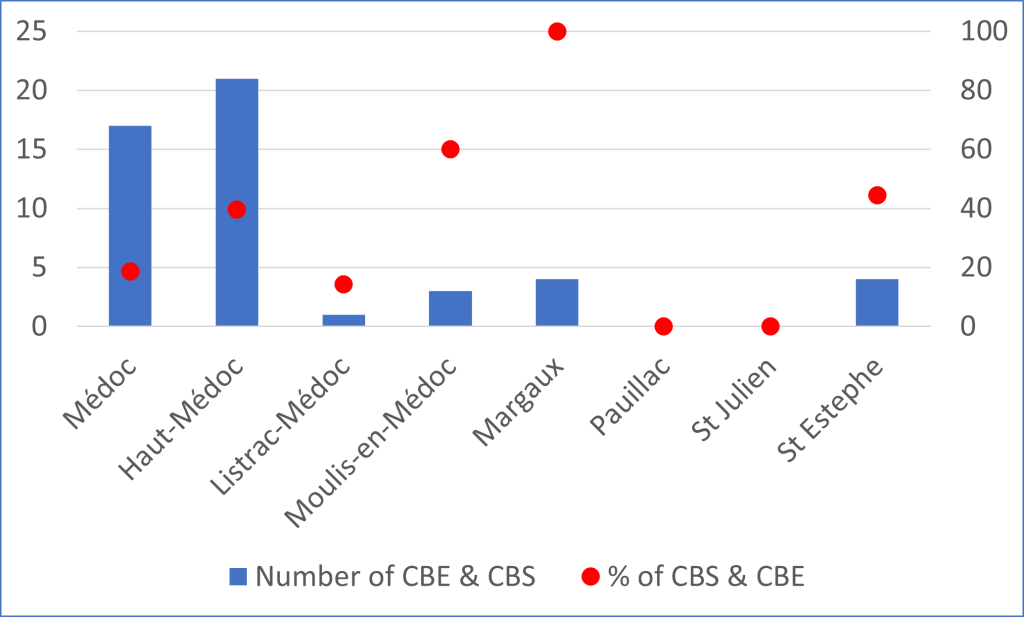
Figure 1: The evolution of the cru bourgeois classification by appellation (2003-25)
Arguably more alarming still is the relative absence of châteaux from the most prestigious appellations of the Médoc – those with the greatest concentration of classed growth estates. Not a single wine from Saint Julien and only one from Pauillac (Château Plantey, at cru bourgeois level) feature in the new classification; and the appellations of Margaux, Saint-Estèphe and even Haut-Médoc, in which the remaining classed growths of the Médoc are located, are all far less represented in 2025 than they were in the halcyon days of 2003. This is, of course, a trend already established in 2020; but what is alarming is that the haemorrhaging has not been staunched.
Yet although the appellation-by-appellation transformation of the classification is stark, this is also not altogether surprising. To a significant extent it, too, is a story of pricing – with the average price of an unclassified wine from Margaux, Pauillac, Saint-Estèphe and Saint Julien being significantly higher than the average price of a wine attaining the Cru Bourgeois quality level prior to the reclassification exercise. It is understandably that châteaux from these appellations do not see classification as an aid to price promotion.
The hope undoubtedly was that the restoration of a competitive and banded classification system would allow the average price of the haut Cru Bourgeoisie (as it were) to rise to a price-point that might entice back the former haut Cru Bourgeoisie. In the tricky market conditions that have prevailed since the 2020 exercise that hope was always unlikely to be fulfilled quickly. Time will tell if it was always a little naïve.
Yet although there may not be many of them, the wines of Margaux and Saint-Estèphe that are present in the classification are typically present at the higher levels (alongside Moulis-en-Médoc). The following figure shows the combined number of Crus Bourgeois Supérieurs and Exceptionnels in the 2025 classification by appellation (on the left-hand axis) and the proportion of wines of each appellation attaining the two upper echelons in the classification (on the right-hand axis).
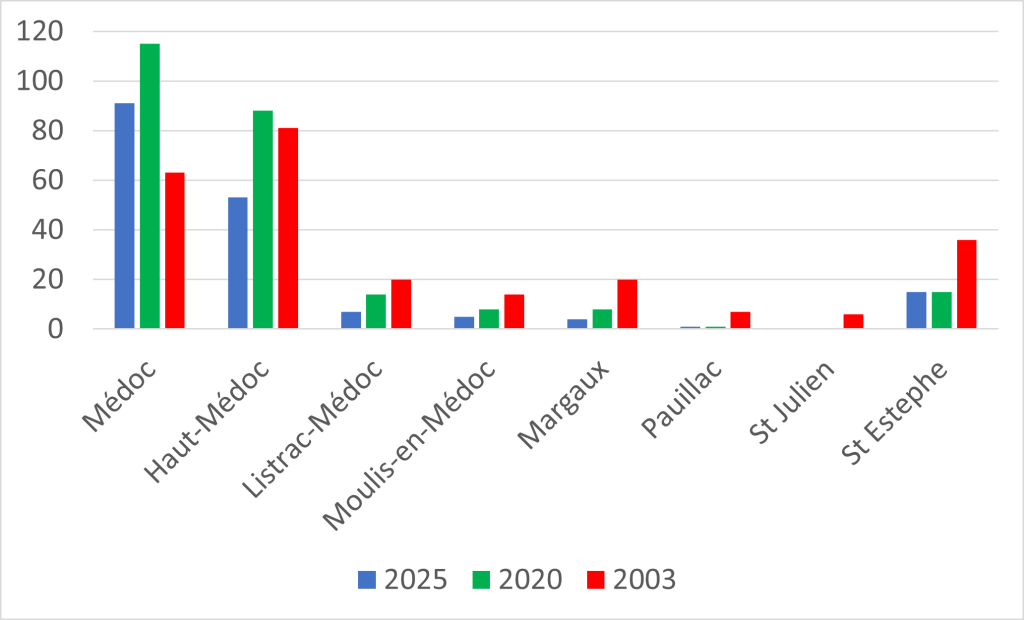
Figure 2: Number & proportion of crus bourgeois supérieurs & exceptionnels by appellation
As we can see, 100% of the wines of Margaux, 60% of those in Moulis and over 40% of those of Saint-Estèphe present in the classification are classified either Crus Bourgeois Supérieur and Exceptionnel.
Overall, of the 170 members of the new cru bourgeoisie, 36 properties are designated Crus Bourgeois Supérieurs. A further 14 are credited with Crus Bourgeois Exceptionnels status. Of these, five are from Haut-Médoc (Châteaux Malescasse, de Malleret, Paloumey, Reysson and du Taillan), three from Médoc (Châteaux La Cardonne, Castera and Laujac), one from Listrac-Médoc (Château Reverdi), three from Margaux (Châteaux d’Arsac. Mongravey and Paveil de Luze) and two from Saint-Estephe (Châteaux Le Crock and Laffitte Carcasset). Of these three were classified cru bourgeois in 2003 (Châteaux Laujac, Reverdi and Laffitte Carcasset), the remaining 11 were classified at the Crus Bourgeois Supérieur level in the same exercise.
The appellation-by-appellation details are summarised in the following table.
| Appellation | CB | CB supérieur | CB exceptionnel | Total |
| Médoc | 74 | 14 | 3 | 91 |
| Haut-Médoc | 32 | 16 | 5 | 53 |
| Listrac-Médoc | 6 | 0 | 1 | 7 |
| Moulis-en-Médoc | 2 | 3 | 0 | 5 |
| Margaux | 0 | 1 | 3 | 4 |
| Pauillac | 1 | 0 | 0 | 1 |
| St Julien | 0 | 0 | 0 | 0 |
| St Estephe | 5 | 2 | 2 | 9 |
| Total | 120 | 36 | 14 | 170 |
Table 1: The composition of the new cru bourgeoisie
Judging the jury: evaluating the classification
So what are we to make of all of this? Has the reclassification exercise been a success?
The difficulty here, as ever, is in picking the appropriate criteria to inform the judgement. For, yes, it is sad and depressing in a way that the likes of Chasse-Spleen, Haut-Marbuzet, de Pez, Phélan-Ségur, Poujeaux and Siran are no longer present in the Cru Bourgeois classification. But it was always naïve in the extreme to believe that they were ever likely to submit themselves again to an exercise of this kind.
That may sound bleak for the future of the classification; but it’s not intended to. This classification needs to work for its current members and there are reasons for thinking that, judged in those terms, it is already a proving itself a success.
First, and above all, its procedures have been very carefully constructed. The result is that, to date at least, there has been not a single legal challenge (of which I am aware) to the deliberations of its expert jury. Better still, those deliberations and the resulting classification have attracted no adverse press. The classification that the jury has produced looks very credible on paper, and is only confirmed by the tasting described below. The process was presided over by a distinguished and professional jury that has clearly been exceptionally well lead by Philippe Faure-Brac. That jury has done its job – and it seems to have done it very well (not least in rewarding a variety of rather different styles of wine-making at the higher levels of the classification). Perhaps no less significantly, it has now performed its role twice without any adverse publicity – rare for any competitive classification these days.
Second, on the evidence of my tasting below of the 2025 vintage, the qualitative distance between Cru Bourgeois, Cru Bourgeois Supérieur and Cru Bourgeois Exceptionnel has been maintained (even in the absence of any of the former Crus Bourgeois Exceptionnels). That this is so speaks volumes for the progression in quality of these highly affordable wines between 2003 and the present day.
On the basis of my own tasting of the 2025 vintage (and my wider sense of the development of these wines over the last two decades), the quality of wines at all three levels is as high as it have ever been. Crucially, also, environmental sustainability is being actively promoted.
This is, in short, a competitive classification that is working and, on my reading at least, its prospects for the future are good. Arguably, the most difficult part of its reconstruction has been successfully achieved. I am optimistic about its future and I wish it well.
Scores
The samples for the tasting were selected by l’Alliance des Crus Bourgeois and brought to Chateau La Cardonne for the tasting which took place in the first week of May. Below, the properties are listed alphabetically by appellation, for full tasting notes, see here.
| Wine | Appellation | Classification | Rating |
| Barreyres | Haut-Médoc | Cru Bourgeois | 89-91 |
| Beaumont | Haut-Médoc | Cru Bourgeois Supérieur | 90-92+ |
| Bel Air Gloria | Haut-Médoc | Cru Bourgeois | 91-93 |
| Bessan Ségur | Médoc | Cru Bourgeois | 84-86 |
| Bibian | Haut-Médoc | Cru Bourgeois | 87-89 |
| Biston-Brillette | Moulis-en-Médoc | Cru Bourgeois Supérieur | 91-93 |
| Carcanieux | Médoc | Cru Bourgeois | 87-89+ |
| Castera | Médoc | Cru Bourgeois Exceptionnel | 90-92 |
| Chantemerle | Médoc | Cru Bourgeois | 87-89 |
| Cissac | Haut-Médoc | Cru Bourgeois | 90-92 |
| Corconnac | Haut-Médoc | Cru Bourgeois | 85-87 |
| Croix du Trale | Haut-Médoc | Cru Bourgeois | 88-90+ |
| d’Arcins | Haut-Médoc | Cru Bourgeois | 89-91 |
| d’Arsac | Margaux | Cru Bourgeois Exceptionnel | 91-93 |
| de Braude | Haut-Médoc | Cru Bourgeois | 85-87 |
| de la Croix | Médoc | Cru Bourgeois | 83-85 |
| de Malleret | Haut-Médoc | Cru Bourgeois Exceptionnel | 91-93 |
| de Panigon | Médoc | Cru Bourgeois | 85-87+ |
| Donissan | Listrac-Médoc | Cru Bourgeois | 86-88 |
| du Moulin Rouge | Haut-Médoc | Cru Bourgeois Supérieur | 87-89 |
| du Taillan | Haut-Médoc | Cru Bourgeois Exceptionnel | 91-93+ |
| Escot | Médoc | Cru Bourgeois Supérieur | 86-88 |
| Fleur la Mothe | Médoc | Cru Bourgeois Supérieur | 90-92+ |
| Gémeillan | Médoc | Cru Bourgeois | 87-89 |
| Greysac | Médoc | Cru Bourgeois Supérieur | 87-89 |
| Grivière | Médoc | Cru Bourgeois | 87-89 |
| La Cardonne | Médoc | Cru Bourgeois Exceptionnel | 89-91 |
| La Fon du Berger | Haut-Médoc | Cru Bourgeois | 90-92+ |
| La France Delhomme | Médoc | Cru Bourgeois | 88-90 |
| La Mouline | Moulis-en-Médoc | Cru Bourgeois Supérieur | 90-92 |
| Lacour Jacquet | Haut-Médoc | Cru Bourgeois | 90-92 |
| Laffitte Carcasset | Saint-Estèphe | Cru Bourgeois Exceptionnel | 91-93 |
| Lamothe-Bergeron | Haut-Médoc | Cru Bourgeois Supérieur | 90-92 |
| Le Crock | Saint-Estèphe | Cru Bourgeois Exceptionnel | 91-93+ |
| Les Lattes | Médoc | Cru Bourgeois | 88-90 |
| Liversan | Haut-Médoc | Cru Bourgeois Supérieur | 88-90 |
| Maison Blanche | Médoc | Cru Bourgeois | 86-88 |
| Martin | Haut-Médoc | Cru Bourgeois | 85-87 |
| Mongravey | Margaux | Cru Bourgeois Exceptionnel | 90-92 |
| Noaillac | Médoc | Cru Bourgeois Supérieur | 90-92+ |
| Paloumey | Haut-Médoc | Cru Bourgeois Exceptionnel | 91-93+ |
| Patache d’Aux | Médoc | Cru Bourgeois Supérieur | 89-91 |
| Poitevin | Haut-Médoc | Cru Bourgeois Supérieur | 88-90 |
| Prieuré de Beyzac | Haut-Médoc | Cru Bourgeois | 87-89 |
| Ramafort | Médoc | Cru Bourgeois | 87-89 |
| Ramage la Batisse | Haut-Médoc | Cru Bourgeois Supérieur | 90-92+ |
| Reysson | Haut-Médoc | Cru Bourgeois Exceptionnel | 90-92 |
| Saint-Christophe | Médoc | Cru Bourgeois | 85-87 |
| Saint-Hilaire | Médoc | Cru Bourgeois Supérieur | 84-86 |
| Sénilhac | Haut-Médoc | Cru Bourgeois | 86-88 |
| Tour Prignac | Médoc | Cru Bourgeois | 88-90 |
| Tour Saint-Fort | Saint-Estèphe | Cru Bourgeois | 90-92+ |
| Vieux Château Landon | Médoc | Cru Bourgeois | 86-88 |
For full appellation-by-appellation reviews for the 2025 vintage en primeur : Margaux, Saint-Julien, Pauillac, Saint-Estèphe, Haut-Médoc & Left Bank satellite appellations (Listrac-Médoc, Médoc, & Moulis-en-Médoc), Pomerol, Saint-Émilion, ‘satellite’ Right Bank appellations (Fronsac, Lalande & Castillon), Pessac-Léognan & Graves red, Pessac-Léognan & Graves white, Medoc & Bordeaux including Vin de France (white) and Sauternes & Barsac.
Related news
González Byass to sell part of its historic bottle library at Christie’s
Sacked and splashed across the front pages: an extract from Peter Stafford-Bow’s Black Odesa
Ste. Michelle to boost reach with Southern Glazer’s deal