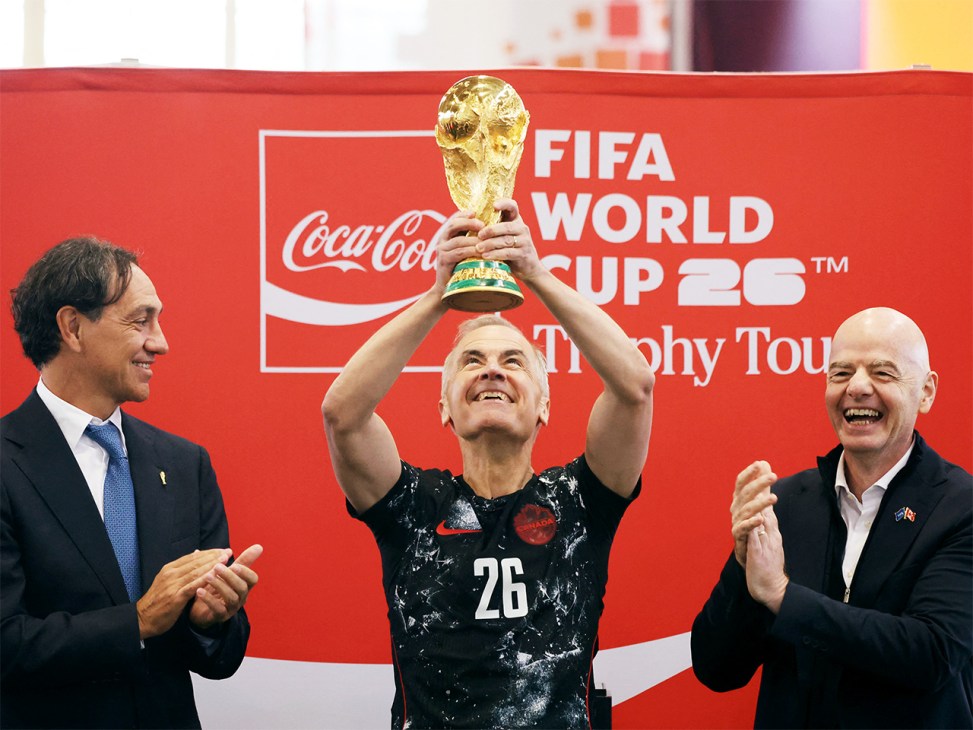
Canada’s best-known football fan – prime minister Mark Carney – was recently in Ottawa to greet football’s most coveted prize ahead of the kick-off of the Fifa World Cup next week. Beaming as though he had won the tournament himself, Carney kissed the trophy and lifted it high into the air for the cameras. “It’s magic, eh?” asked Fifa’s president, Gianni Infantino. “That is magic,” Carney replied, all smiles.
It is not unusual for elected leaders to hitch themselves to the big, global events that overlap their time in office. London’s then-mayor, Boris Johnson, infamously dangled from a zipwire above an agog crowd in the run up to the 2012 Summer Olympics. Twelve years later, French president Emmanuel Macron strained every sinew to ensure that Paris’s glorious Olympic Games were very much his gloire too. But Carney exuded the genuine joy of a fan, one for whom the fairytale of hoisting that storied trophy in the air had, by some miracle, come to pass.
South of the border, however, the public build-up to the World Cup has been defined by a more corporate dialogue, by a transactional president and a profit-hungry organising body. Indeed, the attorneys general of two host states – New York and New Jersey – are launching investigations into Fifa’s alleged manipulation of ticket prices for World Cup matches. Throw in the fact that international tourism to the US is down more broadly and it shouldn’t come as a surprise that the American Hotel & Lodging Association is reporting much reduced hotel bookings across the US’s 11 host cities than was previously forecasted.
Despite all of that, the World Cup remains a significant soft-power star in its own right. The jubilant scenes in capital cities from Sarajevo to Willemstad, in Curaçao (whose sharp World Cup away kit has also become a surprise global bestseller for its manufacturer, Adidas), when their national teams qualified for this year’s tournament, demonstrates how coveted a currency the World Cup still is. And that’s where Canada, as co-host, comes in.
Its own standing in the world’s imagination is higher than it has been for years, spurred, in part by its prime minister’s admirable ascent to high office in a turbulent time. Inward investment into Canada’s economy is up. As are the numbers of tourists, international and domestic, venturing to all corners of the country.
Yes, Canada might have begun its World Cup co-hosting duties somewhat reticently; one by one, most of the six cities vying to stage games – Montreal, Edmonton, Ottawa and Regina in the western, prairie province of Saskatchewan, all withdrew, citing high costs and limited stadium capacity per Fifa’s guidelines. This left Toronto and Vancouver as Canada’s only formal World Cup venues, which will host 13 games – of the tournament’s 104 – between them. “To some degree, [Canada] has not optimised this opportunity,” says David Soberman, a professor of marketing at the University of Toronto’s Rotman School of Management. “But at least we haven’t missed it completely. And when something is scarce, you tend to maximise the return from the events that you do have.”
There is still good reason for Canada to embrace the World Cup. And the timing – as international travel to the US lags and security concerns in Mexico persist – couldn’t be better. “Most of the world has a pretty idealised vision of Canada,” says Ryan Abrams, publisher and co-founder of Darby magazine, which launched in 2019 to report on Canada’s ascendant football culture in print. “Any time that we have the opportunity to host big sporting events, it’s a platform to show off how diverse the country is. The excitement here is definitely growing.”
In the spirit of a football manager pacing the sideline, devising strategies to secure an 89th-minute winner, here are some last-minute plays that Toronto and Vancouver should make to ensure that Canada gets a kick out of this World Cup.
1.
Welcome your guests: Many cities hosting big events find themselves a little begrudging of the build-up. But, without fail, the magic of having the world roll into town is hard to resist. Embrace this as you welcome your guests. Offer directions, suggest places to go and things to do – because it is these warm interactions outside more formal itineraries that will likely outlast memories of the tournament proper. Say hello, shake hands, make your guests feel at home in your city. That shouldn’t be too difficult in Toronto and Vancouver because with big populations who were born elsewhere, much of the world is there already.
2.
Meet face to face: If you’re in business, big or small, set up meetings with your counterparts visiting for the World Cup – particularly those from the countries whose teams are playing in your city. Buoyed by their experience during the tournament, they might want to keep their ties to your city going long after the final whistle blows. Invite them to your shop or studio, or for a tipple at a favourite spot. Showcase the city’s commercial cache. You’d be surprised how a good venue and a bit of sport can smooth the edges of deal-making.
3.
Show off your city: Action should not be confined to the pitch. Big events such as these do best when the whole city is wrapped in the festivities, be it formally or otherwise. The Paris and London Olympics are prime examples of how lasting a place’s refreshed image can be in the minds of both guests and residents. Stage a concert, open an exhibition and enliven public spaces.
As kick-off approaches, Canada would be wise to remember that it is already in the spotlight for a slew of good reasons. Nevertheless, the world will be watching for the six-week span of the tournament. Canada must shake off its pre-match nerves and follow the lead of its prime minister by grabbing the World Cup with both hands.