In a city that, up until recent history, only allowed its residents limited access to urban resources, the MuseumsQuartier has helped to redefine what inclusive public spaces can be.
First-time visitors to Vienna might find the notion that it has a “museum quarter” confusing. After all, the Austrian capital has several cultural clusters, all within easy reach of each other. Isn’t the city as a whole something of a living museum? But the designation belongs to a specific place: the MuseumsQuartier (MQ), which opened 25 years ago this month.
A former imperial stables and trade-fair site, the MQ is now one of Europe’s finest examples of a happy union between culture and public space. Other cities would do well to take note. First, there’s the sheer range of what’s on offer: the Leopold Museum for fin-de-siècle painting and design, Mumok for contemporary art, the Architekturzentrum for architecture and urbanism, and Zoom Kindermuseum, an interactive children’s centre. These are just a small fraction of the 61 venues in the quarter.
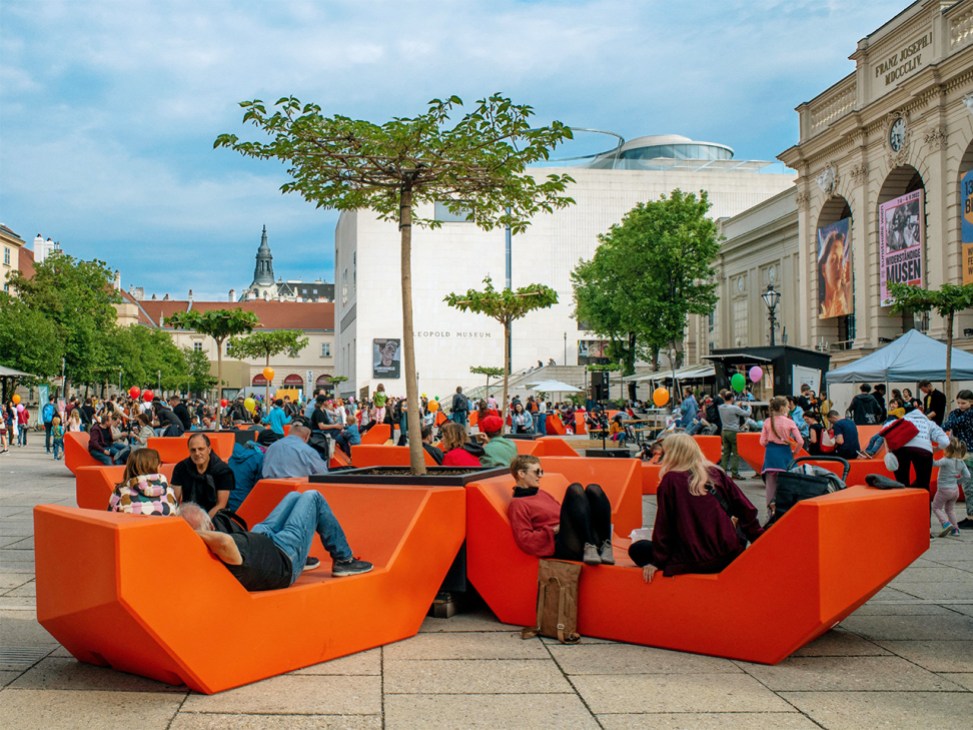
Second, the MQ and its institutions were pioneers of establishing a recognisable visual identity and occasionally making a bold gesture, such as the uncensored posters for the Leopold Museum’s 2012 exhibition on representations of nude men, which made international headlines. Third, the MQ is not merely about the “M”. Its vast courtyards form an expansive public space that’s freely accessible throughout the day. Indeed, many visitors to the area don’t enter a museum at all. For them, the MQ is somewhere to while away an afternoon with a book or a drink; it’s a place where children can run loose.
In winter it hosts one of Vienna’s more stylish Christmas markets. In the warmer months, concerts and readings take centre stage. The MQ functions as a park as much as a cultural complex – little wonder, then, that more greenery has been introduced in recent years.
Public opinion has shaped the MQ’s story from the outset. In the 1990s, when plans for the complex first emerged, opposition to a proposed high-rise tower within the grounds forced officials back to the drawing board. That same spirit of civic engagement endures in the annual online vote that determines the colour of the MQ’s trademark furniture, the Enzis. These modular benches are arguably the most inventive pieces of furniture to emerge from Austria since the mid-19th century, when Michael Thonet relocated his bentwood chair business from Germany.
Owing to their shape and lightweight construction, the Enzis can be combined in all manner of configurations. This year’s colours are punch-cake pink and lemon yellow. Designed by PPAG architects for the MQ, the Enzis have since spread across Vienna and beyond, turning up on university campuses and in schools.
Perhaps its most significant contribution has been less tangible. The MQ has helped to redefine what an inclusive public space can be in a city where, until the 1980s, sitting on the grass in public parks was forbidden. The quarter also encouraged a broader rethinking of urban life. Mariahilfer Strasse, Vienna’s principal shopping thoroughfare, begins at the edge of the MQ and is now hardly recognisable after pedestrianisation. The city’s many Grätzloasen – pocket-sized parklets occupying little more than a parking space – are indirectly part of the same story; so too is the continuing redesign of streets and squares, nudging residents towards cycling and using public transport. As it celebrates its first 25 years, the MQ is proof of Vienna’s long-held conviction that art and design belong at the centre of civic life.
Alexei Korolyov is Monocle’s Vienna correspondent. For more opinion, analysis and insight, subscribe to Monocle today. And read The Monocle Minute tomorrow to see how Vienna ranks in our 2026 Quality of Life Survey.
Further reading:
Monocle’s complete city guide to Vienna