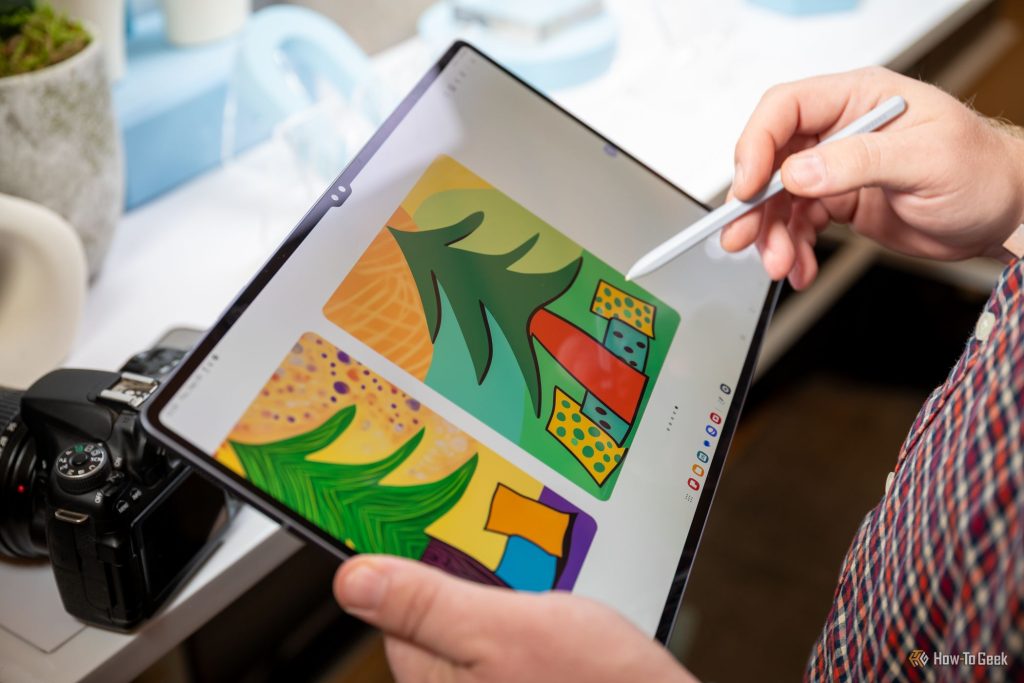
Any small Windows machine has to argue its way past the MacBook Air on my desk, the one I write most of my drafts on. Microsoft made its latest attempt at that argument on September 23, using Snapdragon Summit to refresh the Surface Pro 12-inch and the Surface Laptop 13-inch. Same bodies as last year. New chip.
That chip is Qualcomm’s Snapdragon X2 Plus, and Microsoft brought a wall of percentages to sell it. I care about one of them. The part of the launch I keep rereading is the price.
I haven’t held either machine. My opinions come from Microsoft’s launch material and a few days of early buyers arguing online, and I’ll call my verdict provisional until both go through a proper test.
Last year’s Surface Pro 12-inch topped out at 400 nits. Too dim, in my book, for a tablet built to leave the house. The 2nd Edition climbs to 500, and I’d trade most of the chip gains for those 100 extra nits on a sunny café terrace.
It stays fanless. I like that more than anything else on the spec sheet.
The panel itself hasn’t changed, a 2196 x 1464 LCD at 90 Hz and 220 PPI, and Microsoft’s new Black finish joins Platinum and Violet. My eye went straight past the colors to the battery footnote. Microsoft promises one extra hour of web browsing, 13 in total, and it measured that with brightness locked at 150 nits, less than a third of what the new screen can do.
Microsoft’s optional 5G model is the addition I’d have asked for first. A tablet this portable shouldn’t depend on hotel Wi-Fi, and I’m glad Microsoft finally agrees.
Then there’s Microsoft Ink Canvas, a pen-first space for sketching and summarizing that hands my handwriting to Copilot as context. I’m curious about it. I’m also a footnote reader, and the AI features need a Microsoft 365 subscription with usage limits on top, while the Slim Pen and keyboard both cost extra. Existing Surface owners can download Ink Canvas on October 13 as well, and that takes some shine off it as a reason to upgrade.
Microsoft made the best point of the entire launch—hour six. That’s when the tabs pile up, a call is still burning through battery, and you need the machine to stay cool in your hands. I trust that benchmark completely. The catch? No one outside Microsoft can verify it until units ship on October 13.
Everything else comes as percentages. Of those, I’d circle the 18% battery efficiency gain and park the 95% jump in NPU inferencing for later, because I can’t name one app in my workday that leans on the NPU. All of the figures compare against last year’s Snapdragon X Plus models.
All of them come from Microsoft’s own testing, too.
Qualcomm built the X2 Plus with six cores. A few early buyers have already grumbled about the core count, and I’d hold my judgment until someone runs a long export on the fanless Pro and watches the clocks. A tablet with no fan can only shed so much heat.

The Surface Laptop 13-inch gets the same 500-nit bump and a battery claim I’d love to see hold up, 22.5 hours of local video playback. For my kind of working day, the browsing figure matters more. Microsoft puts it at 18 hours, two more than before.
I can’t look past the screen. 1920 x 1280 at 60 Hz is a tough sell on any laptop today. On a $1,199 machine? It’s absurd. When the 12-inch Surface Pro beats it on refresh rate (90 Hz) and comes in at $1,149. It just makes no sense.
I’d keep the rest as it is. A USB-A port and a headphone jack stay next to the two USB-C ports, and I still prefer a full-size backlit keyboard and a 3:2 touch screen for long documents over any detachable.
I also expected a haptic touchpad this round. Microsoft put its haptics in a separate $79.99 Surface Mouse instead, complete with Bluetooth 6.0 and a Copilot button. That feels backwards to me. Windows 11 already sends small haptic nudges, and the laptop I’d use them on most is the one missing the hardware.
Last year’s 12-inch Surface Pro started at $799.99. This year’s base price is $1,149.99. I had to read that twice.
Part of the jump is fair. Microsoft dropped the 8 GB base model. Every configuration now starts at 16 GB and tops out at 24 GB, and memory costs a fortune during the current RAM crunch. The Surface Laptop 13-inch rises from $899.99 to $1,199 on the same logic, with the same chassis it wore last year.
Microsoft pitches the pair as “entry premium.” I think the word entry is carrying a lot at $1,149.99 before a keyboard or pen goes in the cart, and one early buyer of the first edition put their full tablet bundle at $1,533.
Apple’s $499 MacBook Neo is the comparison I can’t shake, mostly on behalf of students. Microsoft has no Surface Go left to answer it. The cheapest small Surface now costs more than double.
There’s a sibling problem too. The 13-inch Surface Pro with an X2 chip already turns up on sale well below its list price, and I’d bet plenty of shoppers will look at a $1,149.99 12-inch model and decide to wait for a discount on the bigger tablet with the better processor and the nicer display.
Microsoft’s post says the Surface Pro 12-inch enclosure uses 86% recycled content. Footnote 12 says the device, excluding the power supply, contains 3.7%. Both can be true. An enclosure is only part of a tablet. I’d still like Microsoft to print both numbers in one sentence.
Anyone who bought last year’s Surface Pro 12-inch and is still inside a return window should look hard at the swap. I’ve already seen early buyers swap their first-edition tablets for the X2 Plus with 24 GB and the brighter screen.
Beyond that return window, don’t buy either machine unless your needs are razor-sharp. Road warriors should head straight for the 5G Pro 12-inch. The Laptop 13-inch is really just for commuter-typists. Budget buyers should skip both, and IT fleets can start ordering Pluton-backed units October 13.
I’m holding off altogether. Microsoft fixed the Pro’s dim display and missing 5G, but the 13-inch Laptop hinges entirely on an unproven 22.5-hour battery claim. That 60 Hz screen is just too hard to defend at full price.