Japanese fashion brands are leading the way when it comes to developing fabrics designed to beat the heat. With summer temperatures intensifying, their solutions can’t come quick enough.
As Japan’s summers grow hotter, the country is trying everything to keep its cool. Wipes, sprays and fans are big business here; the nation is also a leader when it comes to fabrics that counter the worst of the season. Apparel makers are throwing resources into the latter sector for good reason. The global cooling-fabrics market is projected to be worth €2.5bn by 2030. And where Japan goes, others follow. Asia-Pacific is now the fastest-growing market for this sort of heat-busting clothing.
Technical fabrics, once reserved for sportswear, are moving into the Japanese mainstream. Take, for example, Muji’s Cool Touch line-up of shirts, dresses and trousers that uses uniquely shaped cotton and polyester yarns to allow fabrics to absorb heat and diffuse sweat more quickly. Uniqlo’s summer juggernaut is airism, the smooth, moisture-absorbing fabric that the brand developed with synthetic-fibre manufacturer Toray. The North Face’s Japanese line uses its breathable UV-blocking fabric Breeze Range for a fetching line of Aloha shirts.
Shoppers understandably don’t want their T-shirts and underwear to look or feel like workout gear, so makers have been refining their yarns to maximise comfort. After learning that sweaty undergarments were its customers’ biggest source of summer discomfort, Gunze set about tackling it. The brand’s sweat-busting Asedoron range of T-shirts, boxers and camisoles has sold more than four million units since its launch in 2024. “The market now is about even faster drying,” says Hidetoshi Takeyasu, Gunze’s general manager of merchandising strategy, “along with the development of hybrid fabrics that combine value-added features, such as UV protection, heat shielding and odour control.”
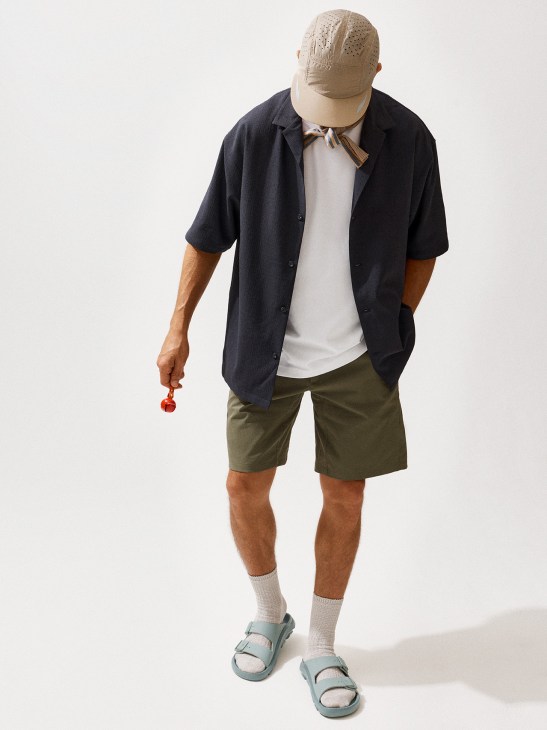
Hat: This ventilation cap from And Wander X Altra is made from a nylon mini-ripstop fabric with laser-cut ventilation holes.
andwander.com
Shirt: The North Face’s Aloha Ripstop shirt is made from breathable Breeze ripstop fabric, with 90 per cent UV protection.
goldwin.co.jp
T-shirt: Uniqlo U’s Airism Cotton Oversized T-shirt incorporates the brand’s sweat-wicking, quick-drying fabric Airism, which is cool and smooth to the touch.
uniqlo.com
Shorts: Wickron Breeze Shorts from Montbell. The fabric – Wickron Breeze – is breathable and quick-drying with a crisp, linen-like texture. The Trekking Bell is also by Montbell.
montbell.jp
Socks: These waffle socks by Tabio are made from 53 per cent washi paper yarn for a dry, crisp feel – perfect for summer.
tabio.com
Sandals: Slip on Birkenstock’s Mogami Terra Stealth 2-Strap for Snow Peak in pure sage, a Japan-exclusive colour.
ec.snowpeak.co.jp
Sweltering temperatures have become a significant health concern. The Japan Meteorological Agency recently adopted a new term for days of 40c and above – kokushobi (literally, “brutally hot day”) – and employers can now be fined if workers’ smart watches show signs of heatstroke. Workman, a brand favoured by Japanese construction workers, is producing lightweight synthetic fabrics (such as Ice Assist) that cool, block UV and dry quickly while also being durable and cheap.
Some of the best Japanese fashion brands, such as Aton and Comoli, work closely with domestic factories to produce custom fabrics with natural materials that perform well in the heat and humidity of a Japanese summer. History has other answers too. Tanaka Hat has been making its straw hats in Kasukabe, in Saitama, since the end of the 19th century. The hats are made from slender straw plaits – each hand-braided from seven strands of wheat stem – that are soaked in water, then sewn together on a special machine and shaped on a mould. It’s a highly skilled process that involves different craftsmen at every stage. Stray strands are then clipped by hand; the final touch is the decoration, usually a ribbon. “Straw hats breathe well due to the natural material,” says brand manager Kyohei Nakada.
“Consumer demand for cooling fabrics is growing rapidly,” says Gunze’s Takeyasu – which comes as little surprise. “Japan’s traditional four-season climate is giving way to more of a two-season pattern, with summer lasting far longer than it used to.” This shift is evidently motivating the problem-solving brains in the textiles business.
Discover Monocle’s selection of Japanese products to keep you feeling fresh this summer in our seasonal newspaper:

This article is from Monocle’s Med, Mountains & More newspaper, on sale now. Subscribers will receive a printed edition including a magazine supplement as part of their subscription and can read the paper and supplement online here. Not a subscriber yet? Purchase a copy of the newspaper here or subscribe today to receive it as part of your package.