The Lombard capital’s bold ambition to host various urban centres where locals can live, work and thrive is shaping up nicely.
“Milan isn’t a pretty city.” That’s the criticism most often levelled against the Lombard capital. It’s a little scruffy around the edges and graffiti-clad in places. The cityscape is made up of a mishmash of architectural styles, 1960s tower blocks and Italy’s take on art nouveau (known as Liberty) sit side-by-side. The product of a work-driven mentality of never getting too attached to the past, Milan is not the sort of place that makes tourists immediately swoon à la Rome or Florence.
It’s a city that requires you to adjust your lens to see its beauty, which can be found in a well-planted balcony, a hidden inner courtyard or a stunning mid-century entranceway. While Italy’s more handsome cities might boast Roman ruins or Renaissance palazzi, they are like open-air museums focused on preserving the past. Milan has little of that historical baggage – damage from the Second World War and 20th-century industrial expansion defined the city’s imperative to build. That future-focused attitude prevails today, and it makes Milan all the more interesting for it. (The city ranked number 12 in our Quality of Life Survey this year.)
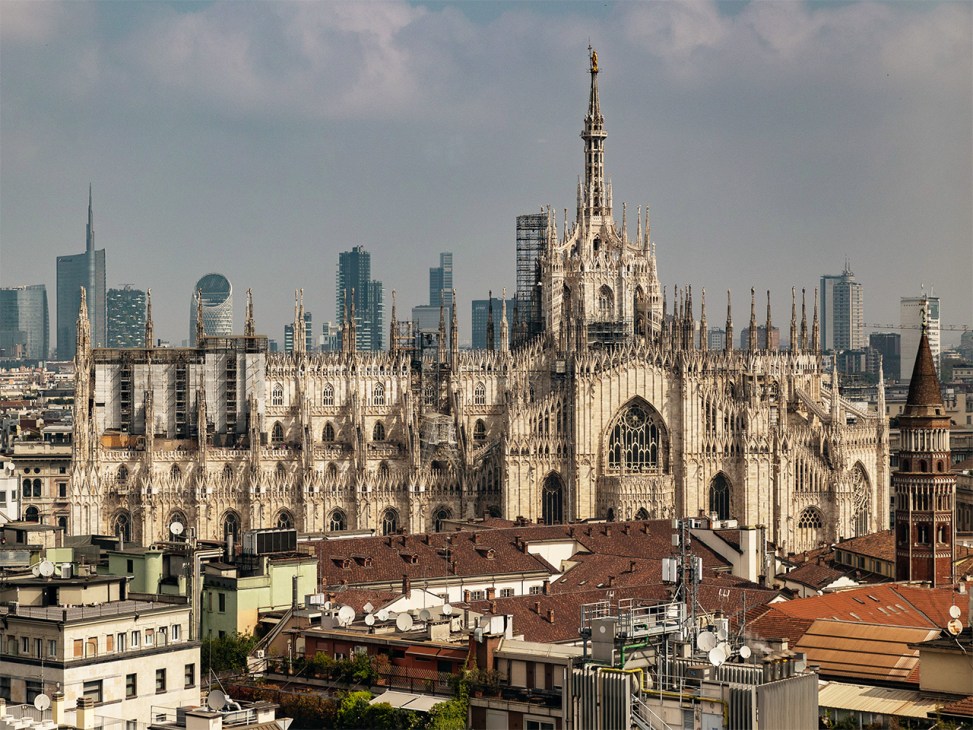
Two urban projects that have reshaped Milan in recent years are the CityLife and Porta Nuova neighbourhoods – both of which are new-build quarters developed over the past decade. Mixing retail, residential and green spaces, they feature buildings by big-name architects including Stefano Boeri, Daniel Libeskind, Zaha Hadid and Mario Cucinella.
It’s hard to think of an Italian city today where so many celebrated architects want to be that also has the capital and the space to welcome them. The latest to join the list is Oslo-founded international mega-practice Snøhetta, having recently completed Pirelli 35, which transformed a 1960s block in Porta Nuova into a mixed-use development. Alongside offices, the project has invited beloved local bakery Pan to open a deli on the ground floor. Snøhetta is also working on an ambitious new neighbourhood at the site of the city’s former slaughterhouse. Porta Romana and Scalo Farini are two other as-yet unfinished developments in former industrial spots.
It’s also important to take a step back from the individual high-profile projects and find out if Milan can achieve its goal of becoming a multicentric city with various urban centres that are desirable places to live and work. Today, Milanese are often focused on the three circonvallazioni (urban rings) that demarcate the city’s central districts. As Milan continues to develop and expand, can it move beyond this limited geographical footprint and unite some of its once industrial areas?
The city certainly isn’t lacking in redevelopment projects, as people get priced out of neighbourhoods or look for more space. The district of Santa Giulia was in the spotlight recently due to its David Chipperfield-designed sports arena that was used during this year’s Milano-Cortina Olympics. The budding Milano Certosa District, led by Italian real-estate developer RealStep and located in the northwest of the city, is working to establish itself as a food and entertainment hub in a bid to attract new businesses and residents. And there is no shortage of urban projects that seem to borrow from the New York school of naming: NOM, or North of Milan, might have been inspired by the rebranded neighbourhood of Nolo (north of Loreto).
Nevertheless, the city has the bones to make these transformations happen. Its tram, metro and urban-rail networks are decent – even if the latter’s Passante train is clearly in need of investment beyond the small cosmetic changes made to key stations during the 2026 Winter Games. If Milan successfully manages to connect its districts in a coherent way, it’s sure to grow into a metropolis deserving of the title as one of Europe’s greats.