Qantas has unveiled the aircraft design for the first-ever commercial flight route connecting Europe to Australia’s east coast, which is set to take off between Sydney and London in 2027.
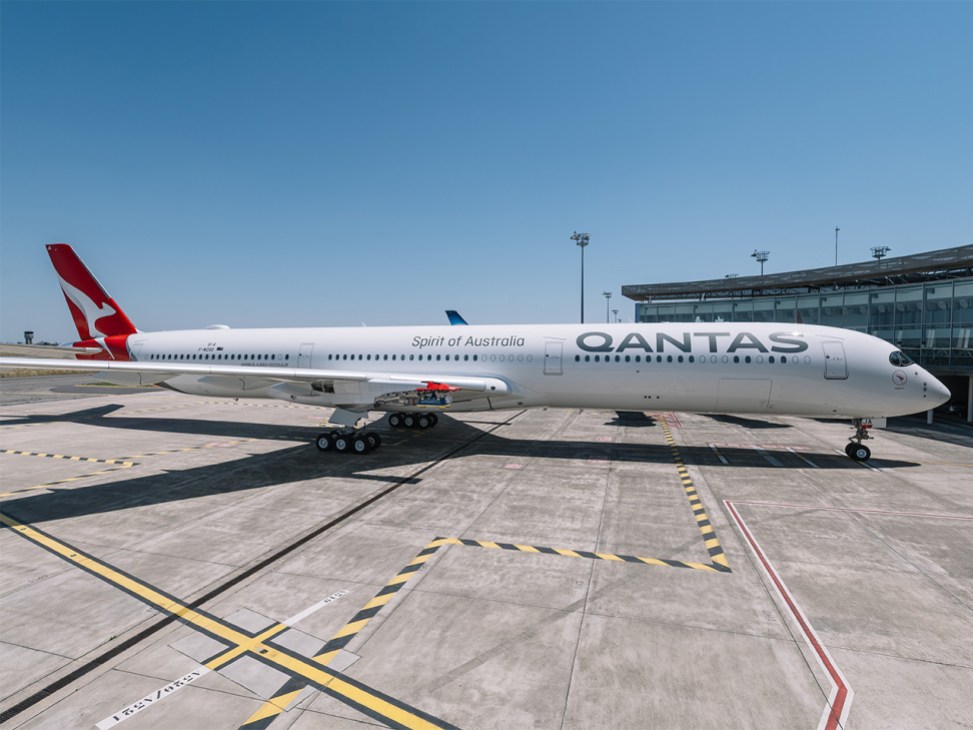
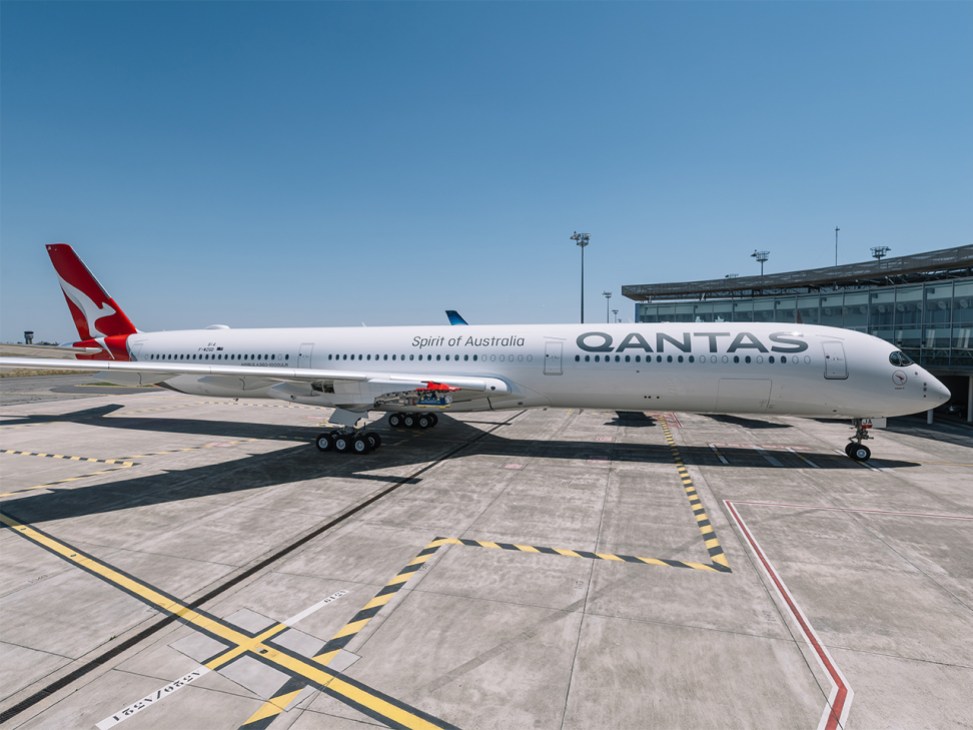
After years of setbacks, redesigns and supply-chain headaches, Australia’s flag carrier has unveiled the route and aircraft that is set to connect the country’s biggest cities to Europe. At Airbus’s facility in Toulouse, Qantas presented its first ultra-long-range Airbus A350-1000ULR, which will traverse the 22-hour non-stop flight path between Sydney and London from October 2027.
It’s a small niche in the global aviation market but the launch solves one of the industry’s persistent challenges: how to directly link Australia’s east coast with Europe. The specially modified Airbus A350s – the first of which is due to be delivered in April next year – is a feat of engineering, with an additional fuel tank that allows it to stay in the air for an extended period.
According to the airline, fuel consumption is broadly comparable to a one-stop journey between Sydney and London. “The challenge is not speed, it’s range,” said Patrick du Ché, Airbus’s head of flight and integration tests, when Monocle visited the company’s facility last week. “To fly longer distances, we need to have much more fuel.” Traditionally, that would mean carrying fewer passengers. Thanks to extensive weight-saving measures throughout the cabin and airframe, however, the Project Sunrise aircraft is about 40 tonnes lighter than a standard A350. Some of the fuel savings also come from eliminating an intermediate landing and takeoff.
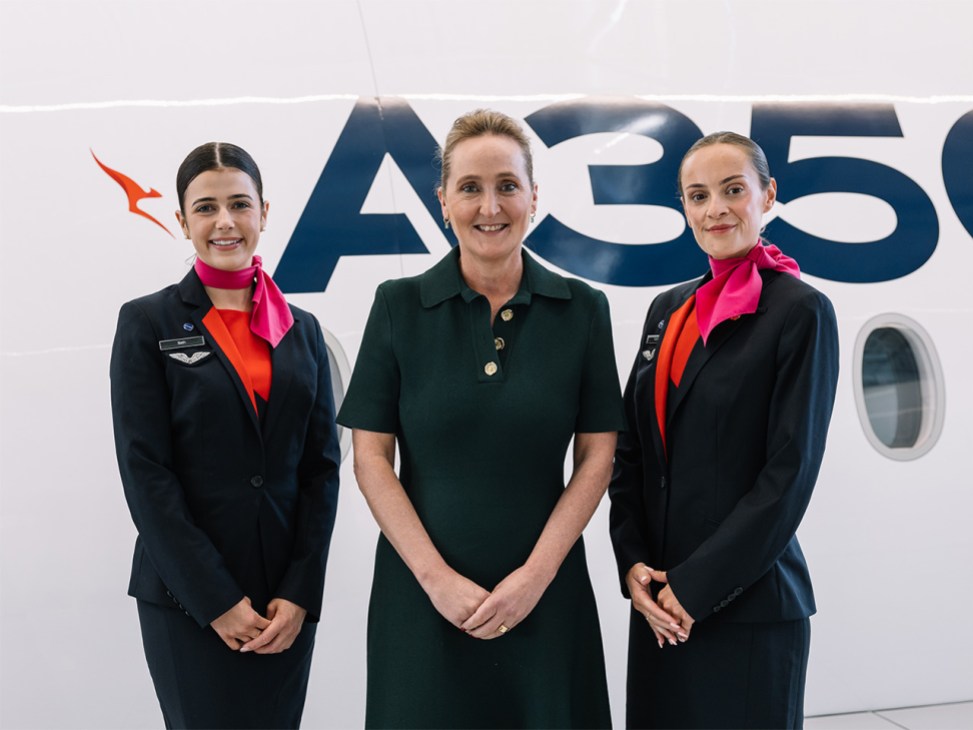
The economics depend heavily on premium travellers. Of the aircraft’s 238 seats, 98 are in first, business or premium economy. That means 41 per cent of the cabin is dedicated to higher-yield passengers, a significantly larger proportion than on most long-haul aircraft. “The premium share is much higher than usual,” says Qantas Group chief executive officer and managing director Vanessa Hudson. The cabin layout leaves little doubt about where Qantas sees demand coming from, with the aircraft itself designed around a simple problem: how to keep passengers comfortable for almost a full day in the air.
For that, Qantas turned to Australian designer David Caon and researchers from the University of Sydney. Their work produced what the airline calls a Wellbeing Zone, a dedicated area where passengers can stretch, move around and hydrate during the flight. Research suggested that movement mattered just as much as comfort. “Passengers wanted more space,” said Caon. “Not just a better seat but somewhere else to go.” The designer has also removed overhead bins from parts of the premium cabin, creating a more spacious interior. Weight reduction drove countless design decisions. According to Caon, discussions often came down to a matter of grams.
Comfort extends beyond the furniture. Peter Cistulli, professor of sleep medicine at the University of Sydney, has spent years studying how passengers cope with ultra-long-haul travel. “The traditional model is to feed people and get them to sleep,” he said. “That doesn’t work on a 22-hour flight.” Instead, Project Sunrise uses lighting, meal timing and nutrition to help shift passengers’ body clocks towards their destination time zone. Spicier food and caffeine promote alertness while lighter, protein-based meals are served before rest periods.
1 / 3


As airspace closures, geopolitical tensions and operational disruptions become more common, range is becoming increasingly more important. It means that there’s value in the programme beyond passenger comfort, with the technologies developed for Project Sunrise likely to find their way into future aircraft programmes. “It keeps us innovating,” says Benoît de Saint-Exupéry, Airbus’s executive vice-president of sales for commercial aircraft. “We can use the same technologies elsewhere, including in freighters and future A350 developments.” After decades of speculation about non-stop services linking Australia’s east coast and Europe, the technology to do so has finally arrived – and will surely keep evolving.