We have been promised a paradigm shift in personal mobility for some time – so where is it? Electric vehicles still only account for about a quarter of global car sales and car-share schemes, self-driving cars and the micro-car revolution all seem to have stalled. Automotive design is stuck in a rut, with European manufacturers often retreating to retro ideas, while Chinese manufacturers chart their conservative path (can you tell a BYD from an Xpeng?). Meanwhile, all are competing on battery range even though most journeys are less than 10km, and vehicles are increasing in size just as urban planners push to reclaim the streets for humans.
But here comes a potential game changer. Dreamt up by Portuguese former investment banker José António Uva, Amble is a low-cost electric four-seater. Uva is the visionary behind farmhouse hotel São Lourenço do Barrocal on his family’s wine estate in eastern Alentejo. When it opened in 2016, it seemed an unpromising location for a high-end independent hotel but Barrocal has become the resort of choice for visitors to Portugal seeking impeccable hospitality in a design-conscious yet authentic setting.
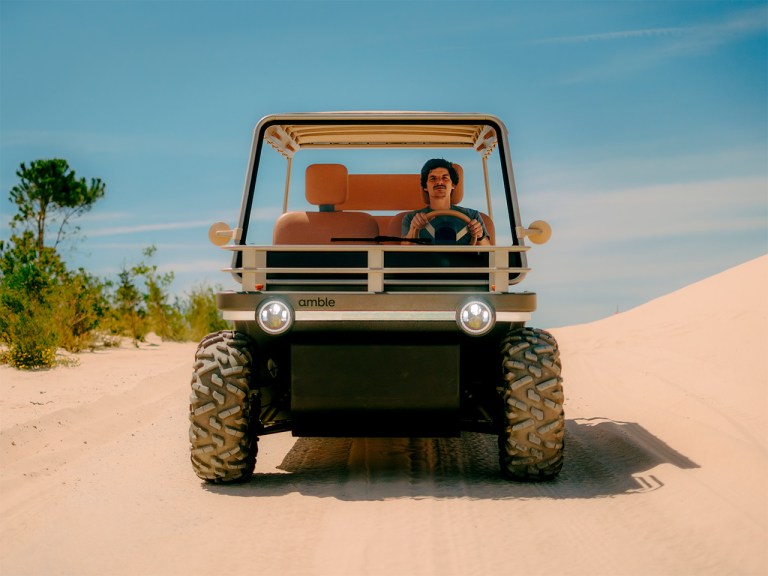
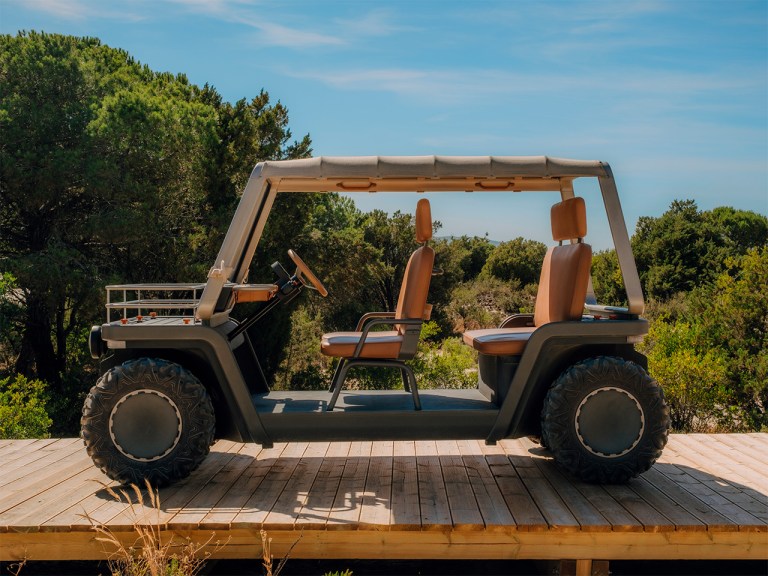
Sebastião Clara, Amble’s business-development director, goes for a spin
1 / 2


“I’m not really an off-the-shelf kind of person,” he tells Monocle when we meet over dinner at Lisbon restaurant Rosamar. Which brings us to Amble. Uva hopes that this vehicle, which resembles a funky Mars rover, will address one of his biggest bugbears: hospitality carts, those moonlighting golf buggies that resort hotels use to ferry guests and supplies.
“As soon as I opened Barrocal, I realised that there was a problem,” he says. “Those carts are the first touchpoint for guests but they never match the beauty of the landscapes or the architecture that you find in top independent hotels.” They are also notoriously unreliable. They don’t have adequate suspension so are uncomfortable (particularly if you sit in the back) and their image has hardly been enhanced by their association with a certain world leader.
Speaking to other resort owners across the globe, Uva realised that he was not alone in feeling dissatisfied by what was on offer. But it’s a long way from a mild irritation concerning your hotel’s mise en scene to a pre-production car such as the one that you see here. Fortunately, Uva is a man with a boundless capacity for project management. He is the kind of person who gives you his undivided attention but is also somehow simultaneously solving a dozen problems. “My wife says that I like tackling tricky projects,” he says, with a shrug. “But my experience is that a complicated, large project is as much work as a complicated, small project.”
This is where Lisbon enters the story. Serendipitously, key members of what is now the Amble team were already living in the city, having been drawn there by its dynamism and celebrated lifestyle. Among them was designer Julian Hönig. While at Audi, he had overseen the A4, Q3 and RSQ models, before working at Lamborghini; he had recently moved from California, where he had served as one of the lead designers on the Apple Watch, the Apple Vision Pro and the never fully realised Apple Car.
Uva’s son happened to be in the same class at school as Hönig’s. “I am not spiritual in that way but I do find that you end up crossing paths with the right people when you are looking for something,” says Uva of encountering one of the world’s leading product designers outside the school gates.
Hönig didn’t take much persuading. “I had already talked with an Apple designer friend a few years ago about golf carts because it was obvious that no one cared about them design-wise, so I was excited about the idea,” he tells me the next day at an exclusive viewing of the first Amble at Uva’s new coastal resort, Na Praia, soon to open just north of Comporta. “But then I realised that, if we do a street-legal version, we could go from selling to resorts to selling to gated communities and all the way to urban mobility. And that would make this really meaningful.”
Hönig confides that he once turned down Elon Musk when he was approached to join Tesla – but what about his old boss? Would the late Apple CEO Steve Jobs have approved of Amble? “That’s a good question,” he says, pausing. “Apple is good at finding the essence of products but without being naive.” He compares Amble to the MacBook in the way that its design fits the materials and how these materials are treated. “With Amble, we worked a lot on keeping straight shapes. The windscreen is flat and the tubes only curve in one direction.”
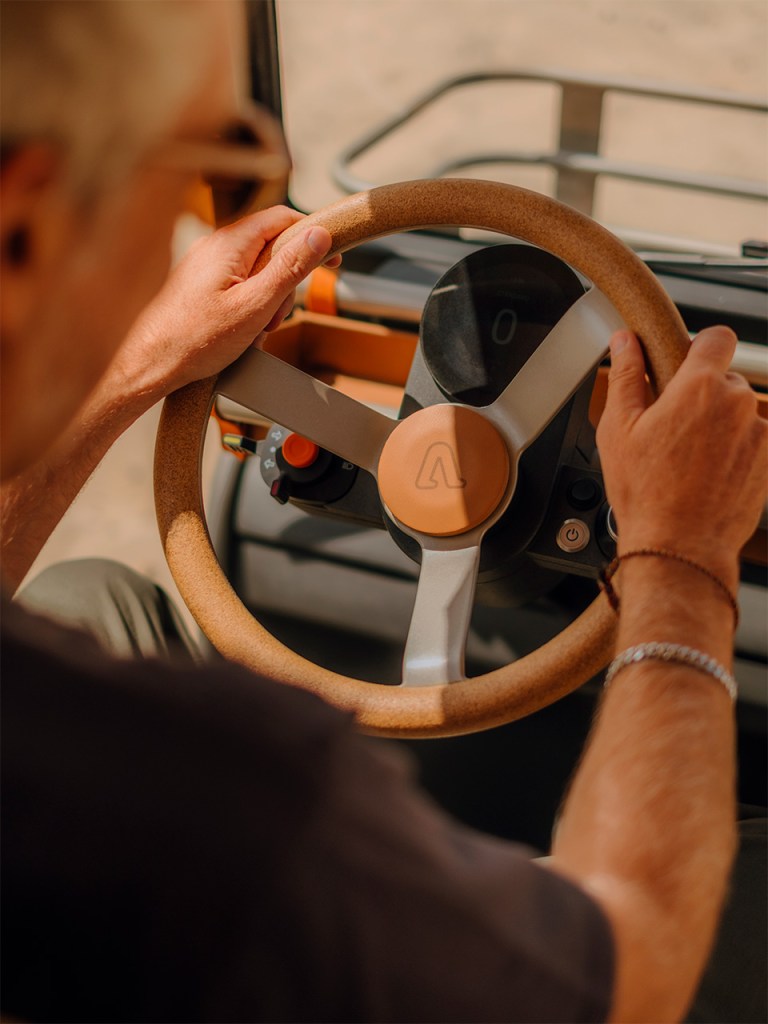
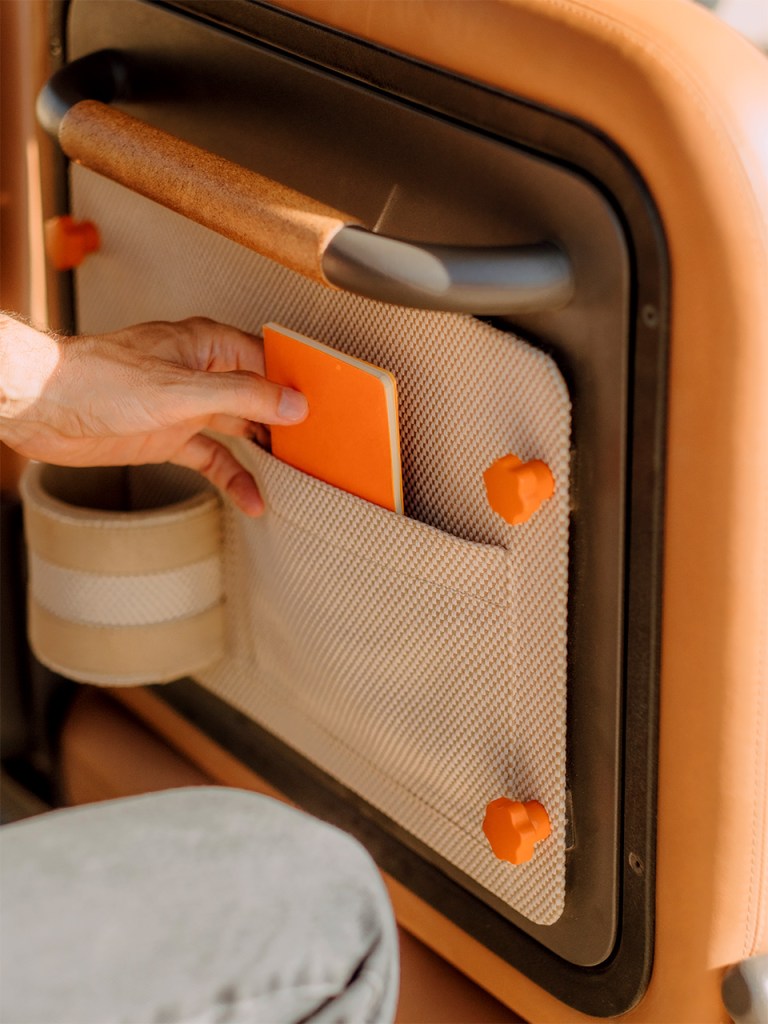
Cork steering wheel
1 / 2


Michael Tropper, a friend of Hönig’s from design school in Graz, came on board soon afterwards. “We have always stayed in touch and connected so well on a creative and personal level,” says Tropper, as the duo sit outside with Monocle, soaking up the sun at Na Praia. He seems to be the more reserved of the two; this is reflected in the under-the-radar approach of Forpeople, the creative studio that he co-founded with offices in London and Amsterdam. They tell us that they share a “quite old-fashioned”, total-design approach to their work, which means that they are as at home shaping brands as working in industrial design.
Tropper was a part of Ford’s advanced-design team (back when the company owned Aston Martin) and Forpeople has the likes of Arc’teryx among its clients. He also worked with Chinese EV giant NIO to create its innovative, community-focused brand universe.
Ever since he designed interiors for British Airways, one of Forpeople’s first clients, Tropper has had a deep respect for the world of hospitality. “When you work on an airline seat, you have to consider the experience of travelling,” he says. “Car designers don’t necessarily think like that: for them, it’s more about the object. But in hospitality, you factor in all of these things. One of our mantras at Amble is ‘Let’s not make it automotive’.”
He and Hönig began designing in May 2021 with a simple flat platform, which houses the batteries but also allows for modularity. In terms of influences, they cite Nasa’s Lunar Rovers and are fans of the original Fiat Panda by Giorgetto Giugiaro and Aldo Mantovani, which combines an almost brutalist simplicity with an engaging personality. “It’s very important to have an emotional factor,” adds Hönig. “Before it turns a wheel, a vehicle must have presence. Car designers often make things too complicated and too aggressive but we bring experiences from furniture, product and interface design, then also a bit of the car world.”
They were joined by an associate of Hönig’s, Adrien Roose, the co-founder of Belgian e-bike company Cowboy, who also lives in Lisbon (and had coincidentally already met Uva at a farmers’ market). Having foreseen the market for e-bikes a decade ago, Roose sensed that the time was right for Amble. “Your second car shouldn’t be a second car,” he tells me as we inspect Amble One outside, among the dunes of the Atlantic coast. “It can be one of these instead.”
Like all prototypes or pre-production models, the car that you see here is a work in progress but, on a brief test drive, Monocle was impressed by the oomph that it had as it ascended relatively steep inclines. That pep will be all the more potent on the production version, thanks to the work of Francois-Xavier Delage, the chief technology officer.
Delage has the perfect CV for Amble, having worked as the lead engineer on a championship-winning car for Renault’s Formula 1 team, before moving on to help create Renault’s Twizy micro-EV. While the pre-production model that we drive weighs about a tonne, the production-stage Amble will come in at less than half of that, thanks to Delage’s work. “We want something that can go anywhere in Lisbon, which means up very steep hills,” says Delage. “It can’t be heavy.” The solution was to switch from all-steel to mostly aluminium construction.
According to Uva, the response to Amble from fellow hoteliers has been extremely positive. Mustique Island, Amangiri in the US and Six Senses Les Bordes in the Loire have “expressed strong interest” in the first cars, which are due for delivery next year. Orders for private customers, with delivery scheduled for 2028, are now open via the website. There will initially be no showrooms; servicing will consist of a combination of online tutorials and mail-order spares for the simplest of repairs, a mobile service team and certified partners for more serious jobs.
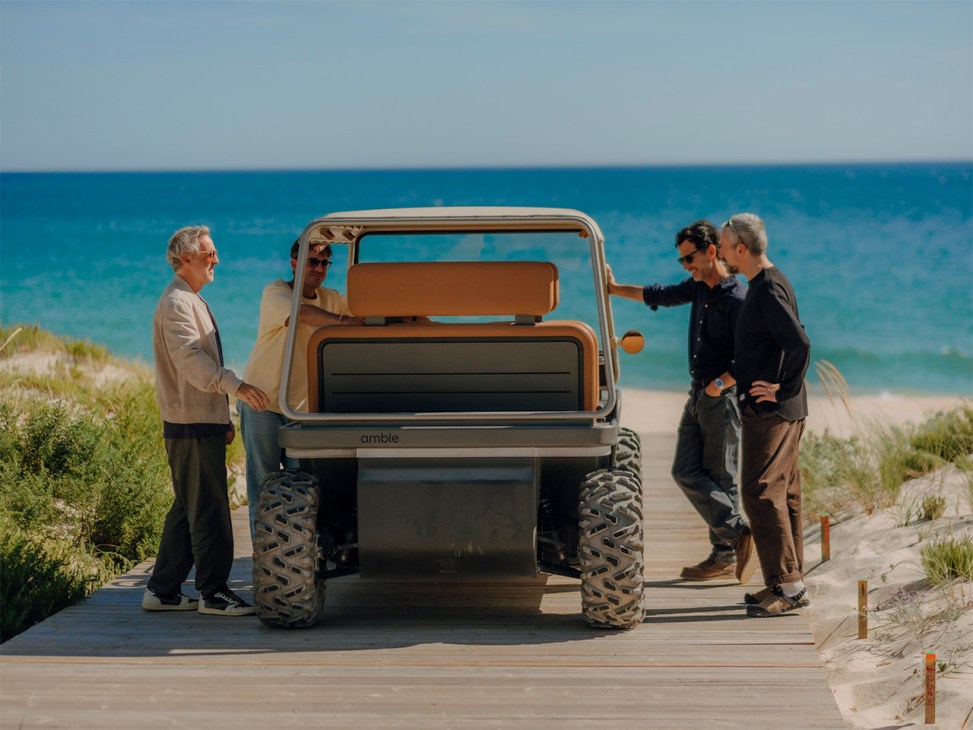
The rollout begins with premium hospitality, where there is a clear demand and Uva has strong connections, before expanding to what the company calls “amble zones”, which include classic holiday destinations such as the Greek islands, southern France, Southeast Asia, the Caribbean and Spain but also residential complexes in Florida and the US West Coast. “What you’re seeing in many of these places is that there’s sort of a trickle-down effect where it starts as a summer-holiday place, the shoulder season grows and it becomes residential, then year-round,” says Uva.
Amble reflects the recent blossoming of Lisbon. The team is currently working on establishing a way to assemble the vehicles in Portugal using as many local components and materials as possible (it even has a cork steering wheel, and materials don’t get much more Portuguese than that), but there is one other way in which it epitomises the nation.
“This is a new phase for Portugal,” says Uva. “We used to make things for other people, for other brands; now we are adding value to what we do with our own products and brands. That’s what we are trying to do with Amble – to create a brand that has authenticity, a sense of community and place, but that will appeal to the world.”
In good company
Amble currently sits in the so-called “heavy-quad” L7E category for road use so drivers require a licence (a licence-free L6E version is being considered). Its modular construction allows for accessorising and adaptation. A pick-up variant is likely – useful for resort staff. The next model, the Amble Two, will be fully enclosed and more suitable for urban use in northern climates.
Amble’s backers are as illustrious as its designers. They include Peter Rive, co-founder of Tesla’s SolarCity, Pete Phornprapha of the Siam Motors Group, Joe Zadeh, a former VP of Airbnb and Ethereum’s Gavin Wood.
driveamble.com
Amble One
Price: €20,000
Top speed: 65km/h
Range: 100km+
Weight: Less than 450kg
Battery: 11kWh, chargeable via domestic socket
On sale: Now, for delivery in 2028