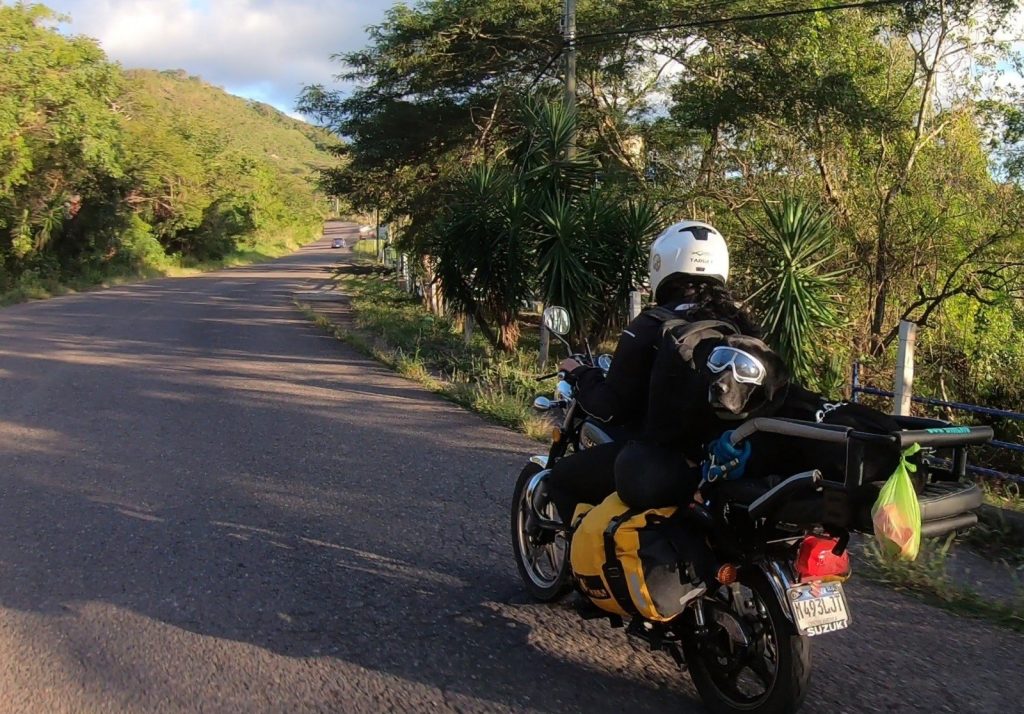
My motorbike journey through Central America with my black Labrador, Gimli, as my co-pilot is one of my most memorable and most adventurous experiences. Yet, before this idea came to mind, I had no plans to become a motorcyclist, and I had never even ridden a motorbike before. Prior to setting off, the pressure was on to get my motorcycle license in record time.
Broken down on the side of the road, trying to take shade from the blistering heat while onlookers watched as if I was the main character in a novela, I wondered how I had ended up here – riding solo through Mexico. This had been the biggest challenge I had ever set myself, and I could hardly believe I was nearing the end of a 10,000km road trip, but with so many mechanical breakdowns, I didn’t know if I would ever make it to my end point at Playa del Carmen.
As I neared the popular resort town, I was shocked that my bike had made it here, especially after yet another breakdown that left me sheltering from a storm under a bridge. Somehow my motorbike started and allowed me to carry on to my final destination, and soon enough I could relax.
Navigating hectic traffic with little to no experience, researching mechanics throughout the journey to keep the bike in tip-top condition and riding long days in all weather conditions were just some of the factors I had to consider on this wild two-wheeled journey.
So, was it worth it? Would I recommend it? Would I advise someone else to embark on a journey this huge?
In this article, I will explore the reasons I set off on this trip, what I learned along the way and what it is really like to travel Central America as a new motorbike rider – with a dog.

How I went from complete beginner to riding across Central America
It all started when a seed was planted in my mind during a motorbike trip through South America. I had completed a huge section of the famous Pan-American Highway from Ushuaia in Argentina to Cartagena in Colombia on one motorbike with my ex-partner, spread over two separate trips.
Although it was an exceptional achievement and a memorable trip, I was heartbroken that Gimli, my black Labrador, could not join in. I had never left him for so long, and I was adamant about making sure he could join me on the next leg.
The simple solution seemed to be that I would need to ride my own bike, but the only problem was I had never ridden a motorbike in my life.

Plans were in place to find a way for him to join us. A sidecar? A customised dog carrier? I had no idea where to start looking, but after a few Instagram searches I came across Dog Bikers, who ultimately changed the way I travel.
With the dog carrier sorted and flight options researched, the biggest hurdle was to get my motorbike licence in just a few months – without this, the trip would not happen. But those who know me know I do love a challenge, and when I set myself a goal, I do everything to achieve it.
By some miracle, I had completed my motorcycle training within 4 months, bought an extremely heavy Suzuki Bandit to practice on, joined a women’s motorbike group and passed my motorcycle test despite not feeling quite ready for what awaited me across the Atlantic. With flights booked, gear packed and a rough motorcycle route in place, I was on my way from Ireland to Mexico to begin the journey of a lifetime – this time with my best friend in tow.

The freedom, challenges and reality of Motorcycle travel
Looking back, I remember the fear taking over as I realised I would have to transport my newly purchased Suzuki GN125 motorbike on a small passenger boat across Lake Petén Itzá in Flores, Guatemala. I had opted to buy this cheap, reliable, easy-to-fix motorbike (despite having no mechanical skills), but had underestimated that I would need to ride it onto a small boat to reach my accommodation on the other side of the lake – little did I know this would be the first of many challenges that awaited me.
I had reached Guatemala overland from Mexico via public transport, which was a struggle with luggage, motorbike gear and a dog, but somehow I managed – even with a brief stop in Belize to soak up some Caribbean sun. I had come to learn from fellow overlanders that Guatemala was the easiest place for foreigners to buy vehicles, so with the help of a local notary, the purchase was complete within a few days of arriving.
Leaving Guatemala was exciting, but for the first few journeys, my partner took Gimli on his motorbike while I got used to the motorbike and, most importantly, the hectic traffic, angry bus drivers and spontaneous detours. Once we had reached El Salvador, I was good to go, and so began the journey of me and my co-pilot bound for Panama.
Riding a motorbike in Central America gives you the ultimate freedom. One of the things I loved most was being able to pull over whenever something caught my attention, but also to visit hidden waterfalls and local attractions most tourists don’t get to see.


Travelling by bus, I would often spot something interesting through the window and never see it again, but this time round I could enjoy every aspect of each country. On the motorcycle, I could simply stop, which was especially practical with a dog, but also if I was hungry, needed to use the bathroom or just wanted to grab a coffee.
The downside, however, was that I had to ride in every kind of weather and terrain, including torrential rain, extreme heat, hailstones and muddy roads – which became increasingly stressful for someone with few skills.
Detours led to challenging roads, traffic jams led to many near misses, and at one point at a roundabout in El Salvador, a car drove right into me as he attempted to take his exit without looking. Within a few weeks, I had come to realise that you need eyes in the back of your head for a journey like this, and getting to enjoy a relaxing motorbike ride was a rarity.
Apart from the freedom, having my own Suzuki GN125 was extremely affordable; in fact, this is one of the cheapest and most well-known motorbikes in the world, so repairs were often very quick, easy and cheap – which was important for me. Regardless of the breakdowns I experienced towards the end, I opted to buy this same model on my return to Ireland.

Despite riding through some of the world’s most dangerous (at least that is what they are known for) countries – El Salvador and Honduras- I never experienced any safety concerns, but perhaps this was because most people were terrified of my lovable black Labrador.
Riding three days solo at the end of the journey was perhaps the scariest experience I had. Breaking down multiple times on my way to my final stop, with no outside help and a dog to take care of, was extremely hard, but it is in these moments that you take a deep breath and pray that everything will work out – and they usually did.
The countries that changed my expectations
One of the reasons I chose to ride through Central America was because it was a region of the world I was yet to explore.
Travelling through this region meant I would reach 100 countries – not that I was counting! It also helped that I knew some Spanish and had a keen interest in Mayan history and unique volcanic landscapes.
Truthfully, I was very excited to visit Costa Rica since I had heard so many great things, but had little to no information about El Salvador, Honduras or even Panama, so my expectations were nonexistent. Each country taught me something different, and I was shocked at how I ended up disliking certain countries and loving others I knew nothing about.
Below is an overview of my experience, including the pros, the cons, and what to expect if you plan a similar trip to this region.

Mexico
Mexico was not new for me since I had travelled here twice before, and loved it. One of the main reasons I chose to fly from Ireland to Mexico to begin the journey was that it seemed like an easy and affordable route to take with a dog, and a safe option for a solo female.
Towards the end of the trip, I spent 3 months house-sitting in Merida, where I got to live like a local, relax after a crazy adventure and make plans for the future.
Mexico has never been a place that scared me, and despite travelling a large part of the country, I can safely say that I never felt uneasy or afraid. I would, however, say that border towns are always the most turbulent places, so I would always hurry through, especially in the volatile region along the Guatemala-Mexico border.
Guatemala
Guatemala was the country where my riding journey began, and so I was ultimately thrown in at the deep end. Guatemalan bus drivers should not be underestimated – they WILL overtake you and drive you off the road, so taking caution is a must.
Guatemalan traffic was chaotic, most notably at rush hour in Guatemala City, and the many colonial towns paved with cobblestones truly tested me and my heavily packed bike.
Guatemala was one of the most affordable, laid-back, and friendly countries despite the crazy drivers. And did I mention this was where I did my first-ever unintentional wheelie and was thrown off my bike, as I attempted to ride a steep hill out of Lake Atitlán in the wrong gear? Locals stopped to help me and offered water, while I laughed off my silly novice mistake.

👉 More on my journey through the colorful lakeside town of Flores, and the cobblestoned colonial streets of Antigua.
El Salvador
El Salvador, which was once one of the world’s most dangerous countries – so much so that it is only recently that even locals can explore their own country – turned out to be my favourite destination.
My first impressions of this ultra-modern country lined with manicured parks, boulevards and scenic coastal roads to rival the United States were extremely positive. Yes, I may have been hit by a car at a roundabout here, but that was the only time this happened, and it did not change my view of the country.

Road tripping along the coastal road reminded me of the Pacific Coast Highway in California, and the surf culture, incredible sunsets and laid-back vibe made this a very memorable destination for me. The only downside was that many of the national parks were not dog-friendly, which was quite limiting, but little did I know Costa Rica would be so much worse.
👉 More from my time in El Salvador: El Tunco surfer town guide, Santa Ana guide, and my road trip through Ruta de las Flores.

Honduras
I visited Honduras briefly on my way north from Panama to Mexico, and my first impression was extremely positive. Like El Salvador, Honduras still has quite a bad reputation in terms of safety, but during my short time there, I only experienced kindness, generosity and friendliness from strangers.
Places like Comayagua and Lake Yojoa truly stood out to me, and I was shocked at how little tourism this country experienced.
However, what I will say is that my worst riding experience was in the capital city of Tegucigalpa, which was incredibly stressful, unorganised and beyond chaotic. I would never advise anyone to attempt this at any time of the day or year. Honduras is very underestimated, and the natural attractions are well worth stopping by to experience, as are the islands of Roatan and Utila, which I plan to visit in the future.
Nicaragua
Nicaragua was one of the most pleasant and least stressful destinations to ride, apart from trying to access remote waterfalls on Ometepe Island. The roads were bad, but not terrible. The food and nature were incredible, and there were so many dog-friendly options around the country.
One of my favourite places was the Corn Islands, accessed from Bluefields on the Caribbean coast, and while it is quite a long detour, it is well worth it.

Nicaragua felt safe; the coastal cities were charming and relaxed, the cities were not as chaotic as the cities in neighbouring countries, and I felt as though it had so many underrated attractions, which you would pay to see in Costa Rica.
What I also loved was the wildlife; in fact, I spent Christmas and New Year’s in a cabin on Ometepe Island surrounded by wild monkeys, which was unique.
👉 Also covered in Nicaragua: the volcanic Islets of Granada, the twin-volcano island of Ometepe, the Caribbean Corn Islands, and the cigar country of Esteli.

Costa Rica
Truthfully, Costa Rica was a letdown for me for many reasons. Apart from being beyond expensive – think Swiss-level price tags – Costa Rica felt very North American, and it was hard to experience the true culture of the country.
Natural attractions were expensive, some of which were unimpressive, and I felt as though I was charged for everything here. As someone who loves to get off the beaten path, I found Costa Rica to be a very overcrowded destination, with many tours passing through.
For a very expensive country, I expected better infrastructure, but one of my first riding experiences was a nightmare as I tried to reach the mountain town of Monteverde on one of the worst washed-out mountain roads I had ever seen.
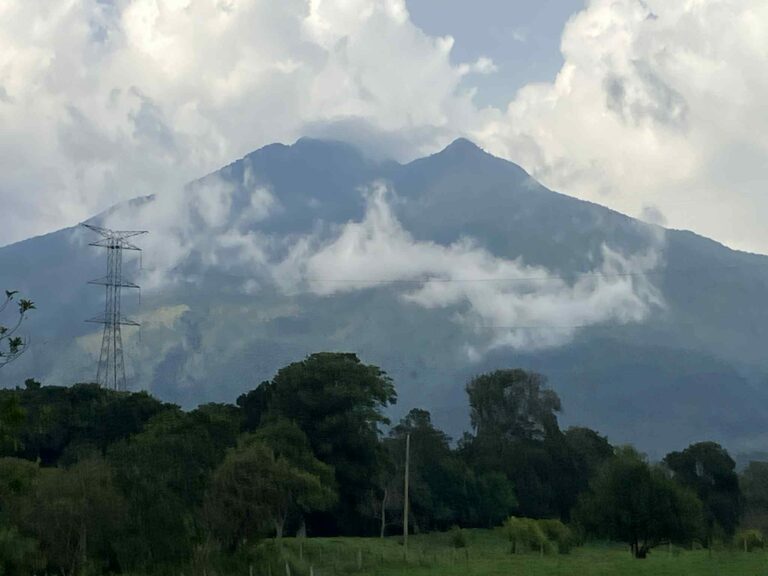
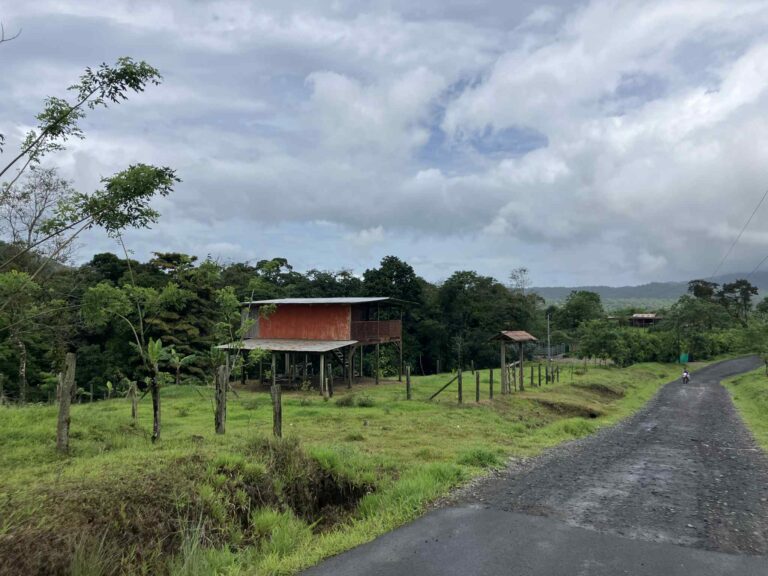
As a budget traveller, I lived off fried chicken from Pollolandia during my time in Costa Rica, and found that even local markets were not as affordable as in other countries I had been to. But it was not all bad; I did enjoy a peaceful experience in a riverside cabin surrounded by wild sloths, a visit to the Starbucks farm and a day trip to Cahuita National Park.
👉 More from Costa Rica: surf and sunsets in Santa Teresa, plus route ideas for bikepacking the Nicoya Peninsula itinerary and 1 week itinerary in Costa Rica.
Panama
Truthfully, given Panama’s extremely strict animal import requirements, I was not sure I would have the chance to enter the country, but last-minute advice from fellow travellers changed the plan.
It turned out that crossing at the Caribbean-side border had more relaxed rules than the Pacific side, which meant we could tick this country off our list.
Panama surprised me in more ways than one. The nature was diverse, the people were very welcoming, the roads were quite good, and it was not as expensive as I had assumed.
While dog-sitting at a penthouse apartment in Panama City for a week, I couldn’t believe my luck. Experiencing life as a local was a great opportunity, and I welcomed the chance to take a break from the open road.

Apart from the extreme heat of Panama City and the chaotic traffic, Panama was one of the most memorable destinations for me, despite initially assuming it would be the most difficult – bureaucratically speaking.
From the cooler climates of the mountains to the chilled vibes of Bocas del Toro and a memorable cabin stay on a cacao plantation, Panama exceeded whatever expectations I did have.
👉 Also from Panama: the highland coffee town of Boquete and the crater valley of El Valle de Anon. For a full route, see Marek’s Panama itinerary.
What it’s really like travelling with a dog on a motorcycle

Many people travel Central America overland, by various modes of transport, but few travel with a large dog as their co-pilot. One of the most asked questions is what it is really like travelling with a dog on a motorcycle. How did I find accommodation? Was I restricted from visiting tourist attractions?
Travelling with a dog was certainly challenging, but honestly it was much easier than I anticipated. Gimli comes everywhere with me, and I was adamant I would make this work, so I had done a lot of research, joined the relevant WhatsApp and Facebook groups and asked for advice from the few people I knew that had done something similar.


- Border crossings varied, but Gimli had all his up-to-date vaccines and paperwork from Ireland, which I had planned and researched in advance. At each border I needed to present a new health certificate from the previous country, but usually this was quite cheap except for Costa Rica.
- I used the “pet friendly” filter on Booking.com to find accommodation and occasionally just asked hotels in small towns I was passing through, which almost always worked out well.
- My gear consisted of one bag for Gimli and one for me. I brought his toys, bed, food, harness and leash, as well as treats and snacks for long travel days – but he usually slept while he was riding. For our flight, I had also bought a travel crate for Gimli and then donated it to a local animal shelter in Holbox, Mexico upon arrival.
- Each country was more dog-friendly than I expected, with the exception of Costa Rica (difficult to find anywhere free and dog-friendly to walk your dog) and El Salvador (usually just the National Parks). The rest of the time we had access to beaches, waterfalls, cacao and banana plantations and Gimli was even allowed to hike Acatenango volcano in Guatemala with us and sleep in our tent at the summit.
- I often found that in this region of the world, travelling with a pet came across as a strange thing to do, so we got some strange looks, but most people were curious and friendly towards Gimli. Rules were either strict or non-existent, so I would ask if I could bring Gimli with me and was often allowed – even on the long 7hr ferry from Bluefields to Big Corn Island in Nicaragua.
What I learned along the way
There are many things I learned along the way and plenty of tactics I used from my previous trip through South America – including riding with a GoPro on my helmet to avoid bribes or tricky situations. This, along with Gimli’s bark, almost always kept people away.
Below are a few of the main things I learned, as well as tips that helped me enjoy a smoother motorcycle journey through Central America.
- I chose a simple bike to suit my budget, and regularly maintained it every few thousand kilometres to ensure it ran smoothly. I missed a service towards the end and experienced three breakdowns while riding solo through Mexico, which was a rookie mistake. In this part of the world, simple, cheap bikes are well known among locals, while expensive, modern bikes are less common and therefore mechanics are not familiar with them.
- A helmet camera, good motorcycle gear and spare parts are essential.
- Bring motorcycle gear from Europe or North America, like I did, since it is hard to find good-quality gear in Central America; however, parts are widely available for this brand of motorcycle. There are many places around the region where “motorbike streets” exist, and here you can find spare parts, accessories and gadgets as well as helmets, yet safety gear is often very hard to find.
- Patience is a virtue at border crossings; some can take hours while others can be quick, so flexibility and arriving early are key. I found that Sundays were often quieter and people were usually more relaxed and less strict. This was a tip from a fellow rider, and it paid off numerous times.
- Don’t underestimate the topes (speed bumps) in Mexico, which appear everywhere from rural country roads to highways. They are much higher than what we are used to in Europe, so it is advised to stay alert and not drive at night.
- On this note, I always tried to avoid riding at night for many reasons, but there were a few times when we were forced to continue due to accommodation that didn’t exist or falling behind schedule.
- Riding in Central America will test your skills. Getting from one destination to the next is one thing, but keep in mind that roads to get to your accommodation or attractions are usually in terrible condition. I bought some off-road tyres, a crash bar and LED lights, which helped me tackle some very tricky conditions around the region.
- If I were to do this trip again, I would avoid riding through cities, or at least avoid them at rush hour – this is not for the faint of heart.
- The freedom of motorcycle travel outweighs the challenges, is much more budget-friendly, and allows you to embark on multiple trips if you prefer to travel at your own pace.

My final thoughts
Riding 10,000km through Central America on a motorcycle is something I never thought I would achieve, especially since I had no experience. While I would never suggest novice riders embark on a journey like this, I would say that this is a journey that every motorbike adventure traveller should strive to do when they feel ready.
Gaining experience is vital to tackle the challenges and obstacles that can and will come your way, and this is something I wish I had taken time to focus more on.
For those who love the freedom of travelling at their own pace, veering off the beaten path and staying overnight in rural towns rather than tourist-heavy hot spots, motorbike travel is the way to go in Central America.
The motorbike community is extremely supportive throughout the world, and there is always someone to give you helpful tips, a place to stay (a fellow female rider invited me to house-sit at her villa in Mexico for three months before returning home), a helping hand, or to meet up along the way.
I cannot recommend this method of travel enough, and for now our motorbike journey continues in Europe and beyond.
Other ways to do Central America overland – here at Indie Traveller: If motorbiking with a dog isn’t your style, here’s how the same route looks by car as experienced by blog founder Marek, who drove the whole way in a barely-alive 1983 Subaru.
Or for a slower, more grounded journey, check out contributor Dustin’s take on travelling accross the Costa Rican coast by bicycle, stopping by villages and hidden beaches along the way.