At the World Humanoid Robot Games 2026 in Beijing, competitors look scared stiff.
China’s technological development has long been perceived as an existential threat to the global order but perhaps Shenzhen’s spooks, America’s TV hawks and the ambassadors of Beijing’s diplomatic quarter have it all wrong. You might have read the headlines this week: “Humanoid robot beats Usain Bolt’s 100-metre record” or “Robot smashes human 400-metre record”. But have you seen the World Humanoid Robot Games? Moments after “smashing” Bolt’s record by 0.19 seconds, the faceless metallic form also smashes into a padded wall, before being doused with a fire extinguisher and stretchered away (by humans). It’s not quite as cool as Bolt’s victory lap at the 2009 World Championships. Rather than being scrapped for parts, he also picked up gold in the 200-metre and four-by-100-metre relay that week too.
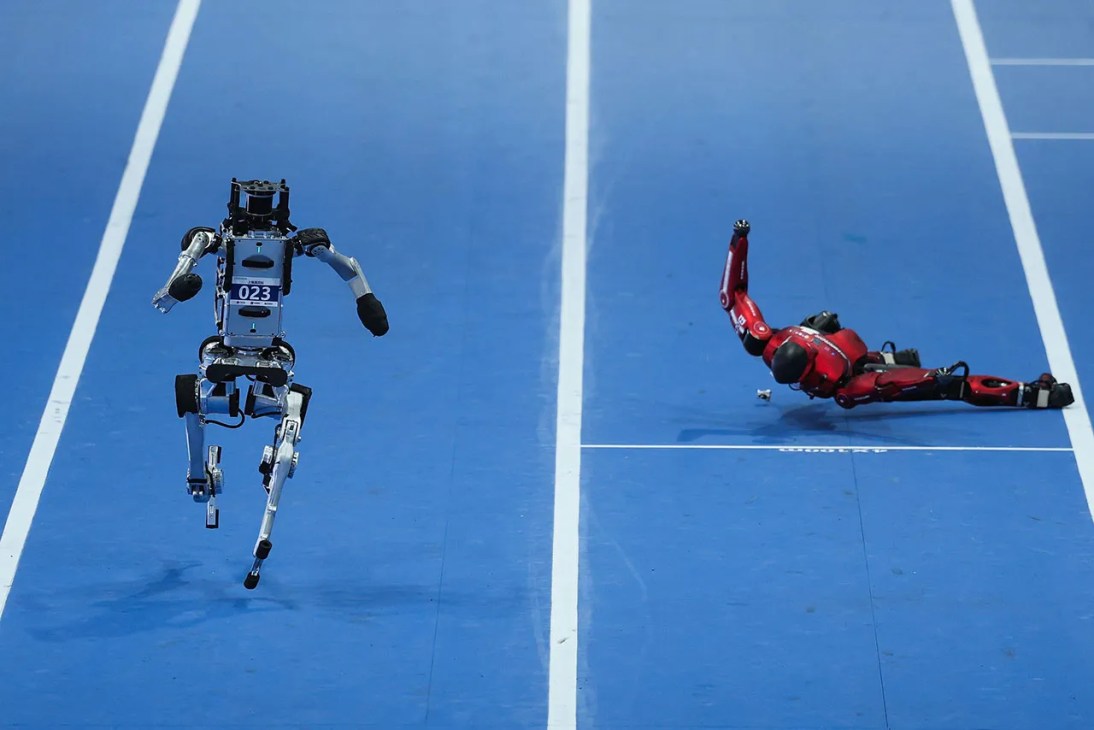
While China’s technological and military prowess is altogether more complicated than this charade, we can take some solace from this event. Just as AI can’t replace the art of a Studio Ghibli film, nor write journalism worth reading, humanoid robots can’t better the spectacle of athletes. We will not be watching droids joust, fence or shoot hoops any time soon. That’s a relief.
Creating humanoid forms capable of sprinting into a heap or even pouring a cup of coffee feels a lot like a big waste of time. We invented machines long ago that are quicker than us over roads, seas and assembly lines. Drones have already begun to offer devastating defence capabilities. Coffee machines are in every home and office. (Indeed, at Dubai’s Museum of the Future, an automated mechanical arm called Café X once made me a coffee in twice the amount of time it would have taken a machine in any hospital waiting room.) China’s robotic and technological capacity will define much of the next century but it needn’t take human form. Morgan Stanley bets that, by 2030, China will produce 450,000 humanoids a year. Whichever Silicon Valley start-up inevitably decides to invest in these dumb droids over human interns or baristas deserves the liquidation that’s surely headed its way.