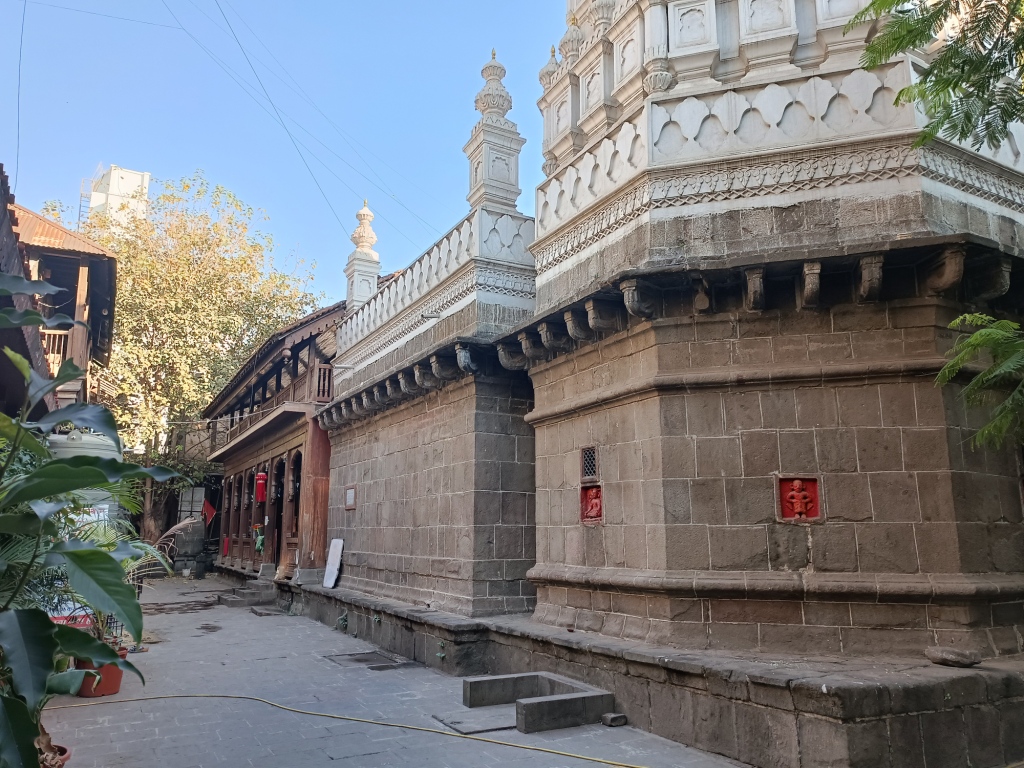
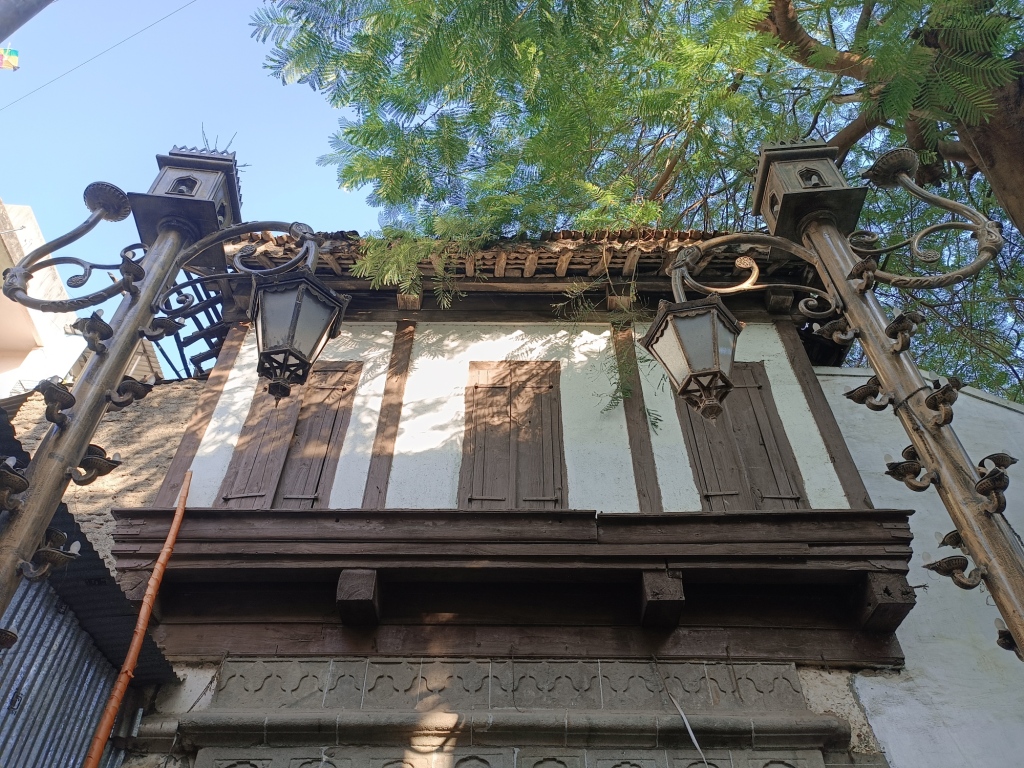
The old areas of Pune are called Peths. A Peth is a neighbourhood or a ward. The old city has been divided into a number of such wards. These areas have been in existence since several centuries. Narrow lanes, houses with timber overhangs, stone mansions, mysterious alleys, curiously shaped streetlamps, random crumbling walls…
In the midst of all this, the temples of old Pune have historically served as community gathering centres for people of all ages to come together and socialise. Many of these temples are Shivkalin (built during the time of Chhatrapati Shivaji Maharaj) or Peshwekalin (built during the time of the Peshwas). In this post, I will be discussing some of the most commonly seen traditional features of Pune’s heritage temples I have come across during my explorations of the city.
Most of these temples have a vintage old fashioned stone gateway or a gatehouse to enter the premises. The gatehouse has a room above it and one can see traditional arched windows built in it. The door is always ancient and wooden, with shiny metal bolts and latches. Often, there are statues of Dwarapalakas (guardian deities of temple entrances in Hindu culture) on either side of the door.
Once you step through these doors, you enter a time machine. The hustle and bustle of the street falls behind and you enter a different world. A slower world. A calmer world. There is generally a tiled courtyard open to the sky. The old temples are always set in a nice, peaceful courtyard. There is also a Tulsi Vrindavan near the temple entrance. A Tulsi Vrindavan is a stone or marble pedestal housing the Tulsi plant (Holy Basil, Ocimum tenuiflorum) which is considered to be sacred in Hindu culture.
The temples are generally constructed out of both stone and wood. Particularly in the old temples in these old areas, since there is a lot of history involved, one can find a lot of paintings and historical information on the walls. Many temples also have intricately designed glass lamps hanging from the ceiling.
Back into the courtyard, you will always find birds chirping around, squirrels nibbling at nuts or a cat snoozing in a corner. It is their home. The courtyard also generally has other smaller shrines dedicated to other deities, apart from the main deity of the temple. There can be a huge tree in the courtyard as well, one big enough to provide shade to the entire place.
Such courtyards also have mysterious locked doors and closed windows. These generally lead to other houses in the area. A couple of times, I have seen beautiful stone statues lined along the corridor. Upon asking the locals, I found out their history.
The locals are really kind and when you ask questions with a curious smile on your face, they are only too happy to share their knowledge. They have probably lived in that area all their lives and are privy to information not available elsewhere. People rarely stop to ask questions and when they do, the locals are delighted to share what they know.
The kind of interesting facts and anecdotes they tell you will fill you up with a sense of wonder about the history of these places. There is so much that has happened in the past. We only know a small portion of it so it a delight to explore these places.
There are many such temples in Old Pune, out of which I have visited a few. There is Tulshibaug Ram Temple in the Tulshibaug area whose spire was once upon a time the tallest structure in the city. There is Nageshwar Shiva Temple which is said to be around 700 years old. There is Belbaug Vishnu Temple which has a Portuguese bell and an interesting story behind it. There is Trishund Ganpati Temple which has an idol of Lord Ganesh with three trunks. There is Lakshmi Narasinha Temple in Sadashiv Peth with a nice courtyard. There are many more temples I am yet to explore. Most of them have some fascinating historical fact or anecdote associated with them.