Visiting Cairo for Ancient Egypt’s wonders used to mean traveller’s whiplash — wonder one moment, frustration the next.
Egypt’s awe-inspiring past would constantly collide with the harsh reality of stuffy, antiquated museums and a deplorable situation at Giza, where you’d have to run the gauntlet of incessant touts and scammers — barely able to take in the pyramids before someone was hawking you a camel ride. Or at least, so it has always been described to me by travellers who went before me.
Well, I’m happy to report that a lot has changed.
Based on my recent visit in 2026, I would say that Cairo now delivers on Ancient Egypt in a way it never used to. The Grand Egyptian Museum, finally open after a decade-plus wait, is spectacular. The Giza site has also been redesigned into a pleasant, mostly stress-free visit.
Nevertheless, there are still some important things to know to properly plan your visits. Giza in particular can be approached in several different ways (both figuratively and literally), and ticketing for both sites can be a little confusing. So, let me share here some essential tips to ensure your Giza and GEM visits go smoothly.


For the Grand Egyptian Museum, there are no walk-ins. You MUST pre-book for a designated timeslot. For Giza, pre-booking gives you the flexibility to use either entrance.
The Giza situation in 2026
As I mentioned in my Cairo travel guide, in late 2025 Giza was reopened with a whole new setup. Annoying sellers were pushed into one specific area, camel rides got standardized, and you can now hop around using a free shuttle bus — among many other improvements.
Here’s the lowdown on how everything works at Giza today.
New vs old entrance
The first thing you need to decide is where to enter the renowned archeological site. A new modern entrance was constructed on the west side, but the old gate in the east remains in operation as well.
New entrance: it’s located here and it’s the only place where you can buy tickets in person. It opens at 7am.
Old entrance: If you bought your tickets online, you can also still use the old entrance here. It’s no longer marked on Google Maps, but it’s definitely still there! You can find it opposite of KFC. The gates open a little later, at 7.30am.
So… which gate to use?
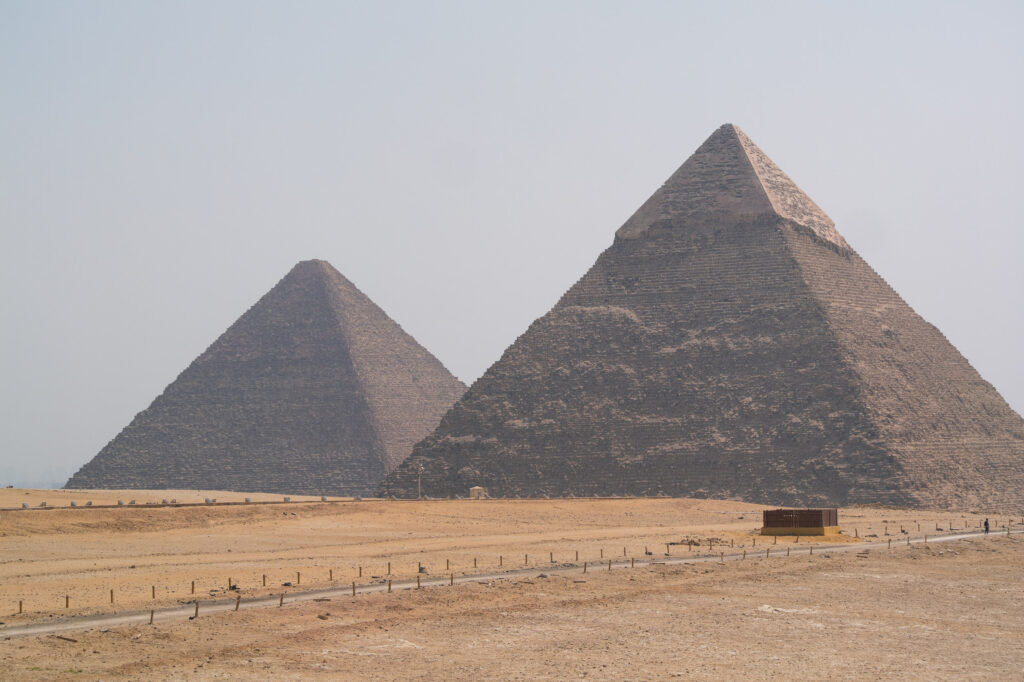
Well, the new one works a bit better story-wise: you first approach the pyramids from a distance, getting the overview before the close-up, with Khufu (the largest pyramid) likely being your last stop.
The old entrance is right in front of the Sphinx and Pyramid of Khufu, letting you beeline straight to it. It’s less of a dramatic build-up, but it can be useful if you’re trying to beat the crowds.


Best time to visit
Regardless of which entrance you use, it’s highly worth going early!
If you’re travelling independently (i.e. not with a group tour), then this gives you a unique chance to see the pyramids in a more immersive way. Most tours arrive later in the morning or afternoon, but if you’re there right at opening hour, you can still feel like you have the site almost to yourself.
I entered through the old gate at 7.30am and for the first hour or so, I felt like I was there with maybe just a dozen other visitors. I often didn’t see a single soul in frame. Only around 10am-10.30am or so, a few crowds started to form. (While the site overall is huge, specific spots like the paths around the Sphinx and the inner tunnels of Khufu are space-constrained and do get crowded.)

Now, I should say I visited in May, which is the low season in Egypt. Most Ancient Egypt-focused trips go in winter, when temperatures are a lot more pleasant. During this busy season, I’d focus even more on planning an early morning visit.
If you want to go inside the Khufu Pyramid, I recommend making it one of your first stops. The narrow tunnels get a lot more stressful and claustrophobic when it’s full of visitors later in the day.
Speaking of…
Tickets
The Giza entry tickets include several optional add-ons. Whether they’re worth adding depends.
Khufu interior access: If you want to go inside Khufu it’s a bit pricey at Approximate — rates updated daily. There’s nothing really inside the tomb chamber, but it can be worth it just for the bucket list factor of having been inside the Great Pyramid. I wasn’t on a strict budget, so I went for it and didn’t regret it.

Just know it’s very hot, confined, and definitely not for anyone with mobility issues. When traversing through the initial tunnel, your back will surely be touching the ceiling as you slowly climb a wooden ladder. The grand gallery offers more space, but it’s still single-file. Inside the burial chamber you’ll see only plain limestone walls, so you’ll need to use your imagination. A collection of AC units is meant to keep the air cool here, but it can still feel like a sauna.
On a budget? Alternatively, you can go inside the Menkaure Pyramid for a fee of just Approximate — rates updated daily. However, the longest and most adventurous tunnels are actually in the Red Pyramid and Bent Pyramid in Saqqara, which are included in the general admission if you go there. (You can check out my Cairo travel guide for my take on whether these alternative pyramids, located further south of Cairo, are worth it.)

The Mars Ankh Tomb add-on: this will give you access to a mastaba outside the Great Pyramid that’s decorated inside. The Tomb of Meresankh III is considered only worth it if you’re not going to Luxor or Aswan– otherwise, you’ll see much more hieroglyphs and relief carvings there. I still checked out the Tomb of Meresankh and it was pretty cool, though it’s small and will benefit from having a guide who can actually explain a bit about what you’re seeing.
Cafes & restaurants by the pyramids
There are several restaurants on the premises at Giza. The options for cafes and shops were also expanded a lot with the site redesign in 2026.
There are now many air-conditioned shops and restaurants on site. Most are not yet marked on Google Maps, but they’re there. I was pleased to find the markup on the prices wasn’t so bad. I bought a bottle of water which was normally priced for a tourist site. At the cafe at the panoramic viewpoint, you can get an espresso for Approximate — rates updated daily or a flat white for Approximate — rates updated daily. There’s even V60 drips for the single-origin coffee aficionados, which you can enjoy with a view of the pyramids.
As far as restaurants, the classic luxury dining option is Khufu’s Restaurant, which has a viewing deck looking out to the pyramids. There are a few casual places with sandwiches and such on-site, but not many. Restaurants outside the old gate are maybe a better bet, having rooftop views and usually lower prices. I ate at Pyramids Cave Lounge which was really nice.

Do you need a guide?
One piece of advice I kept reading online is that you absolutely MUST have a guide at Giza. Not even for the added context, but just to have someone help you swat away all the unwanted approaches from sellers and touts. This advice is now outdated.
Whether you should get a guide is now all up to how you want to explore. If you think it will be an added benefit in terms of information, you can certainly get a private guide. All guides have to be officially registered and must have studied Egyptology, though not all of them will be gifted narrators — I would advise pre-booking one with star-ratings so you get a good one. I looked around the booking platforms, and found one that gets great reviews.
Get a Top-rated guide for Giza
Personally, having consumed a lot of information on the pyramids over the years, I opted to explore the site on my own. Using the free shuttle bus system, you can easily hop around the site, so transportation is also not really a main reason to have a guide.
The key things to hit up are the three pyramids, the Sphinx, and the panoramic viewpoint. The two places that can get very crowded in high season are the Sphinx (the entranceway is very tight and it’s a small site altogether) as well as the tunnel to the tomb of Khufu (also very little space), so you may want to be strategic around your timing for visiting those spots in particular.
Camel rides
A classic thing to do at Giza is to ride a camel to the pyramids. It’s a bit of a famous photo-op, though purely in terms of transportation or convenience, it’s no longer a necessity as there is free bus transport available.
If you want to ride a camel, I would say the ideal way is to approach the site from the new entrance gate to the west. You’ll slowly make your way to the panoramic viewpoint for that scenic reveal.
I read some efforts were made to improve animal welfare, such as mandatory checks with a vet. Some sources still question the animal treatment though, so use your best judgment. The rates are now standardized and the camel riders are supposed to no longer harass potential customers.

Camera & filming rules
Not all potential annoyances are gone at Giza, and the filming rules could still be one point of frustration, especially if you’re unaware.
At Giza — and other sites managed by the ministry of antiquities — it’s a rule that you can’t do any professional videography without a permit. So, if your photography or videography gear looks like it might be used for a professional shoot, you may get questioned at the entrance.
Maybe I was just lucky, but I still managed to take inside a micro-four-thirds SLR camera with 3 lenses as well as a DJI action camera. Only my microphone was not permitted inside, so I had to leave it at the entrance to pick up again later. (They know that high-quality audio is a must for commercial shoots, so a mic is often where the cutoff point is.)

If you’re just going to Giza with your phone, a small SLR, or an action camera, I doubt you’ll face issues. But if you’re a vlogger with a serious camera system, you may not be allowed to take it inside.
Note that drones are illegal in Egypt – don’t pack one for your trip or it will be confiscated at the border.
Prohibited items
Finally, I should mention certain other items may also not be allowed at Giza.
For instance, friends of mine went as a family and had to leave some plastic toys and a card game at the entrance (to pick up again afterwards). They were deemed ‘not respectful’ to use at the site.
Dealing with salesmen
Although I experienced none of the stress that travellers would report in years past, I should mention there still are some annoying salesmen at Giza.
They’ve just been corralled into specific areas, mainly focused around the Sphinx, where some rows of market stalls are set up. I overheard one seller here trying to sell someone a trinket for a truly ridiculous price — yes, these guys will try to scam unwitting tourists.
I would simply advise against buying any souvenirs at Giza to save you any potential headaches. If you really want to buy souvenirs, there will be shops in Cairo with better prices and a better selection.
The Grand Egyptian Museum
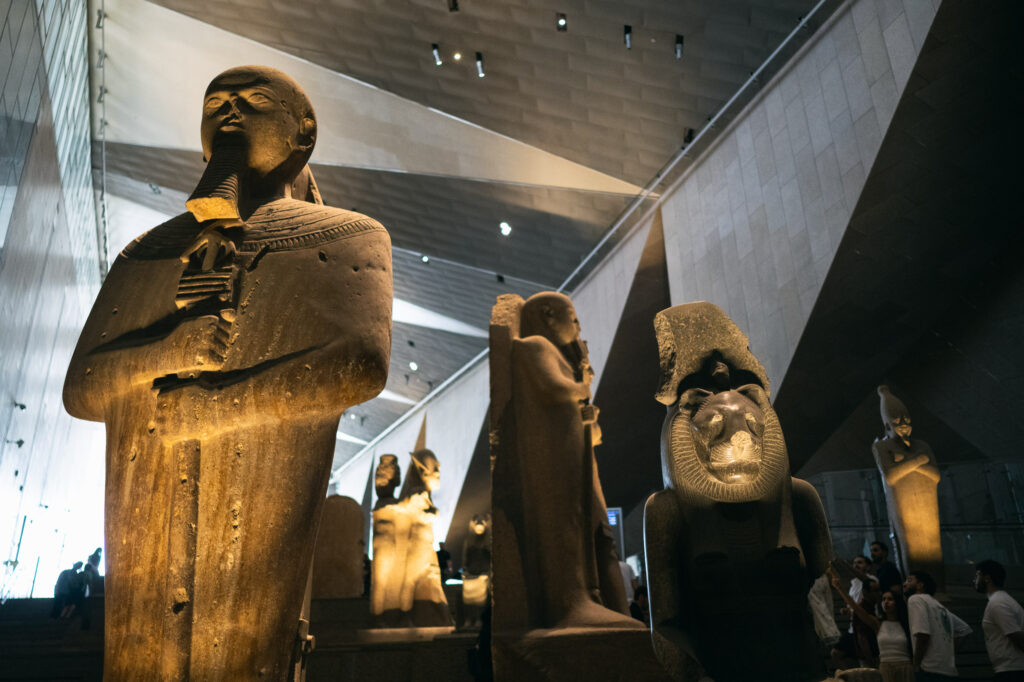
The new GEM has been more than a decade in the making. Finally opened, it’s exactly the world-class museum you would hope for considering the depths of the world’s fascination with Ancient Egypt.
While Cairo long had to make due with a much smaller, aging museum, it now has a modern and immersive museum experience truly befitting the subject matter.

I loved exploring highly the 12 main galleries of the GEM, which start at the top and let you slowly work your way down.
Each gallery is not only in chronological order — moving through the dynasties from Old Kingdom to the Thirtieth Dynasty — but each sumultaniously delves deeper into a particular sub-topic (organized around the themes of society, kingship, and beliefs). This clever curation, as well as the excellent mix of artifacts and information panels, make this the best overview of Ancient Egypt you could wish for.
The ultimate star of the show is the complete, unified collection of King Tutankhamun. While various pieces recovered from Tutankhamun’s tomb have been on display before, they were never before brought together the way it is in this one spectacular gallery. It’s filled with golden thrones, gilded chariots, and of course King Tut’s iconic golden mask. (It’s kind of the ‘Mona Lisa’ of this museum; you queue for it seperately and get a brief moment to observe it up-close.)
There are fewer tips and tricks for the controlled museum experience of the GEM than for the open-air Giza plateau, but there are still a few important things to know.


Above: highlights from the Tutankhamun collection
Tickets MUST be prebooked
Unlike Giza, you have to get tickets in advance, which are available from the official ticketing website. You can’t just walk up and get a ticket at the entrance!
You can also book tickets through third-party websites, which may be easier especially if you already have an account there. Get tickets here through GetYourGuide, get it at Viator included with a private tour, or get your ticket through Klook.
The other twist is that you have to select a timeslot, usually a window of around 2 hours. This is just for your entry into the museum — once you’re in, you can stay as long as you want (until closing hour). So while there’s no time limit once you’re in, you have to get through the gates within the timeslot on your ticket, or your ticket becomes invalid.
Getting to the GEM
The Grand Egyptian Museum is not in the same place as the Pyramids. It’s pretty close though; they’re separated by only a 15 minute taxi ride. Inside the GEM is a window that looks out directly onto the Pyramids, visible in the distance.
There is not yet a metro connection from Cairo to Giza and/or the GEM. A taxi is the most practical way to travel between them. Don’t miss my taxi and Uber tips in my Egypt travel tips article so you don’t get scammed. If you’re doing an organized tour of both locations, that will take care of transport for you.

Camera & filming rules
As with Giza, there are certain limitations for video- and photography. Only non-commercial videos/photos are allowed, unless you have the official permits.
I was not able to take my camera microphone inside, nor two small tripods that I had packed for the day. No tripods or monopods (i.e. selfie sticks) are allowed, nor is other professional gear such as external lighting.
Fortunately, there are free lockers just to the side of the main gates where you can leave them securely until you’ve concluded your visit.
I was still able to take non-flash photography and even some B-roll video once inside the building. Live-streaming (and presumably also conspicuous/extended A-roll) is not allowed.
Timing & time needed
It personally took me 5 hours to work through the main galleries plus the King Tutankhamun collection, taking it more or less slowly. A dedicated Egyptology enthusiast could probably do it in 7 hours, and someone only interested in the visuals and less so in the plaques could probably speedrun it in about 3.5 hours. It all depends on how engaged you are with what’s on display.
There are cafes and restaurants on-site, so you can always take a break and resume. In fact, about half the building’s floor space is dedicated to retail (to the side of the entrance hall), so you won’t go hungry and there are many possibilities to shop for souvenirs.

Don’t miss the ‘bonus content’: Khufu’s Boats Museum. It’s in its own dedicated annex, home of two ancient solar boats of Pharaoh Khufu dating back over 4,500 years. With a staircase winding around the boats at several levels, it will give you a great appreciation for the sheer shipbuilding prowess of ancient Egypt. It takes about 20-30 minutes at most.
Since the museum is climate-controlled, it can be a good place to hide from Cairo’s midday heat. A morning visit could make sense to, and would likely be a little quieter, but an afternoon visit lets you get out of the searing sun for a while, especially when visiting outside of winter.
Giza and GEM: how to combine them?
With the Pyramids and the GEM being so close to each other (about ~2km apart), it seems to make logical sense to tackle them on the same day.
Just one word of warning: it may be a very tiring day.
I roamed around Giza for about 5 hours, taking the occasional shuttle hop but otherwise unaided by tour transport or camels. It also included the tunnels inside Khufu, which are a pretty demanding climb. After lunch, I took a taxi and dove right into the GEM, where I spent another 5 hours.


Needless to say, nearly 10 hours of walking on a single day is a lot. During the last couple of hours in the GEM, my feet were absolutely killing me. I was very strategically using every bench in the museum to minimize my time standing. While I managed to squeeze through in the end, it was pushing it.
I had a long travel day the next day where I mostly just sat in a car, so that meant I could recover a little. But if it had been a sightseeing day, I would have probably paid a high price for my Giza+GEM combo in terms of my energy levels and not gotten much done on the second day.
If possible, I would put them on separate days. Tackle Giza in the morning to beat the crowds, then have a relaxing afternoon, then tackle GEM the following day.
Where to stay
Finally, a word on where to base yourself in Cairo. While it may seem logical to book a hotel in the Giza area, I should say this area is overall not very appealing, hemmed in by highways and often having dirty streets. It may seem like the area nearest to the pyramids would be the most prestiguous, but it really isn’t.
If you’re here for a quick stay and you’ll just rest inside your hotel, then that doesn’t have to be too much of an issue. But if you’re also here to enjoy other aspects of Cairo, I would personally stay in the more appealing historic center.
For my detailed accommodation tips, plus how to get the best of the rest of Cairo, be sure to check out my overarching Cairo travel guide.