It was only my second week in Vienna when a resident took me to swim in the Danube. It was an experience that moved me – quite literally. After relocating to the Austrian capital, I fell in love with early morning swims at Badeareal an der Promenade der Unteren Alten Donau. Emerging from a brisk 20-minute trip to Donaustadtbrücke station, you navigate along paths dotted with cottages, reeds and a series of wooden piers overlooking a tranquil part of the canal. It attracts ardent, older swimmers (plus one impressively strong, grey-haired man who paddleboards). The piers are filled with students working on their tan lines and flirting in groups. In Vienna, there is a swimming spot for everyone, no matter your plunging particularities.
Walking towards the Alte Donau station, it becomes a little more crowded, with groups taking over park spots and stone steps. Those looking for something livelier bring speakers and rent small platform boats – that often have palm-tree-shaped umbrellas for shade – or take out a trusty pedalo. Most tend to bring cherries and a cool box but if you forget you can always don something presentable and book a waterside table at Das Bootshaus for a Hugo spritz and calamari. The restaurant is run by the Querfeld family group, which owns Café Landtmann and the Loos-designed Café Museum in the city’s first district – the family’s sons are competitive rowers who trained at the club next door.
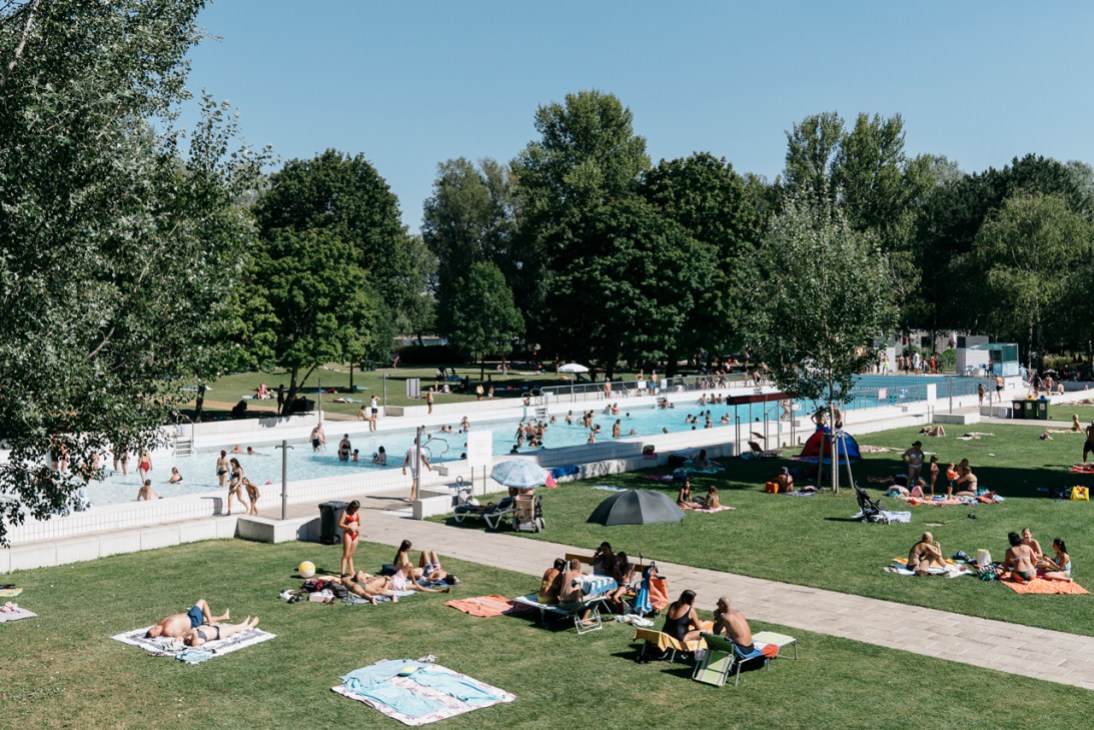
But it’s Strandbad Gänsehäufel – known as “the lido on Goose Island” – for which the masses have fallen. It’s a classic, modernist swimming option that attracts families and older clientele for a small fee. Revamped by architects Max Fellerer, Carl Appel and Eugen Wörle in the late 1940s, it’s a multi-generational space with volleyball, a climbing park, schnitzel sandwiches and 2km of manicured beach. Though the water here is not without issues – its algae and underwater foliage needs to be cut back at bimonthly intervals. However, the city is vigilant about keeping the water clean and well-trimmed.
If you like things a little more bourgeois, head to Bundesbad Alte Donau, where the water flows a little faster and feels even fresher. “It is my all-time favourite spot,” says Monica Titton, who teaches fashion history and theory at the University of Applied Arts Vienna. “It used to be a military swimming school; today it is listed and owned by the Republic of Austria, so it is kept in absolutely spotless condition. The architecture folds beautifully into the landscape, with a lovely restaurant with white wire chairs, a little terrace and plenty of places to relax.”
For the wild and rebellious, Donauinsel is the pick. Don’t expect beds here, just dive in and wade through the reeds. The manmade island, originally built in the 1980s to prevent flooding, is also the place for which you’re likely to receive late-night party invites – many take place among the 1.8 million trees planted here.
The early risers working near the UN at the Vienna International Centre dive in at Kaiserwasser for a swim between meetings. Meanwhile, nudists head to the upper section of Neue Donau, near Floridsdorf, for some privacy. Many residents also jump on a train to Bad Vöslau – a Wes Anderson-style thermal spa that has been attracting people since the 1820s. Alternatively, they head to the Schönbrunner Bad pool above the imperial castle for a regal bathe that’s best enjoyed before noon, with sunbathers on the lawn drinking coffee where Emperor Franz Joseph kept his paddling pool.
Despite the city’s bounty, some residents are campaigning to increase swimming in the heart of the city. The Swimmable Cities platform aims to use urban waterways to build climate-resilient cities. “Cities should think about wastewater and flood management systems as something multiuse that could bring more vitality to a place,” says Ana Mumladze Detering, co-founder of Schwimmverein Donaukanal (Swimming Association of the Danube Canal). The group’s aim is to make swimming part of everyday life. “Vienna is really good at managing its waterways but more people need to cool down. Eventually, other cities will have to follow suit.”
Francesca Gavin is a Vienna-based journalist and regular Monocle contributor.For more opinion, analysis and insight, subscribe to Monocle today.
Further reading:
Vienna’s most naked secret lives on the Danube
Monocle’s complete city guide to Vienna