The first reaction when you see La Paz is just bemusement. By all rights, a city just should not exist in such an extreme location.
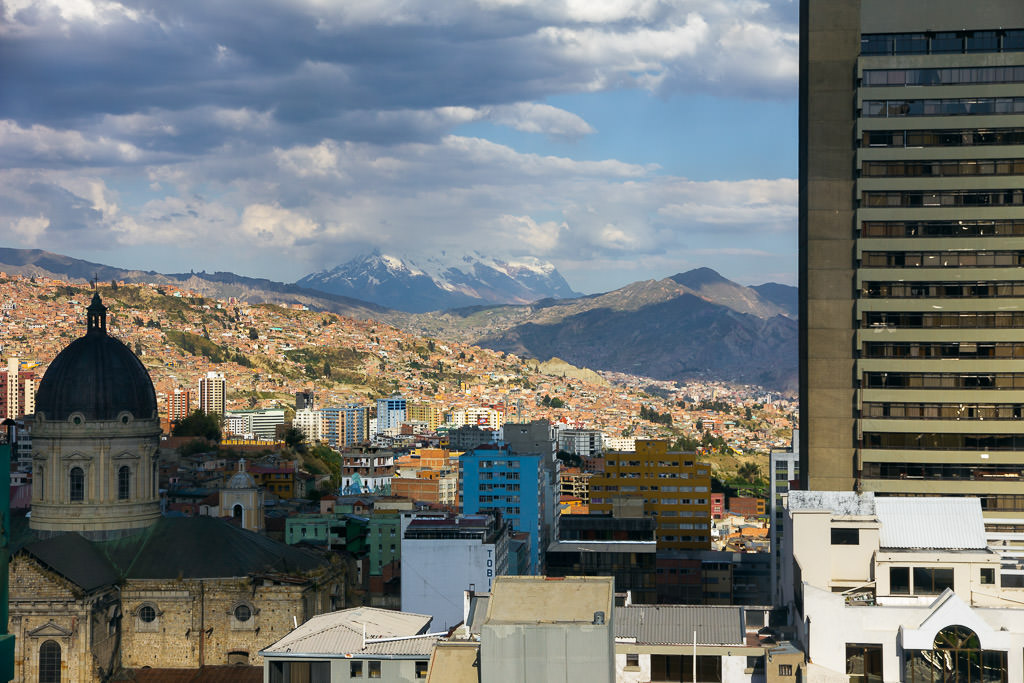
La Paz sits in a bowl at 3,900m of altitude, with its sister city, El Alto perched above, while the glacial fangs of sacred Mount Illimani shimmer on the horizon. It can be chaotic and uncomfortable with the cold and altitude, but it is one of the most interesting cities in the Americas with everything from love potions, indigenous women wrestling and a moon valley gilding its streets.


Dealing with altitude
There are no two ways about it: La Paz is very high up, and unless you are already acclimatised to the altitude from time on the Altiplano, you will feel its effects. Walking up hills will be difficult for a few days, and you could feel the dizziness and nausea that come from what the locals call soroche.
Take it slow for the first few days by meandering through the city’s museums before taking on any substantial exercise.
Fortunately, the indigenous Aymara are no stranger to high altitude and have tried and tested remedies. The foremost is coca, the infamous plant that gives us cocaine. It is traditionally chewed, and then kept in a ball in the cheek, but is also commonly taken as a tea. La Paz also has a fascinating range of soft drinks infused with coca.
La Paz’s setting already seems crazy, but when you factor in the biting cold and the altitude, it seems utter lunacy that Spanish colonists would choose this desolate but beautiful spot to build a city. It often drops below zero degrees Celsius at night and it suffers from poor air quality, leaving you fighting for breath in multiple ways.
This does not mean that you should not visit La Paz — the guide would end here if that were the case! — I just want readers to be prepared for what awaits them outside of the bus.

Security situation
Funnily enough for a city whose name literally translates to ‘The Peace’, La Paz has been in the eye of some political storms in recent years such as an attempted coup in 2024 and a blockade of the city early in 2026.
While eye-catching, these have not presented a huge threat to tourists, just the annoyance of disrupted travel. Keep an eye on such developments to ensure that you do not miss an important connecting flight or bus.
More broadly, the same rules of staying safe and preserving your belongings in a big city apply. If you keep an eye on your stuff and do not do silly things like walking around alone and drunk, you will be just fine here.
Getting to La Paz
Flying in: La Paz is reachable via international flights from other South American countries, but you will need a transfer for intercontinental flights.
Coming overland from Peru: From Cusco, Puno or Arequipa, you’ll cross the border at Lake Titicaca. Pick a bus that goes via Copacabana rather than Desaguadero: it takes about the same time, and you get lake views and a short ferry crossing at the Strait of Tiquina.
See schedules and costs:
- From Cusco to La Paz (about 15 hours)
- From Puno to La Paz (about 7 hours)
- From Arequipa to La Paz (about 14 hours)
Coming from elsewhere in Bolivia: Most people take an overnight bus here, and it saves you a night’s accommodation too. From Uyuni you could also fly, which takes about an hour, but you’ll pay a lot more for it.
See schedules and costs:
- From Uyuni to La Paz (about 9 hours)
- From Potosi to La Paz (about 9 hours)
- From Sucre to La Paz (about 11 hours)
Things to do in the city
1. Witches Market
This is more of a familiar shopping street than the riotous stereotypical South American market, but it is hard to picture stranger contents. What look like soft toys hanging from the awnings of each shop is, upon closer inspection, dried llama foetus.
In Andean folk belief, these are supposed to bring good luck when buried in the foundations of houses. My local friend Sdenka said, with a black smile, that occasionally homeless people in La Paz meet the same fate.


Within the shops, there are remedies for anything from hair loss to heartbreak, as well as love potions! One sip of these liquids from your beloved is supposed to win you undying devotion forever.
They also contain a range of indigenous textiles, replica figurines from the Tiwanaku civilisation and native instruments. You can also buy the coveted fake Patagonia fleeces that are pretty much the uniform of South American travellers from here too.
While it is unlikely that many will walk out with a llama foetus, the market gives you a sense of the strange that lies beneath much of what is familiar about La Paz.

2. Mirador Killi Killi
This was my personal favourite view of La Paz, and visiting on my first day created a sense of wonder that never quite went away. I climbed up at sunset, groggy from my 20 hour bus ride from Santa Cruz and leaden with altitude sickness, but all of my bodily complaints went away when I gazed at the sprawling city tapering up to the jagged fangs of Illimani.
No matter how tall cities such as Dubai get, they will never match La Paz’s natural skyline. The glaciers glowed magenta in the sunset while I sipped a $0.30 beer provided by a street vendor, just the perfect introduction to La Paz.

To see these spots in one go, join this free walking tour with Leo, who adds a storyline and a bit of fun to the experience. The tour also covers El Alto (coming up next in this guide), cable car rides, and more.

3. Ethnography Museum
This is a brilliant option for one of your first days in La Paz when you are getting to grips with the altitude. The cultural diversity of Bolivia is pretty bewildering to visitors – it has the highest proportion of indigenous ancestry people in the world.
This is not a uniform group, as different societies developed in every environment from mountain to jungle. Bolivia can often seem to exist more on a map than in reality, a fact reflected in its official name – the Plurinacional state.
This brilliant museum, set in a beautiful building just off the Plaza Murillo seeks to tell the story of Bolivia’s tapestry of people from artefacts like masks and textiles.
The sterility of mountain environments means that a surprising amount of material survived. Seeing the everyday dress of vanished civilisations like the Inca and the Wari gives a unique insight into these alien worlds.
They also showcase the colourful outfits used during famous carnivals like Oruro, and tell the stories that gave rise to spectacles like hundreds of devils dancing in town squares. This will give a deeper understanding of what may seem bizarre on your trip around Bolivia.
The models of potatoes and corn were also fascinating. Both originate in the Andes, and what we take for granted is the result of a long process of deliberate selection to create the staples that we enjoy today.
Bolivia claims to be the home of the potato, though Chile and Peru would disagree! It has 600 different types of spuds, and the models show the full spectrum of varieties.
Entry is Approximate — rates updated daily.
4. San Francisco Basilica
A church has stood on this site since the first Europeans laid the foundations of the city, and while the current structure dates from 1748 after the original was destroyed by heavy snow, it feels like the heart of La Paz.
Every time political turmoil afflicts the city, crowds descend upon this church. In the cloisters, you will notice the stained-glass windows riddled with bullet holes, a remnant of the 1952 revolution.
Many churches suffer from looking so similar, but San Francisco is truly just one of a few.


While having the facade of a Baroque Spanish church, its indigenous builders wove native faces and symbols into the religion of their conquerors. This act of resistance also gives a beautiful insight into experiencing Bolivia – the timeless Andean universe is entwined with familiar European aspects. Particularly interesting are faces on the outside to represent the Inca, Tiwanaku and Aymara people.
The inside of the church is free to enter, and services get absolutely packed. For 20B ($1.63) you can get a ticket to visit the belltower for sweeping views of La Paz, an attached monastery and a tranquil garden of fruit trees,
5. Ride El Teleférico (a city-wide cable car network)
La Paz’s crazy setting means that instead of an underground metro, they put it in the air! The cabs give you hours of 360-degree views of the city for a few dollars. The vistas down onto the city are astounding. Furrows of apartment buildings are punctuated by tender vignettes of Pacena life, like football games being played oblivious to their hanging spectators.
However, the star of the show is undoubtedly the natural setting. From the cable cars, you can see all three of the peaks that surround La Paz – Illimani, Huayna Potosí, and Mururata – as well as the bowl that the city is set within.

I would recommend visiting at sunset, which never disappoints from this height, and has the added benefit of seeing La Paz’s urban chaos turn into pinpricks of light as night falls. The lines with the most striking views are the Yellow and Red lines that link La Paz and El Alto. These are accessible from the central Prado station, which is close to the majority of hostels. The purple line has the steepest descents for thrill seekers.
You can pay for a single ticket ($0.25) or buy a physical card which can be topped up.
6. Cholita wrestling
I must admit that I was surprised by this. Initially, the thought of indigenous women with their layers of traditional skirts and pig tails wrestling each other seemed exploitative and a way of mocking the women.
In reality, these Aymara women are tough – a group called Cholitas Escaladores climb the surrounding 6000m mountains in their native dress, and likewise, the cholita wrestlers love the physical challenge. They also have legions of loyal local fans and often outearn their male counterparts.


The experience begins before the first blows are traded; the fighters have ring walks and pre-fight dances. If you sit in the front row, the wrestlers may invite you onstage to join in! Once the bell tolls, they unleash everything from hair-pulling, slaps and rugby tackles to defeat their opponents while a commentator provides an ecstatic soundtrack.
The day with the biggest bouts is Thursday, which ties in with the famous 16 de Julio Market, but matches are also held on Tuesday and Sunday.
7. El Alto
As if building a city at 3900m of altitude wasn’t mad enough, there is another city, perched on cliffs at 4000m, in the mix too. Unlike most other cities, where the rich live on the hills and the poor are below, La Paz reverses the dynamic, with what was once an entire shanty town looking down on La Paz.
El Alto has moved on since it was solely a shanty town made up of rural Bolivians seeking a better life in the city, but it is more ramshackle than La Paz. The two cities are fierce rivals and have much mutual suspicion. When I visited in 2025, one Pacena woman I met said that she still wore a face mask on public transport in case people from El Alto were there!
The most striking feature of El Alto’s buildings is a style known as Cholets. People who have struck it rich from El Alto have been competing with one another to build the most ostentatious, whimsical buildings possible. On my walking tour of El Alto, I saw to-scale replicas of the Titasnic, Wayne Manor and the Statue of Liberty. How different cultures decide to show wealth is fascinating.


On Thursdays and Sundays, El Alto plays host to one of the continent’s largest markets, Mercado 16 de Julio, which sprawls across 400 blocks.
While I did not find much to buy, the spectacle of everything from car engines to purple potatoes on sale was striking. Visiting the market also ties in with the dates for Cholita wrestling.
Take the Teleférico up to 16 Julio station. Catch the beautiful Chualluma murals of Aymara symbols and animals on the way.
8. Museo de Metales Preciosos
This brilliant little museum houses over 2000 pieces of glittering golden artefacts from Pre-Columbian cultures like the Incas, Aymara and Tiwanaku. Very few golden items survived the Spanish furnaces, so visitors should always take advantage of their chances to see them!
This is located on Calle Jaen, just 10 minutes walk from the Plaza Murillo.
9. Coca Museum
When South America is mentioned, many people’s minds jump straight to scenes from Narcos. While the drug trade has caused much suffering, the actual plant that gives us cocaine has a more complicated story than newspapers often tell.
With a pretty clear angle to change people’s perceptions of coca, the museum narrates its story through indigenous eyes.


For thousands of years before the USA even became a country, South Americans chewed coca as a stimulant and for religious practices.
The museum showcases interesting points like how during colonial times, the Spanish encouraged coca production to sustain the workers forced into mines and that in 19th century Europe, it became popular to drink wine infused with coca.
The museum ends with a cafe where you can try various coca products like the classic leaves, tea, toffees or coca fizzy drinks. They make you feel as if you have drunk an espresso but also a bit silly! Entry costs Approximate — rates updated daily.
10. Museo del Littoral Boliviano
Bolivia has not always been a landlocked country. Its coastline was taken by Chile in the War of the Pacific in 1879, and it is fair to say that Bolivia has never forgotten! It is an extremely touchy subject and has become a national pathology, with a countrywide day of mourning on March 23.
The Museo de Littoral Boliviano, meaning the museum of the Bolivian Coast, preserves relics from the war like battle flags, cannons, uniforms and maps of Bolivia’s original size, which was further diminished by wars with Paraguay and Brazil.
While none of the artefacts gleamed like those in El Museo del Oro, the storytelling power of the items combined with life stories of Bolivian war heroes really gave a fascinating insight into this conflict that is so important to the Bolivian psyche.
As entry is just Approximate — rates updated daily, you cannot go wrong. It is just 10 minutes from Plaza Murillo and 5 minutes from the Ethnography Museum, making it an easy add-on to a cultural day in La Paz.
11. Crazy Dave and San Pedro Prison
In the heart of La Paz is the San Pedro Prison. Instead of seeking to punish or reform its inmates, prisoners in La Paz are simply dumped within its walls and left to fend for themselves. The result is a parallel society with families, elections, shops and prisoners paying rent for the cells. The prison became famous from the book Marching Powder, by Rusty Young, an essential read for La Paz visitors.
In its heyday, backpackers could go on tours inside the prison and even party with the inmates who had their own cocaine factory. Tours are still available, but I would warn against this as there is no guarantee for your safety within the prison.
The best alternative is a man infamous on the Bolivian travelling circuit, Crazy Dave. Dave is an American who served 14 years inside for drug trafficking. He lives under a bridge near the prison and makes his living regaling tourists with stories from his jail days. Walking tours will include him as a fixture and while his tales of drug-fuelled jacuzzi parties in prison stretch the imagination, he knows how to spin a good yarn.
12. Valle del Luna
Even if this maze of barren rock formations were set in wilderness, it would be a tourist attraction. That it is just half an hour from downtown La Paz is simply outstanding. It is not for nothing that it is named the Valley of the Moon, these twisted towers of bleached stalactites do not seem to be of this planet.
Popular lore says that when Neil Armstrong visited La Paz shortly after the moon landings, he was the first to call it the moon valley. He knows a thing or two about how that looks.


Another perk of Valle del Luna is that it is easy to visit independently. Simply walk to Plaza San Francisco and hail a collectivo going to Mallasa and ask the driver to drop you off at Valle del Luna.
The fare will be about 3Bs ($0.50). There is an entry fee of 15Bs ($1.25) and the path takes about 45 minutes of walking, but likely more including photos. To return, just hail a collectivo going back to San Francisco.
13. Plaza Murillo
Plaza Murillo is the real heart of La Paz.
This leafy, tranquil square is ringed by Bolivia’s presidential palace and Plurinational Assembly, one of the most important political forums in Bolivia’s confusing constitution. Most hostels and museums are close by, meaning that you will inevitably pass through here at some point.
I delighted in people-watching from a bench here; uniformed guards in Bolivarian uniforms holding muskets standing sentry, while Pacenas read newspapers and played chess. Confusingly for such a central location, it is an oasis of calm in the hubbub of La Paz.


Eating
I explored Mercado Rodriguez with a local Bolivian friend who showed me some of the city’s delicacies. I most enjoyed saltenas – a slightly juicier take on the classic empanada with a sweet pastry.


Anticuchos are very popular – hearts of either chicken or beef cooked with a spit. I mistook them for grilled peppers and I must admit that it was not for me. A classic fast food is salchipapa, a mass of fries and sliced sausage doused in ketchup. Simple but hearty.
To my surprise, I stumbled across a very good Indian restaurant, Curry House. Run by Indians, its naan bread and chicken tikka satisfied the cravings for my favourite food, which is difficult to find in the Andes.
I also became a regular at The Writers Coffee, a cafe cum vintage bookshop with a homely interior that only feels more cosy against the altitude and cold.
Excursions
1. Death Road
This was the single best excursion that I did in La Paz. Once the most dangerous road in the world, with hairpin bends above hundred-metre drops, it is a completely safe but thrilling cycle path.


Ride Bolivia’s infamous Death Road, descending from the Andes into lush valleys along winding cliffside roads. The full-day tour includes safety equipment, snacks, lunch and round-trip transport from La Paz.
Now traffic-free, it’s a thrilling but safe adventure experience with unbelievable views from beginning to end.
The route begins at 3900m with snow falling in the cold, and ends in steaming jungle at 1700m. You descend 2,200m on a mountain bike without even braking, passing through multiple different biomes. The bleached altiplano gives way to a temperate landscape, which falls away into cloud forest before ending in humid lowland jungle.
The plants and climate change every few hours, and the ride gives a sense of just how tall the Andes are. Rather than simply tall mountains, they are mountains toppled on top of mountains. Riding down their magnificent slopes is awe-inspiring; the road passes beneath waterfalls and alongside plunging, jungled canyons. Thankfully for you, you will get a lift back up!


2. Tiwanaku
Before the Inca Empire rose, a series of civilisations ruled various pockets of the Andes. Perhaps the most magnificent were the Tiwanaku. They ruled a swathe of territory across what is now Bolivia and Southern Peru, and their capital was located on the banks of Lake Titicaca, 1.5 hours from La Paz.
They built a ritual landscape of pyramids, sunken moats, arches and finely carved stone monoliths. Structures mirror the sacred peaks in the distance and evidence survived of astronomical observations. The standout feature is their skill at carving stone.

The great Puerta del Sol shows the image of the Andean creator god, Viracocha, which was replicated throughout the Andes. It is no surprise that the Incas claimed descent from this sophisticated civilisation. Bolivia’s first indigenous president, Evo Morales, likewise held his inauguration here as a show of national pride in these ruins.
The brilliant museum also houses artefacts found throughout the site and discusses themes like Tiwanaku astronomy and human sacrifice. Easily accessible via day trip from La Paz, I highly recommend this dive into a vanished world.
Expect to pay Approximate — rates updated daily for an all-day guided excursion. If possible, visit on the winter solstice to celebrate Aymara New Year with traditional dress, dancing and copious amounts of chicha beer.
3. Huayna Potosi
Summiting a 6000m peak is a huge achievement under any circumstance, but it certainly helps if the city you set out from is at 4000m already, and that guides can be obtained for as little as $150-$200.
Climbing this peak is usually a three day undertaking – a day trekking from the trailhead to base camp at 4,700m, followed by technical training with ice axes and crampons on a nearby glacier, a night at High Camp at 5,130m and then a summit push by torchlight the following morning.

Seeing dawn from the summit was the proudest moment of many travellers’ lives, and a highlight of their trip to South America. If I return to La Paz, climbing Huayna Potosi is a top priority, if only for the bragging rights in the city’s bars.
Huayna Potosí is the most popular big peak in Bolivia’s Cordillera Real. You can take on the climb and reach its 6,088 m summit on a guided 3-day trip.
✔ You don’t have to be experienced to do the climb
✔ Your gear, meals and refuge nights are all covered
4. The Amazon in Rurrenabaque
What I love most about Bolivia, and also of South America in general, is how the altitude interacts with the tropical latitude. You can drive a few hours in one direction, descend a thousand metres or so, and you end up in a completely different climate, ecosystem and culture.
The Amazon, being an overnight bus journey from cold, snowy La Paz, is one of the best examples of this diversity.
Rurrenabaque is one of the most affordable ways of experiencing the Amazon. A 15 hour bus ride from La Paz will deposit you in this charming town, which is upriver from Parque Nacional Madidi.
This is one of the largest protected areas in the world, and is staggeringly biodiverse, with more than 1000 separate bird species and 272 mammals. Highlights include jaguars, capybara and caimans. It is also worthwhile to visit an indigenous community for a glimpse of traditional jungle life.
A 2 day excursion into the jungle will cost in the region of $185.
Going deeper into the Andes, here are a few ways to continue your South America journey:
- Head south towards Sucre, Potosí and the surreal Uyuni Salt Flats on a classic Bolivian route.
- Or go west to Lake Titicaca and the Peruvian border
- Plan your Peru itinerary – Cross the border and head towards Cusco, the Sacred Valley and Machu Picchu.