Credit: Kia
Plug-in hybrids promise the best of both worlds, but they only deliver their biggest benefits if you remember to charge them regularly.
For many drivers, a conventional hybrid is the simpler and smarter choice. It offers impressive fuel economy without changing your daily routine or relying on home charging.
That’s exactly where the 2026 Kia Niro Hybrid stands out, delivering up to 53 mpg while costing thousands less than many plug-in alternatives.
In order to give you the most up-to-date and accurate information possible, the data used to compile this article was sourced from Kia and other authoritative sources, including CarEdge, Edmunds, the EPA, iSeeCars, J.D. Power, Kelley Blue Book, and TopSpeed.
Why a hybrid still makes more sense for many drivers
Convenience often outweighs the extra electric range
 Credit: Nissan
Plug-in hybrids make a compelling case on paper, especially if you have reliable access to home or workplace charging. Drive enough on electricity alone, and you can dramatically reduce your fuel consumption while keeping the flexibility of a gasoline engine for longer trips.
The catch is that those benefits depend on changing your routine. Forget to plug in regularly, and a plug-in hybrid often ends up carrying the extra weight and cost of a larger battery without delivering its maximum efficiency.
A conventional hybrid avoids that compromise. It charges itself through regenerative braking and the gasoline engine, so drivers never have to think about charging schedules, public chargers, or installing equipment at home.
That’s why hybrids continue to make sense for so many buyers. They deliver outstanding fuel economy with no learning curve, making them an easy transition from a traditional gasoline-powered SUV.
The Kia Niro Hybrid delivers exactly what most buyers need
Up to 53 mpg without plugging in
 Credit: Kia
The 2026 Kia Niro Hybrid proves you don’t need a charging cable to achieve exceptional fuel economy. The LX, EX, and SX trims are EPA-rated at 53 mpg city, 54 mpg highway, and 53 mpg combined, making the Niro one of the most efficient SUVs on sale today.
Pricing starts at $27,390 for the LX, rising to $30,190 for the EX, $33,390 for the SX, and $35,790 for the range-topping SX Touring. That makes it significantly more affordable than many plug-in hybrid SUVs while still offering outstanding everyday efficiency.
The SX Touring sacrifices a little economy because of its larger 18-inch wheels, returning 53 mpg city, 45 mpg highway, and 49 mpg combined. Even so, it remains remarkably efficient for a compact crossover that never needs to be plugged in.
Efficiency is only part of the story
A powertrain built for everyday driving
 Credit: Kia
The Niro Hybrid pairs a 1.6-liter four-cylinder engine with a 32-kW electric motor and a 1.32-kWh battery, producing a combined 139 horsepower and 195 lb-ft of torque. Power goes to the front wheels through a six-speed automatic transmission rather than the continuously variable transmissions many hybrids use.
It won’t win many drag races, with a 0–60 mph time in the low 11-second range, but outright performance isn’t the point. The payoff is fewer fuel stops, with the most efficient trims offering an EPA-estimated driving range of up to 588 miles on a full tank.
For most buyers, that’s a worthwhile trade-off. The Niro feels perfectly suited to commuting, errands, and long highway drives, where efficiency and low running costs matter far more than brisk acceleration.
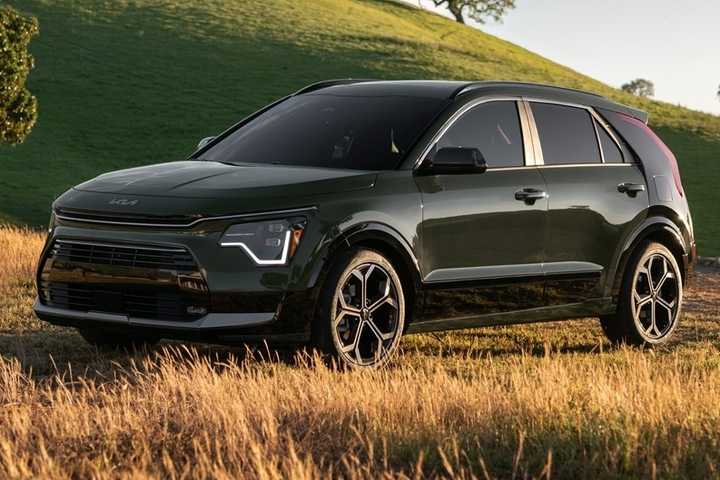

Base Trim Engine
1.6L I4 Hybrid
Base Trim Transmission
6-speed auto-shift manual
Base Trim Drivetrain
Front-Wheel Drive
Base Trim Horsepower
103.5 HP @5700 RPM
Base Trim Torque
106.3 lb.-ft. @ 4000 RPM
Base Trim Fuel Economy (city/highway/combined)
53/54/53 MPG
Base Trim Battery Type
Lithium polymer (LiPo)
Make
Kia
Model
Niro

Small footprint, surprisingly practical
More space than its size suggests
 Credit: Kia
The Niro Hybrid is compact enough to make city driving and parking easy, but its interior is designed to make the most of its footprint. It offers 41.5 inches of front legroom and 39.5 inches of rear legroom, giving adults plenty of space in both rows.
Cargo capacity is equally impressive for a vehicle of this size. There’s 22.8 cubic feet of space behind the rear seats, expanding to 63.7 cubic feet with the 60:40 split-folding rear bench folded flat.
Thoughtful details make everyday use even easier. An available power liftgate, underfloor storage, a wide hatch opening, and a variable-height cargo floor help the Niro punch above its weight when it comes to practicality.
It doesn’t feel like an economy SUV
The equipment list is surprisingly generous
-
 Credit: Kia
 -
 Credit: Kia
 -
 Credit: Kia
 -
 Credit: Kia
 -
 Credit: Kia



-
 Credit: Kia
 -
 Credit: Kia
 -
 Credit: Kia
 -
 Credit: Kia
 -
 Credit: Kia
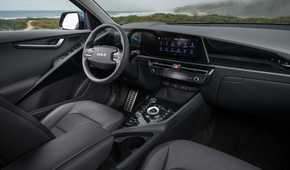



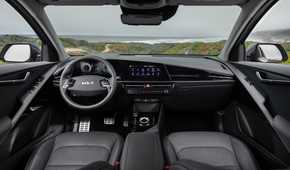
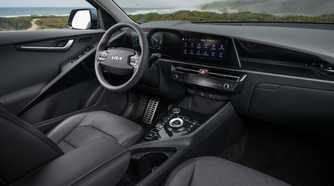
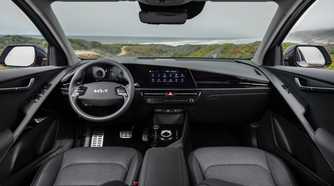
The Niro Hybrid’s biggest selling point may be its fuel economy, but Kia hasn’t treated it like a stripped-out commuter. Even the entry-level model comes with an 8-inch touchscreen, wireless Apple CarPlay and Android Auto, automatic climate control, multiple USB-C ports, remote keyless entry, and a digital instrument display.
Move up the range, and the cabin starts to feel genuinely premium. Higher trims add Kia’s dual 10.25-inch panoramic displays, built-in navigation, Digital Key 2.0, wireless phone charging, and an available Harman Kardon premium audio system.
Comfort improves as well, with available heated and ventilated front seats, a heated steering wheel, and a power-adjustable driver’s seat. Every trim also comes standard with Kia’s Drive Wise safety suite, making the Niro feel like a well-equipped family SUV rather than one built solely to chase fuel economy.
Low running costs strengthen its value
The savings continue long after you leave the dealership
 Credit: Kia
Outstanding fuel economy is only part of the Niro Hybrid’s appeal. According to the EPA, owners can expect annual fuel costs of $1,150 to $1,250, depending on trim, with estimated fuel savings of $4,750 to $5,250 over five years compared with the average new vehicle.
Ownership costs also compare well with key rivals. Edmunds estimates a five-year True Cost to Own ranging from $31,708 for the LX to $39,013 for the SX Touring, while equivalent estimates for the Toyota RAV4 range from $35,543 to $43,903.
Those numbers reinforce what makes the Niro Hybrid so compelling. It isn’t just inexpensive to fuel—it can also cost less to own over time, making its value proposition even stronger.
Why it makes more sense than a plug-in hybrid
Simplicity is one of the Niro’s biggest strengths
 Credit: Kia
Plug-in hybrids can deliver lower running costs if they’re charged consistently, but that isn’t how every owner uses them. Without regular charging, you’re carrying around a larger battery and paying a higher purchase price without seeing the full efficiency benefits.
The Niro Hybrid avoids that compromise. It delivers up to 53 mpg, never needs to be plugged in, and costs less than many comparable plug-in SUVs, making it an easier recommendation for buyers who simply want excellent fuel economy with minimal effort.
For drivers who don’t have home charging or don’t want to build their routine around plugging in every day, the conventional Niro Hybrid is arguably the smarter buy. It delivers the efficiency most people want without adding extra complexity.
Why the Niro Hybrid is one of the smartest SUVs you can buy
Outstanding efficiency without the extra hassle
 Credit: Kia
The 2026 Kia Niro Hybrid proves that you don’t need a plug-in powertrain to achieve exceptional fuel economy. It combines up to 53 mpg with a practical interior, generous standard equipment, and ownership costs that remain competitive long after you leave the dealership.
It won’t satisfy buyers looking for quick acceleration or luxury-car refinement, but that’s missing the point. The Niro Hybrid succeeds because it gets the fundamentals right, offering an affordable, easy-to-live-with SUV that quietly delivers exactly what most drivers actually need.