For decades, Greece’s defence strategy has centred on fighter jets streaking across the Aegean and naval patrols threading between its islands – an approach driven by long-standing tensions with neighbouring Turkey. But as drones, autonomous systems and cybersecurity transform modern warfare, Greek companies are developing technologies aimed at operational environments far beyond the country’s borders. The nation’s defence minister, Nikos Dendias, has been blunt about its potential. “The solutions to tomorrow’s problems will not come from the dinosaurs of yesterday,” he told a conference in May. Instead, answers are being sought from a new generation of firms based in coastal facilities and research sites around Athens and in industrial spaces repurposed for advanced engineering. The companies featured here are helping to turn the country’s ambitions into a reality.
Velos Rotors
The V-Twin sits on a workbench like a stripped-back aircraft in miniature – about two metres long, with a carbon-fibre fuselage. In flight, it rises to a steady hover on twin rotors, making subtle corrections through the fuselage instead of the jittery movements of conventional drones. It is one in a helicopter series of Unmanned Aerial Vehicles (UAVs) developed by manufacturer Velos Rotors for surveillance, logistics and defence, with systems deployed in Ukraine. The company was born of founder Aris Kolokythas’s fascination with remote-controlled aircraft. “I was always building them, tuning them, improving them,” he says.
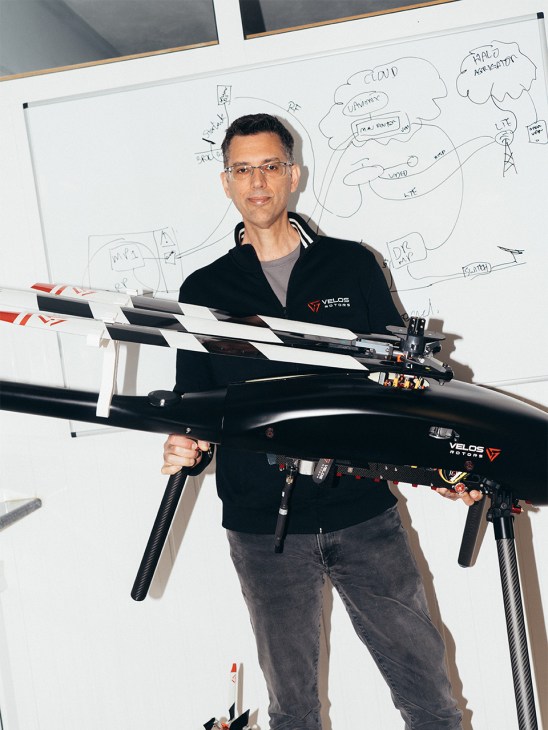
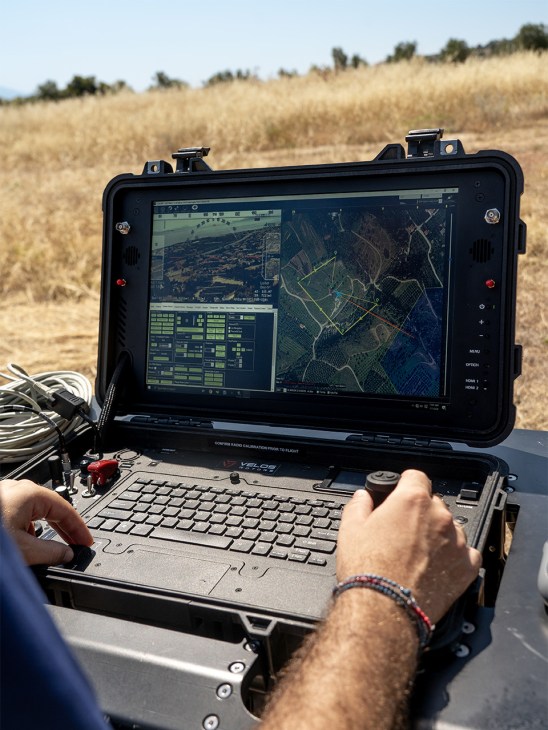
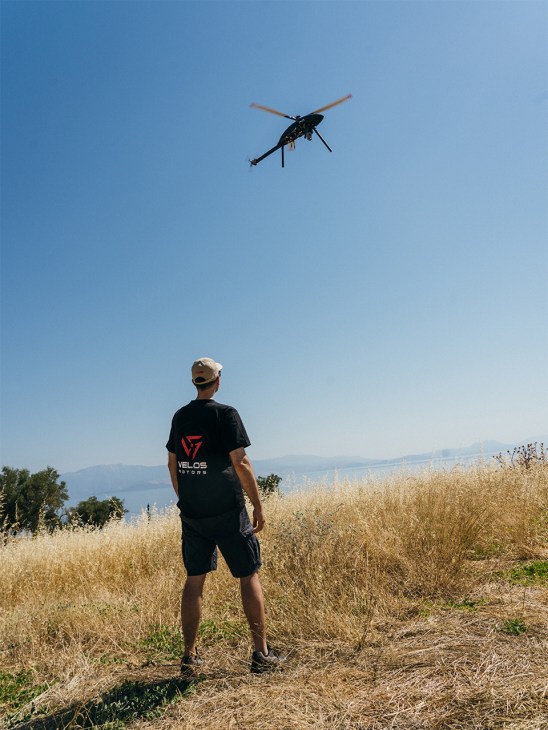
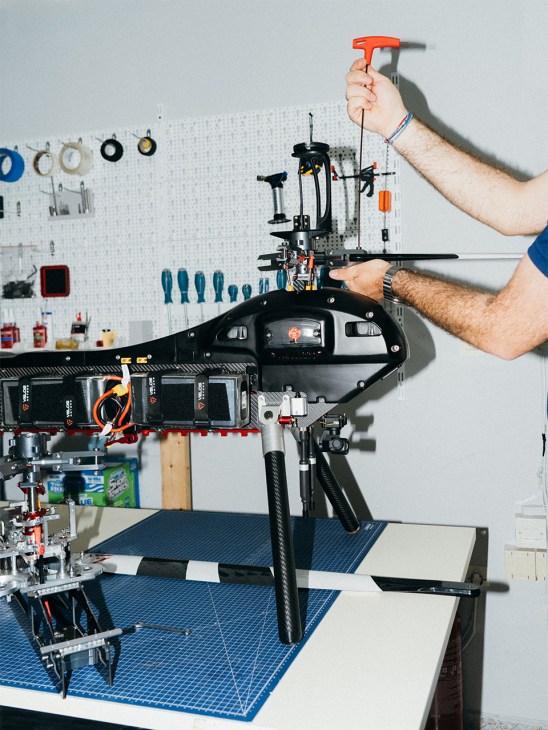
The goal, he says, was to make a reliable scaled-down helicopter. The project underwent a demanding real-world test in 2021, when Velos technology was used by US drone operator MissionGo to transport a human pancreas in Minnesota. Since then, deployments have expanded into defence. In the early months of the war in Ukraine, Velos’s V3 was sourced for battlefield use by a private US fund.
As demand has grown for more robust and adaptable aircraft, Velos has built an international customer base, stretching from the UK and Canada to India, Thailand and Malaysia. The company still operates in a space dominated by cheap, multi-rotor drones but its founder argues that helicopters are regaining ground in more demanding applications. “Helicopters didn’t have the market share that they deserved,” he says. “But that’s quickly changing.”
Sotiria Technology
“There’s no internet, no GPS, no energy – you can’t see very well,” says Angelos Tsereklas Zafeirakis of the silent underwater domain where Sotiria Technology operates. From its base at a low-rise research campus in a pine forest north of Athens, the Greek deep-tech defence start-up works on underwater sensing systems. The company’s 35-year-old CEO points to a laptop showing live data from a test-bed off a port south of Athens, where multicoloured graphics map the acoustic and magnetic impact of passing vessels. The system helps to locate submarines and other underwater vehicles – crucial when it comes to protecting infrastructure such as ports, offshore platforms and pipelines. “It’s about finding submarines and other threats before they find you,” Tsereklas Zafeirakis tells Monocle. Founded in 2021, Sotiria has already deployed systems in Greece and elsewhere in Europe, though specific locations remain undisclosed because of the sensitivity of the missions. Last summer, the company presented its technology to the US Navy at Naval Station Newport after receiving a €110,000 Nato accelerator grant.
Hack The Box
Haris Pylarinos transformed a hacking hobby into a community of like-minded individuals who enjoy solving problems. That group eventually became Hack The Box, which is now a globally recognised cybersecurity training platform used by governments and corporations to prepare defence teams. When Pylarinos, who is now 42 years old, first started working in IT in Greece more than 15 years ago, cybersecurity was a less prominent issue. “Cyber is a weapon now,” he tells Monocle. “Every army has a cyber division – it’s a necessity.”
Today, Hack The Box has almost five million users, attracting about 3,000 sign-ups a day. It has raised $66.9m (€58.8m) in European and US funding, opened offices in New York and Sydney, and works with a growing roster of corporate and government clients, including the US Department of Defense, the FBI, Siemens and Verizon.
What sets the company apart is its insistence on practice. Traditional cybersecurity training remains overly academic, says Pylarinos. The company builds simulated environments that force users to think creatively. “It’s like a house – completely locked. And you have to find your way in.” The result is continuous pressure training. “You need to be battle-ready. Whether we’re talking about organisations or countries, there are criminals or state actors who want to harm you.” Participants face virtual battles so that when a real incident occurs, it’s “just another day at work”.
Greek defence in numbers
€6.9bn
Defence spending in 2025. This represents 2.8 per cent of Greece’s GDP, making the country among Nato’s highest military spenders.
€25bn
In spring 2025, Greece’s Ministry of National Defence announced a new 12-year strategy, outlining an investment of €25bn on land, air and sea modernisation, joint training and digital services.
24
Number of Dassault Rafale fighter jets acquired since 2022. Greece has received all 24 of these fighter jets, ordered from France, with the last delivered in January 2025. It’s separately progressing on acquiring 20 F-35 aircraft valued at approximately €3.5bn.