Blink and you’ll miss the whole thing. A Formula 1 car rolls into its pit box, twenty people move at once, and about two seconds later it’s gone again on four fresh tires. It looks like a magic trick. It isn’t one. It’s twenty people doing one tiny job each, all at the same time.
Here’s the short version. Three people work on every wheel: one runs the gun, one pulls the old wheel off, one puts the new wheel on.
Four wheels means twelve people, and nobody waits for anybody. The rest of the crew lifts the car, holds it steady, and watches for the signal to send it back out.
Twenty people, one job each
The crew is bigger than most fans expect. Around twenty people take part in a stop, and one team has said up to 22 can be involved. Twelve work the wheels. Two run the jacks, front and rear, with spares standing behind them. Two hold the car steady at the sides.
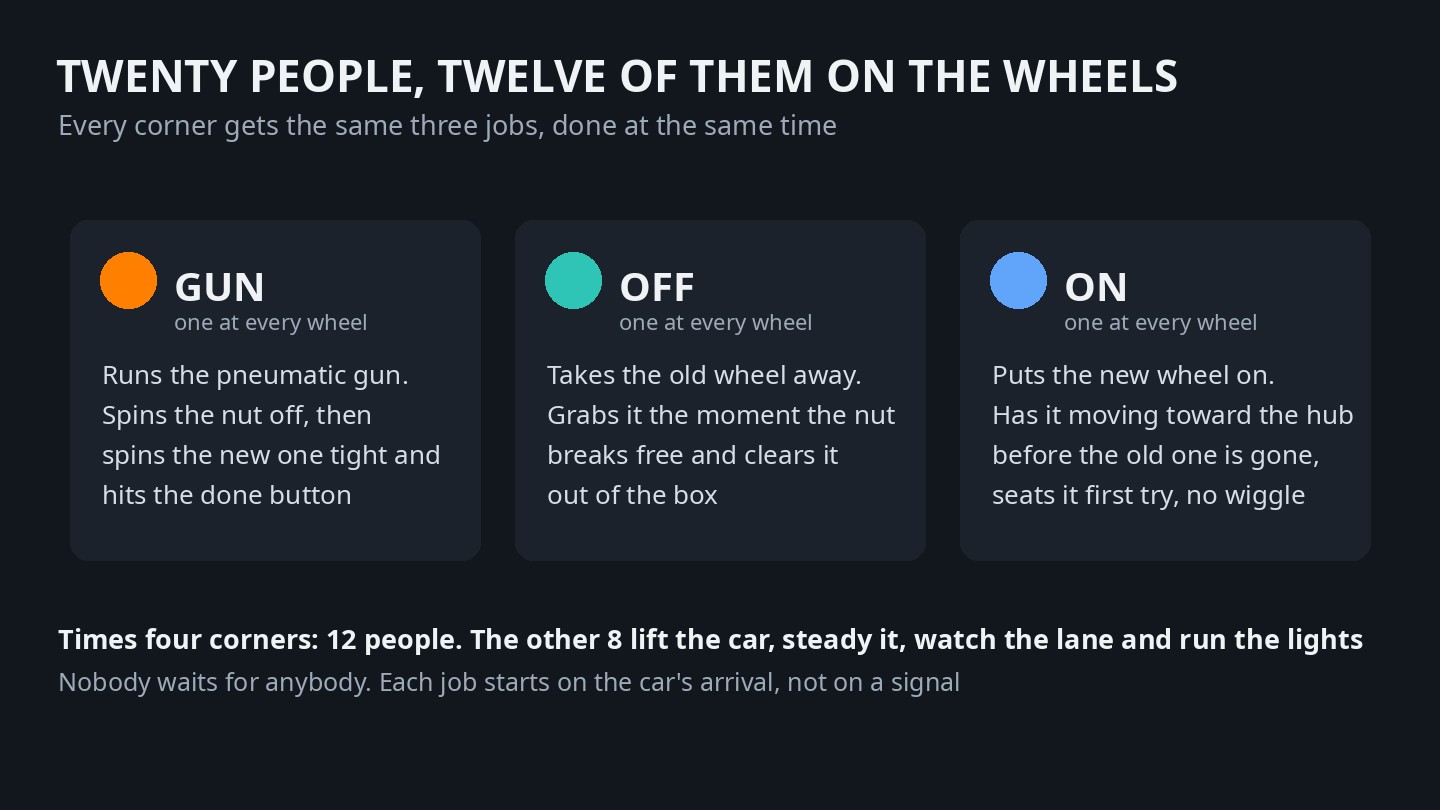
Two more wait at the front wing in case the driver wants a quick tweak. The last two run the release lights and keep an eye on pit lane traffic. Most of the crew are mechanics who build and care for the car all weekend. The stop is just the fastest two seconds of their job.
They practice like it’s a sport of its own, because it kind of is.
A top crew can run through about 60 practice stops across a single race weekend, and the moves get drilled until nobody has to think about them.
One nut per wheel, and it can’t fall off
Your car probably has four or five lug nuts holding each wheel on. An F1 car has one. A single big nut sits in the middle of the wheel, and the clever part is where it lives. The nut is built into the wheel and held there by sprung pins.
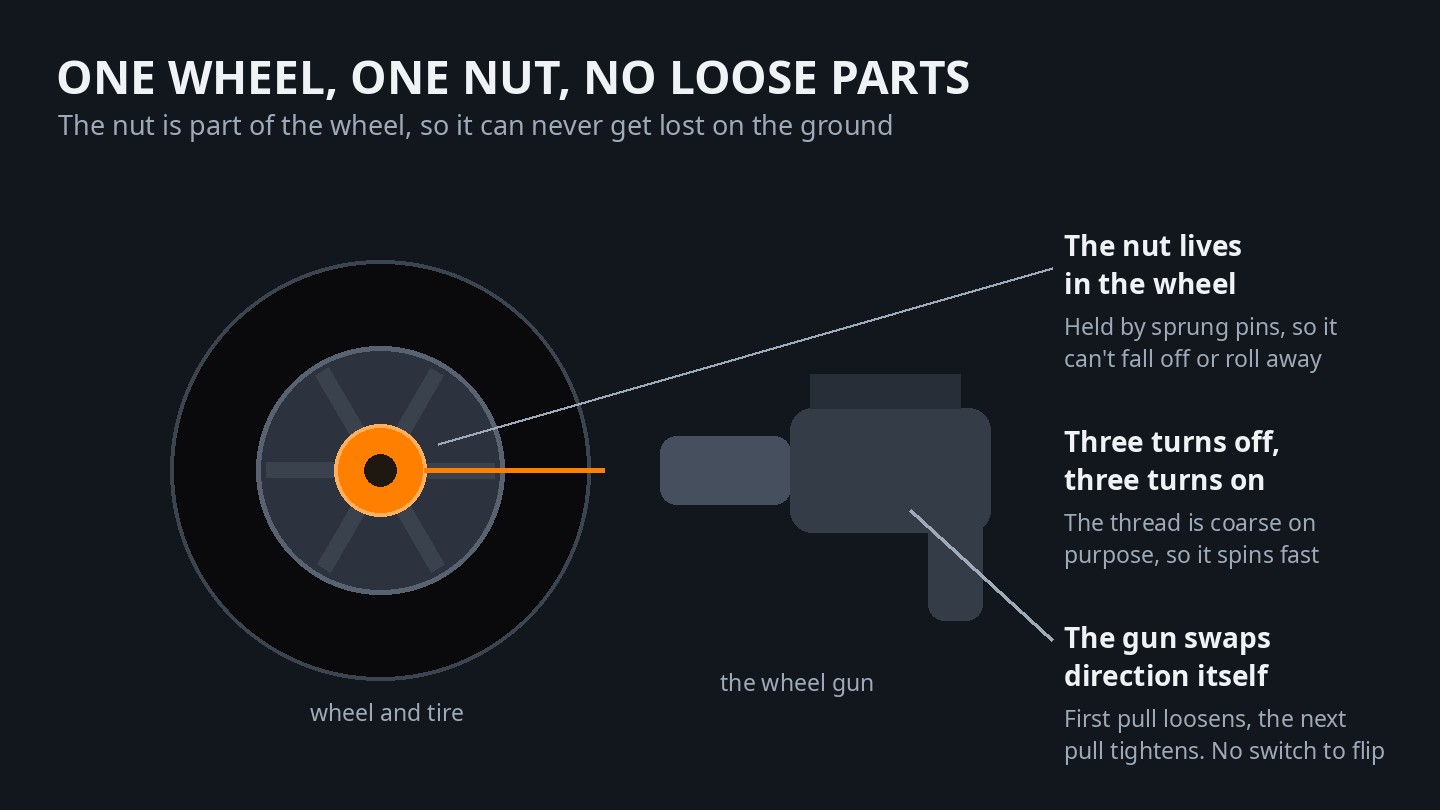
Take the wheel off and the nut goes with it. Put the new wheel on and its nut is already in place, ready to spin. Nothing to drop, nothing to chase across the concrete.
The gun helps too. It’s air-powered and seriously strong, with more than twenty times the twisting force that holds your own car’s wheels on. The nut’s thread is coarse, so about three turns takes it off and three turns locks it back down. The gun even swaps direction by itself. First pull loosens, second pull tightens, and nobody burns a split second flipping a switch.
The stop itself, beat by beat
The driver starts the clock. They come down the pit lane at the speed limit, 80 km/h at most tracks, brake hard, and stop the car right on its painted marks. A few centimeters long or short and every gun angle shifts. The guns are already reaching for the nuts before the car fully settles.
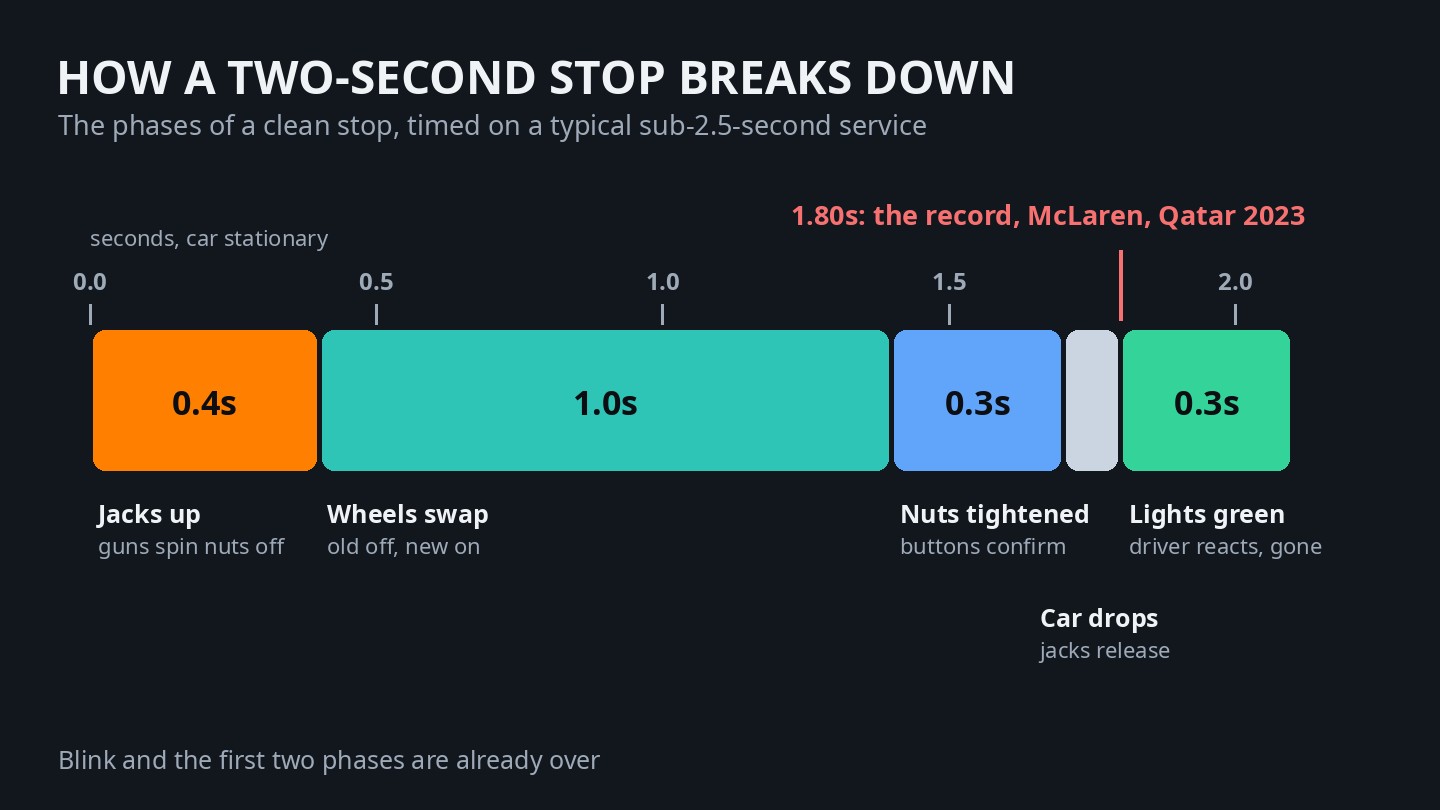
Then everything fires at once. The jacks lift the car while the guns spin the nuts free, about four tenths of a second. Old wheels come off, new wheels go on, about a second. The guns spin the new nuts tight, each gunner taps a button to confirm their corner, and the car drops back to the ground.
Above the box, lights do the job the old lollipop sign once did. The lights stay red while any corner is unfinished. A rule change in 2021 made the system wait for the tightened signal from every gun before the release can even start.
When all four corners report done and the lane is clear: green. The driver launches.
So how fast is the fastest?
The record is 1.80 seconds, and it belongs to McLaren, my favorite detail in the story. At the Qatar Grand Prix in October 2023, the crew changed all four tires on Lando Norris’s car in 1.80 seconds flat.
The old record was 1.82 seconds, set in Brazil in 2019. Two hundredths of a second was the gap.
One catch on the record number: it only counts the time the car sits still. Rolling down the pit lane and back out costs much more, which is why teams argue about when to stop far more than how fast. It also helps that there’s nothing else to do down there. Refueling has been banned since 2010, so a modern stop is tires only. No fuel hose, no waiting on anything but wheels.
And when one nut says no
Then there’s the other end of the record book. At Monaco in 2021, Valtteri Bottas rolled in for tires while running second. Three corners went fine. The right front didn’t. His car had stopped a few centimeters off the marks, he’d later explain two or three centimeters, and the gun met the nut at a slight angle. Instead of gripping, it chewed the nut’s splines smooth.
The wheel wouldn’t come off. Not in the pit lane, not back at the garage.
Bottas climbed out, his race done, and the car traveled back to the team’s factory in England with the front wheel still attached. Mechanics finally freed it about 43 hours after the race ended. The quickest stop in history took 1.80 seconds. The slowest took the better part of two days.
So the trick was never raw speed. It’s twenty people, four wheels, one nut each, practiced until it looks easy. Next race, try this: pick one corner and watch only that wheel. Even at full speed you’ll catch the order. Gun, off, on, gone.
Sign up for our newsletter today.
No ads, no spam, just links to our latest articles!