Agriculture might not be the first thing that comes to mind when sampling the delights of Berlin. It’s a sprawling metropolis, cross-hatched by boulevards and large cement buildings. Yet tucked between the city’s warehouses, apartment blocks and train lines is one of Europe’s largest collections of urban allotments.
For well over a century, Berliners have used allotments – kleingärten or schrebergarten in German – to spend time outside and grow fruit, vegetables and herbs. This land was especially crucial during times of war and instability, when shop shelves were often empty and fresh produce commanded extremely high prices. At roughly 24 sq m per plot, the allotments were large enough to help provide food security for many families.
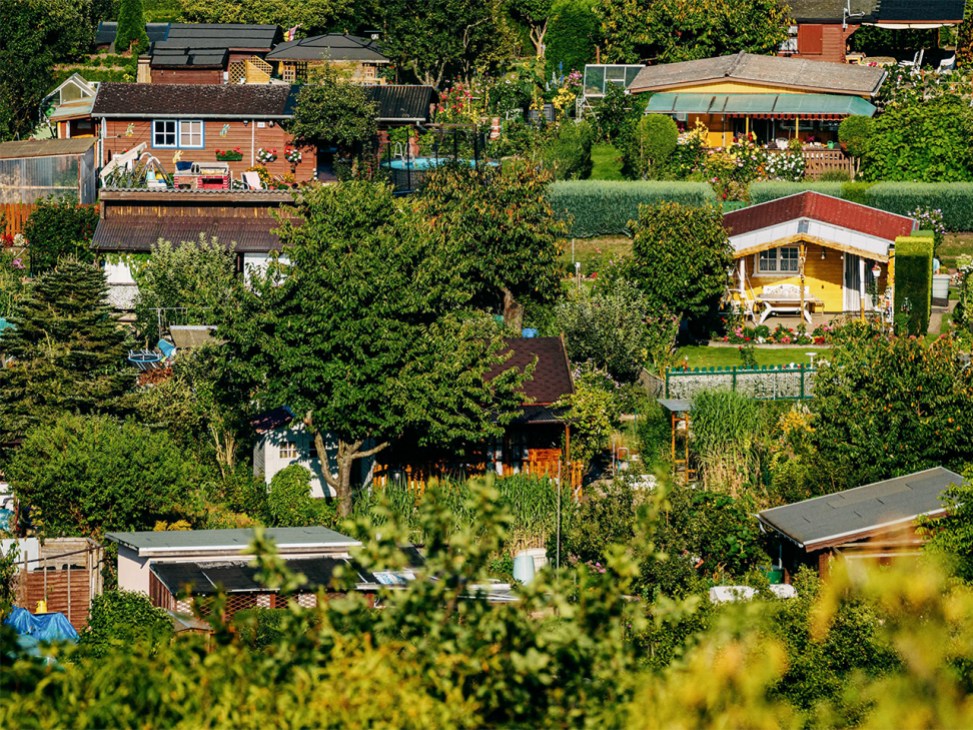
Today, Berlin has 870 community gardens with roughly 70,000 allotment plots. Though the majority of Berliners no longer depend on them for food, they are increasingly popular for hobbyist farmers; wait times for an allotment can reach eight years. The plots preserve a “cultural memory of urban cultivation” and reinforce the idea that “food production belongs in the city”, says Dr Monika Egerer, a professor of urban productive ecosystems at the Technical University of Munich.
Egerer views allotments’ modern value less as a matter of production volume and more about keeping culinary heritage alive. “Kleingärten aren’t feeding cities quantitatively at scale,” she says. “But qualitatively, they’re very significant. They maintain practical knowledge of cultivation, preserve local and heirloom varieties, and sustain a culture of seasonal eating and food literacy that’s increasingly rare in industrial food systems.”
‘Brotzeit’ at Nobelhaft & Schmutzig
(Image: Marko Seifert/Nobelhaft & Schmutzig)
1 / 3


In recent years, many of the city’s most ambitious dining rooms have started connecting their kitchens with allotments. Chefs have built direct relationships with small growers across Berlin, designing menus around what the land can provide. Dubbed “brutal lokal” by Berlin restaurant Nobelhart & Schmutzig, the movement’s central principle is strict enough to warrant the name: nothing reaches a diner’s plate that couldn’t be grown, raised or foraged in Berlin or the fields around it.
For Vadim Otto Ursus, the founder of acclaimed restaurant Otto, brutal lokal improves both the food and the dining experience. “Local ingredients taste of your surroundings. They give you a sense of time and place,” he says. “It’s one of the best ways to get to know a culture.” Working closely with small suppliers, he adds, also opens up ingredients that commercial supply chains don’t offer: seeds, sprouts and vegetables picked unripe or overripe.
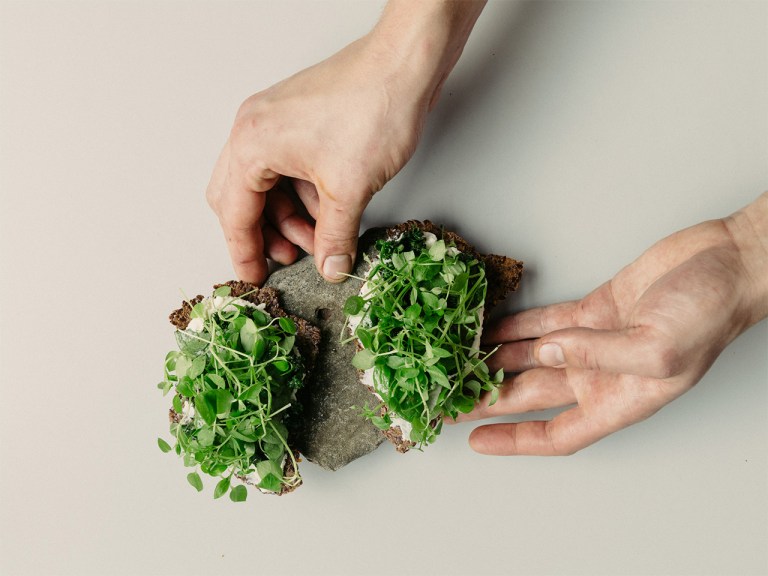
Green shoots: Linseed cracker, labneh, salsa verde, chickweed at Otto
(Image: Robert Rieger/Otto)
1 / 2


To help support small farmers, a number of Berlin kitchens have joined charity Die Gemeinschaft (the community). Founded in 2017 by Nobelhart & Schmutzig and fellow Michelin-starred eatery Horváth, Die Gemeinschaft brings together a network of German farmers, food producers and restaurants in a bid to create a “better food system” that uses regionally grown food and promotes equitable working conditions. The charity currently has 145 members across Germany.
“[Berlin] is an incredibly green city and people genuinely want to know where their food comes from”, says Nikodemus Berger, the head chef at Michelin-starred vegan restaurant and Die Gemeinschaft member Bonvivant. The focus on sourcing food from the region has, he believes, helped the city define its identity within the fine-dining scene. “We don’t need to import everything to do fine dining anymore,” Berger continues. “We take pride in showing what the region can do. Vegetables harvested in Brandenburg in the morning and arriving by midday simply taste better, crisper and more intense.”
Few places embody the kleingärten spirit as literally as Café Botanico in Neukölln, where a 1,000 sq m permaculture garden supplies the restaurant with herbs, vegetables and edible flowers. Its founder, Martin Höfft, didn’t set out to run a restaurant. “I’m a geographer and permaculture gardener,” he says. He kept an allotment of his own for years and admits that Café Botanico “was essentially built to market my herbs because I had more than I could eat and I needed money to come in to pay for the garden’s rent”.
Homegrown: Café Botanico’s 1,000 sq m permaculture garden
(Image: Sascha & Laura-Lee Timmler/Café Botanico)
1 / 3


Unlike the city’s Michelin-starred brutal lokal restaurants, Café Botanico is not a fine-dining establishment – and that’s entirely by design. Offering high-quality, garden-grown food at mid-range prices, the restaurant is metres from where the ingredients are picked, allowing the plot-to-plate journey to become part of the meal. During service, the grounds – which were an allotment prior to Höfft’s arrival – stay open to anyone who wants a mid-meal wander.
Growing your own food, Höfft says, takes “more thought, more patience, more creativity”. Dishes have to be built around whatever the season delivers. But that constraint is exactly what many Berlin chefs have come to value. When winter leaves Berger, Bonvivant’s head chef, with little but cabbage and root vegetables, he turns to fermentation and preservation, using koji, pickles and aged vegetable garums to build variety from a thin harvest. With fewer ingredients on hand, he becomes more inventive. “If you have access to everything all year round, you get lazy,” he says. “Seasonality forces us, in a very positive way, to dig deeper into our technical toolkit.”