Despite US president Donald Trump’s threats, world leaders landing in Ankara for the Nato Summit today will be certain of the alliance’s gravest danger: Vladimir Putin. But that doesn’t mean that they’re afraid. In fact, Europe is keener than ever to sit down with the Russian premier. Ukraine, despite heavy bombings on the eve of the summit, has scarcely been in a stronger negotiating position. And Washington, which has excluded European leaders from talks with the Kremlin, is now distracted by the conflict in the Middle East.
Putin’s diplomatic playbook is Machiavellian and talks will not be easy. Two weeks before Russia invaded Ukraine, for example, Emmanuel Macron visited Moscow to dissuade Putin. True to character, Putin pulled a trick from his KGB hat and sat Macron six metres away across a long table. The image quickly became the subject of memes: one depicted the leaders on a seesaw; another showed figure skaters on top of the table. My favourite was that of Leonardo da Vinci’s The Last Supper, with Jesus and his 12 disciples filling the vast gulf between the two leaders.
Four years on, that distance has grown wider. Macron has said that it is important for Europe to restore communication channels with Russia – not only to end the war but also to claim its place as mediator in a conflict that has direct security implications for Nato countries. So who can talk to the bully?
Gerhard Schröder is Putin’s man in the race. The former German chancellor, a known Putin confidant long described as a Russian “stooge”, has been nominated by the Russian president to lead talks. Schröder pushed for Russian gas pipelines, championed ties with Moscow – even out of office – and was rewarded with lucrative jobs in Russian oil giants Rosneft and Gazprom. Though he criticised Russia’s invasion of Ukraine, he opposed what he described as “the demonisation” of Russia. Schröder is an obvious choice for Putin, which also makes him an unlikely candidate for the allies.
Kaja Kallas, the EU’s foreign policy chief, said that Putin “would be sitting on both sides” of the negotiating table if Schröder were anointed mediator. The former Estonian prime minister pitched herself as the perfect intermediary. “I think I could see through the traps that Russia is presenting,” she said.
Her policy is guided by Estonian fears of being invaded and her family’s past experiences. Early one morning in the late 1940s, Soviet soldiers rounded up thousands of people in occupied Estonia, including her mother, grandmother and great-grandmother, and sent them to Siberia in a cattle wagon. Her family survived but “not everyone fared so well – thousands lost their lives in Siberia”, Kallas later wrote.
However, her outspoken criticism of Putin and her efforts to build consensus for sanctions and billions in aid to Ukraine also put her at a disadvantage. She is seen as a Russia hawk, not a neutral observer.
Enter Angela Merkel, the former long-serving German chancellor endearingly referred to as Mutti (mother), who says that Trump alone should not be negotiating with Russia. She was among the leaders who negotiated the Minsk agreement with Russia after Crimea’s annexation in 2014 and has experience in dealing with Putin. But the Russian leader violated the Minsk agreement when he invaded Ukraine, which makes it hard to believe in Mutti’s persuasive powers a second time around.
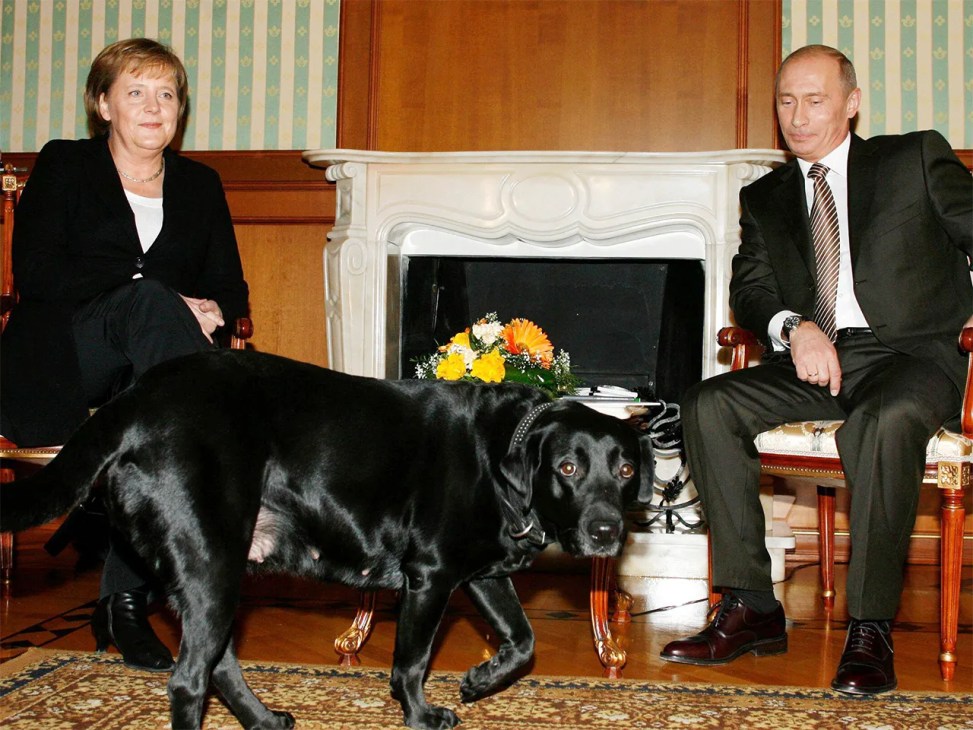
Merkel has also famously been bullied by Putin. Despite her well-documented fear of dogs, Putin brought in his big black Labrador, Koni, to a meeting between the pair in Sochi in 2007. Merkel recounted the experience in her memoir. “Was he just trying to see how a person in distress would react? Was it a small show of force? I just thought: ‘Stay calm, focus on the photographers, this will pass.’”
Photos of Finland’s dapper president, Alexander Stubb, playing golf with Trump have earned him a reputation for being close to the US president. Some have referred to him as a “Trump-whisperer”, a useful description at a time when ties between the US and European allies are under unprecedented strain. If Trump were to get upset with Europeans trying to displace him and take the lead in talks between Ukraine and Russia, Stubb’s personal rapport could come in handy. But Finland’s recent accession to Nato has probably made him a less acceptable intermediary to Putin.
That leaves us with António Costa, the sexagenarian president of the European Council. Costa is the former prime minister of Portugal and of Indian descent. He is called the Gandhi of Lisbon thanks to his transformation of districts battling drug trafficking and high crime. The man responsible for building consensus between the often-sparring EU members might be the wildcard.
In late January, hours after the EU and India inked their free-trade deal, I sat down with Costa for a briefing. He said that Europe must talk to Putin, not to disrupt the American process but to have its own.
Time is of the essence and Europe must hurry. Despite all the names floating around Brussels bars and, no doubt, in Ankara’s meeting rooms, the big names will also have their eyes set on the task. Macron hasn’t offered to hold the talks himself but neither has he ruled it out. Russian foreign-affairs minister Sergei Lavrov spoke plainly on the matter. “If you want to call and discuss something seriously, then call. Putin will always pick up the phone.”
The question is not whether Putin will pick up but whether he is ready to cross the length of that famous table and make peace. The Europeans will do better if they project unity. They have the numbers and can each take a chair. After all, it is a very long table.