When we think of any group of countries as a supranational entity, our frames of reference tend to be geographical. We think of Europe, Asia, Africa or Latin America and make (often erroneous) cultural or strategic assumptions based on nothing more than proximity. In an interconnected world, however, it isn’t always that simple: countries can have overlapping interests without sharing a particular landmass.
Hence the 21st-century fad for acronyms that encourage us to consider particular groups of countries as coherent blocs. One of which we will likely hear more of is Crink: representing China, Russia, Iran and North Korea. Granted that there are neighbourly relationships among these sovereign states – two of them are so immense that this can scarcely be avoided – the coalition includes four very different political constructs: an authoritarian superpower, a chaotic revanchist, an Islamist imperialist and a cult compound.
The Crink acronym is intended to identify the menace that these four autocracies pose to the West and warn of their accelerating co-operation. Though not a formal alliance as such, the included countries are most certainly working together. Ukraine – and therefore Europe – is presently beset not only by Russia’s military but by North Korean missiles, Iranian drones and Chinese satellites. If a popularisation of Crink reminds Europe’s people of the threat, it will be a valuable addition to the lexicon.
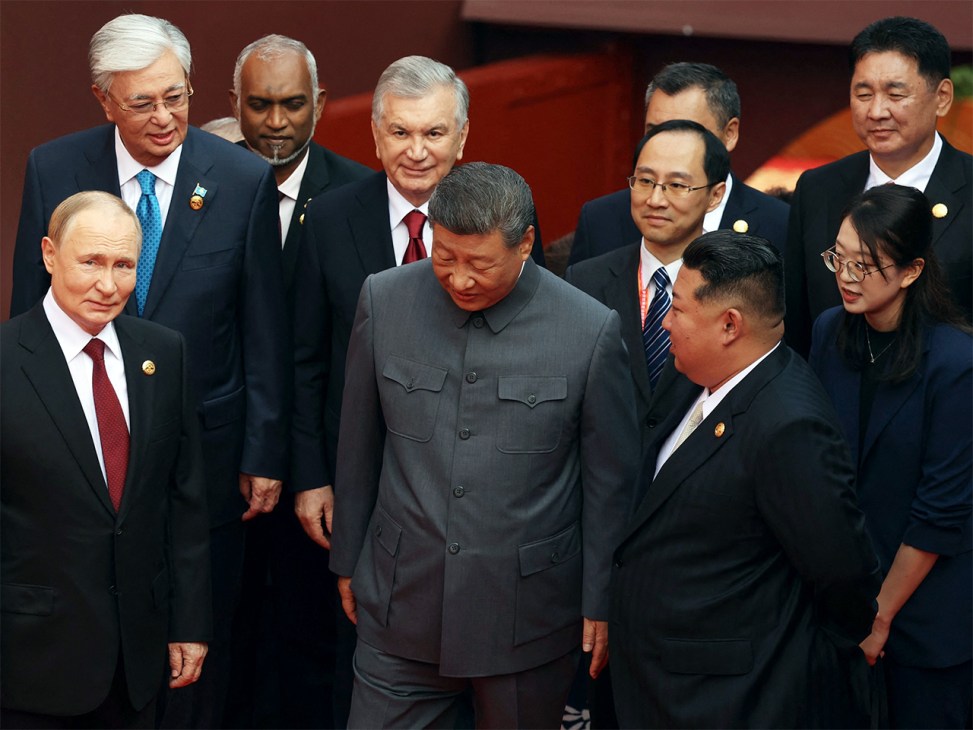
The acronym appears to have been coined by Canadian foreign-policy boffin Peter Van Praagh in 2023, when he identified the four states as partners in an endeavour to dismantle the global order (the same alliance has been described as the “Axis of Upheaval”). Crink is therefore also a useful mnemonic for reminding Western policy-makers who and what they’re up against – and if you add fellow intransigent troublemakers Libya and Yemen, Crinkly is right there for the taking.
It is unlikely, however, that the abbreviation will be embraced by the quartet that it describes. There will be no Crink headquarters, no website, no summits, no souvenir tote bags. This is usually why such acronyms lapse: they are imposed from without rather than gestated from within and the countries involved are often annoyed or baffled by them.
During the Eurozone crisis a decade ago, Portugal, Italy, Greece and Spain did not appreciate being bracketed as Pigs (also sometimes rendered as Piigs to include Ireland). Colombia, Indonesia, Vietnam, Egypt, Turkey and South Africa must have been bemused at being arrayed as Civets.
Attempts have also been made to float Mint, Mist, Vista and Mikta – all being varying combinations of Mexico, Indonesia, Nigeria, South Korea, South Africa, Turkey and Australia. Some of these have proved more viable than others. The foreign ministers of Mikta have met annually since 2013; their most recent gathering – a meeting between senior officials – was in Canberra in July. Mikta might even be thought of as a precursor to Canadian prime minister Mark Carney’s notion of so-called middle powers, combining their diplomatic weight to organise without the interference of superpowers.
But the only acronym that has gained any real popular traction is Brics. Devised in 2001 by Jim O’Neill, chief economist at Goldman Sachs, the acronym bundles Brazil, Russia, India and China (the uppercase “S” for South Africa was added in 2010.). Though the four countries are geographically disparate, they have certain factors in common, including physical heft, large populations, untapped potential and a certain caginess about being seen to consort with the West.
Crucially, the term Brics has been happily adopted by the countries involved. The coalition holds an annual summit – next scheduled for September in New Delhi – and yes, souvenir tote bags have been reliably reported at previous such conclaves. Brics has also enlarged its membership, adding Saudi Arabia, Ethiopia, Egypt, Indonesia, Iran and the UAE as formal members. The acronym, however, has not been expanded accordingly, most likely because there are now just too many vowels (luckless Scrabble players will understand the difficulties).
This frantic acronymising by pundits and analysts is understandable. It is a big and complicated world, and breaking down the geopolitical landscape into blocs can be a way to usefully simplify concepts for a general audience. The kudos of being the person who names such a coalition is doubtless considerable. But it must be done sparingly. An unceasing blizzard of such terms will cause more confusion than clarity. And if, as in the case of Crink, we array our enemies under one flag, it might give them ideas.