Most watches tell you the time. Citizen’s newest one tells you where the stars are.
Price: ¥363,000 ($2,262)
Where to Buy: Casio Japan
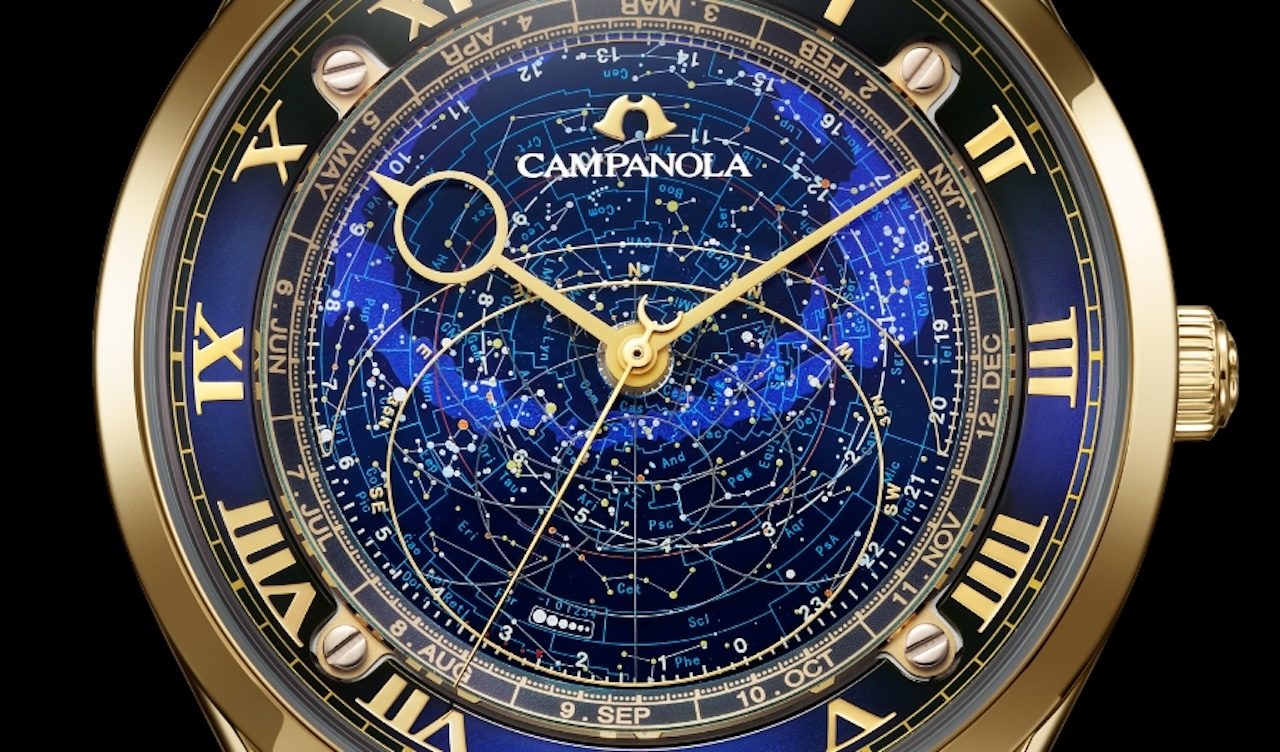
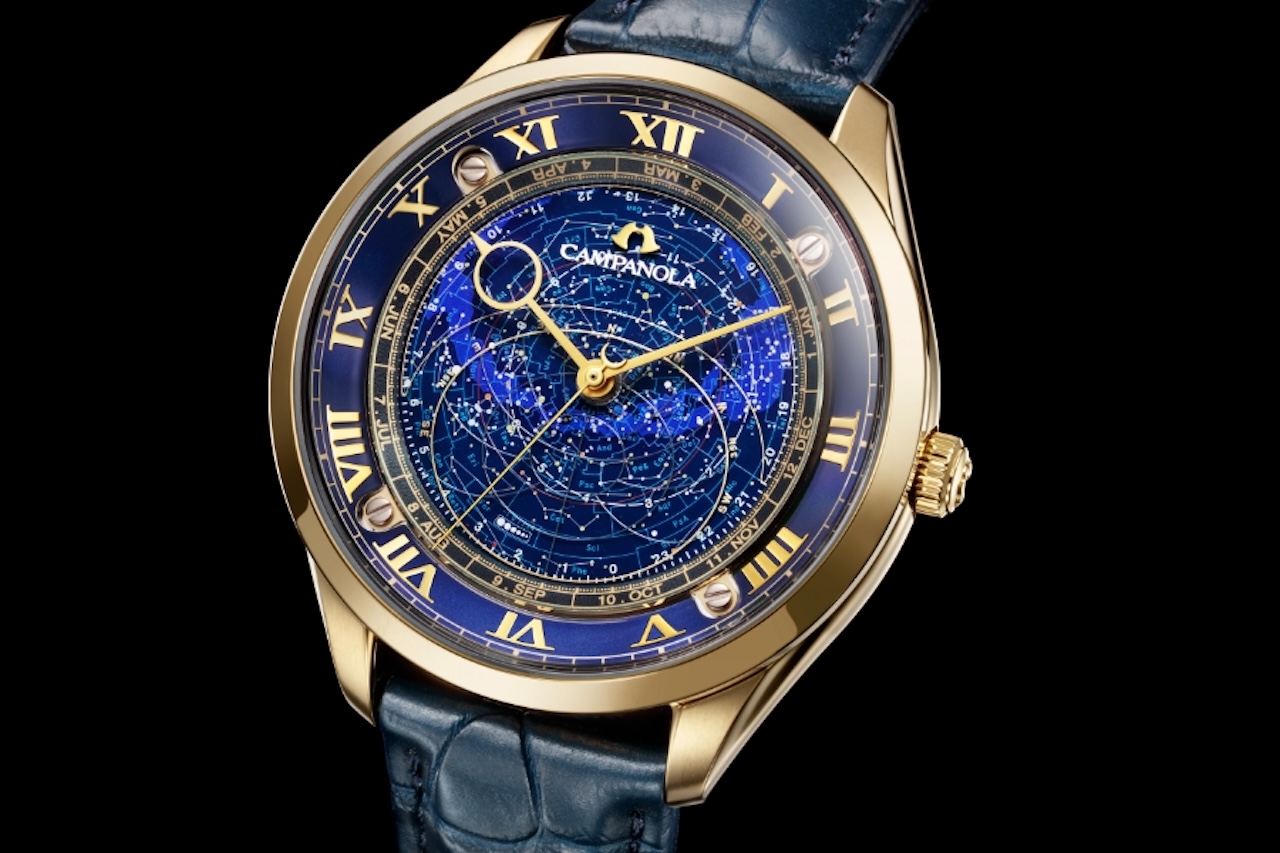
The brand’s luxury division, Campanola, has revived one of its most quietly astonishing ideas, a wristwatch that carries a rotating map of the night sky, to celebrate the 40th anniversary of the original Cosmosign. The new Campanola AO1032-03L is limited to just 210 numbered pieces, and it turns a 39mm deep-blue dial into a miniature planetarium.
It’s the kind of star map watch that stops a conversation cold. Under a lamp you’re not looking at hour markers and a date window; you’re looking at a working chart of the heavens, shrunk down and set spinning beneath the crystal. For a brand best known for solar-powered daily drivers, it’s proof that Citizen still has a genuinely strange, beautiful streak.
A dial that actually charts the night sky
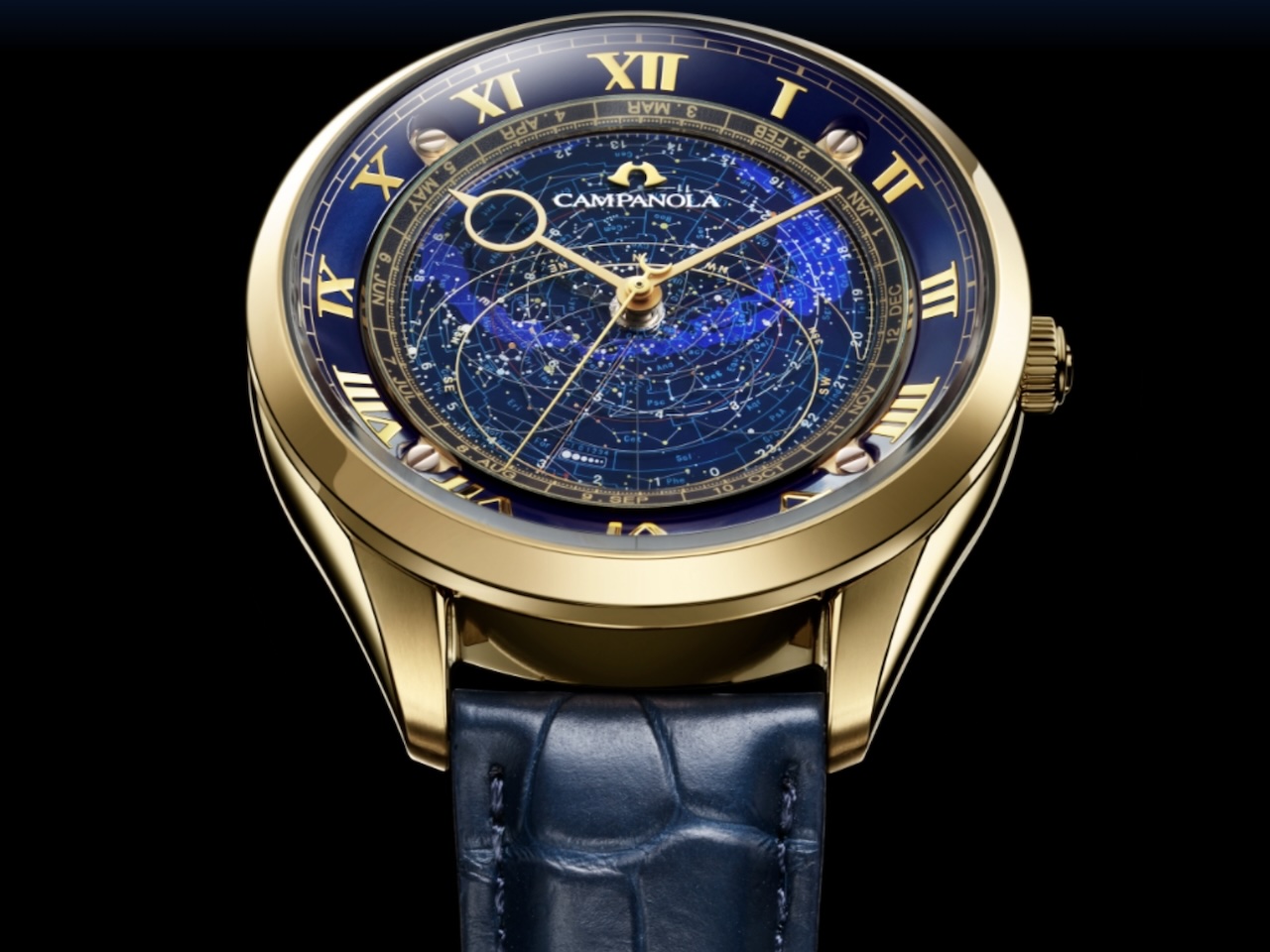
The centerpiece is a rotating planisphere, a star map calibrated for 35° North latitude. Packed into that small dial are 452 of the brightest stars, plus 119 nebulae and star clusters. As time passes, the disc slowly turns to mirror the real motion of the constellations overhead, so the sky on your wrist stays in sync with the sky above you.
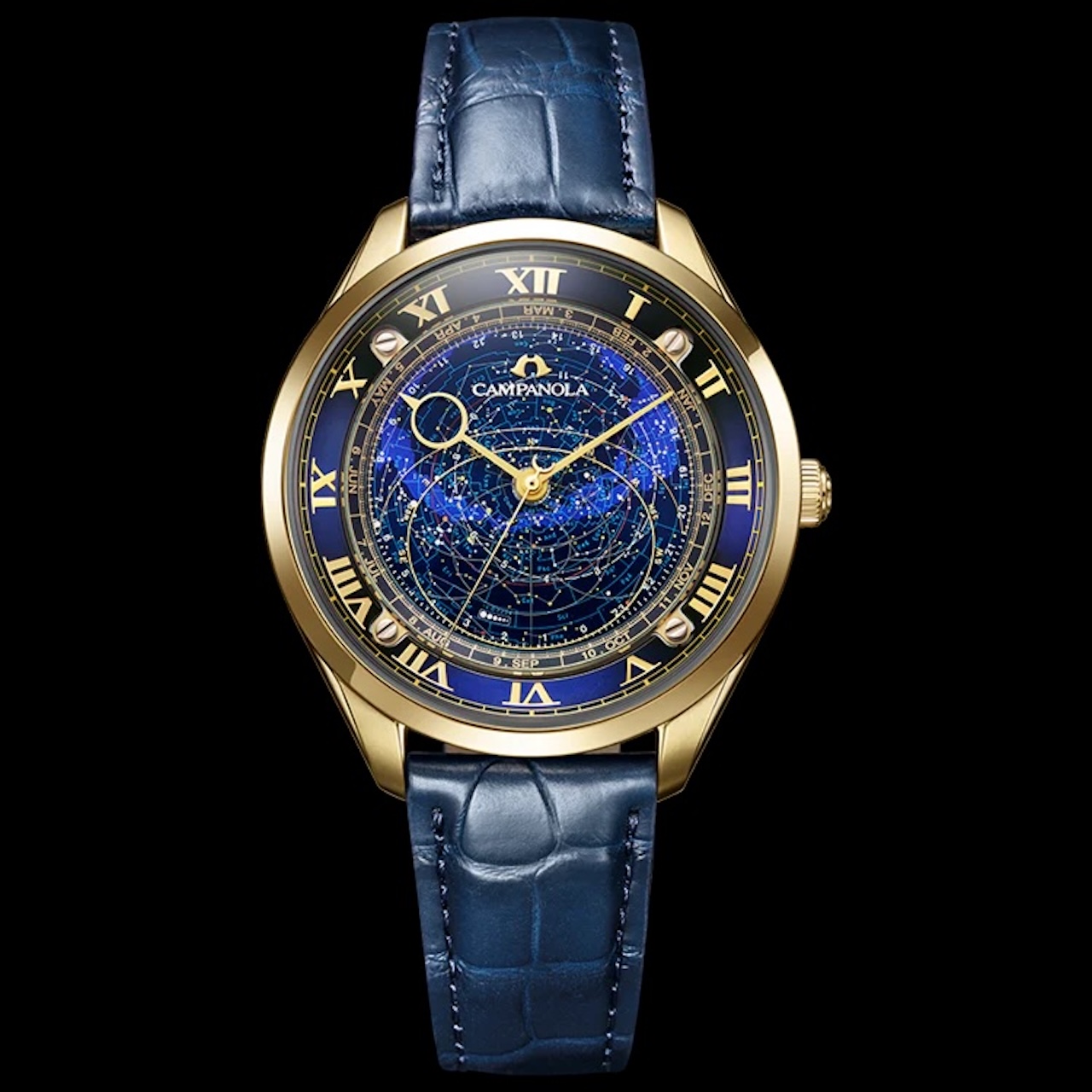
This is the trick that made the Cosmosign a cult favorite when it launched 40 years ago. Citizen prints these maps using a high-precision, eleven-layer printing process to fit that much celestial detail into a few square centimeters, a genuinely nerdy flex that watch enthusiasts and stargazers both appreciate.
What makes it more than a novelty is precisely that the map is live rather than decorative. It’s about as close as a watch gets to a wearable observatory, and a big part of why collectors have long sought out original Cosmosign models on the secondhand market.
Built like a piece of jewelry, priced like a serious watch
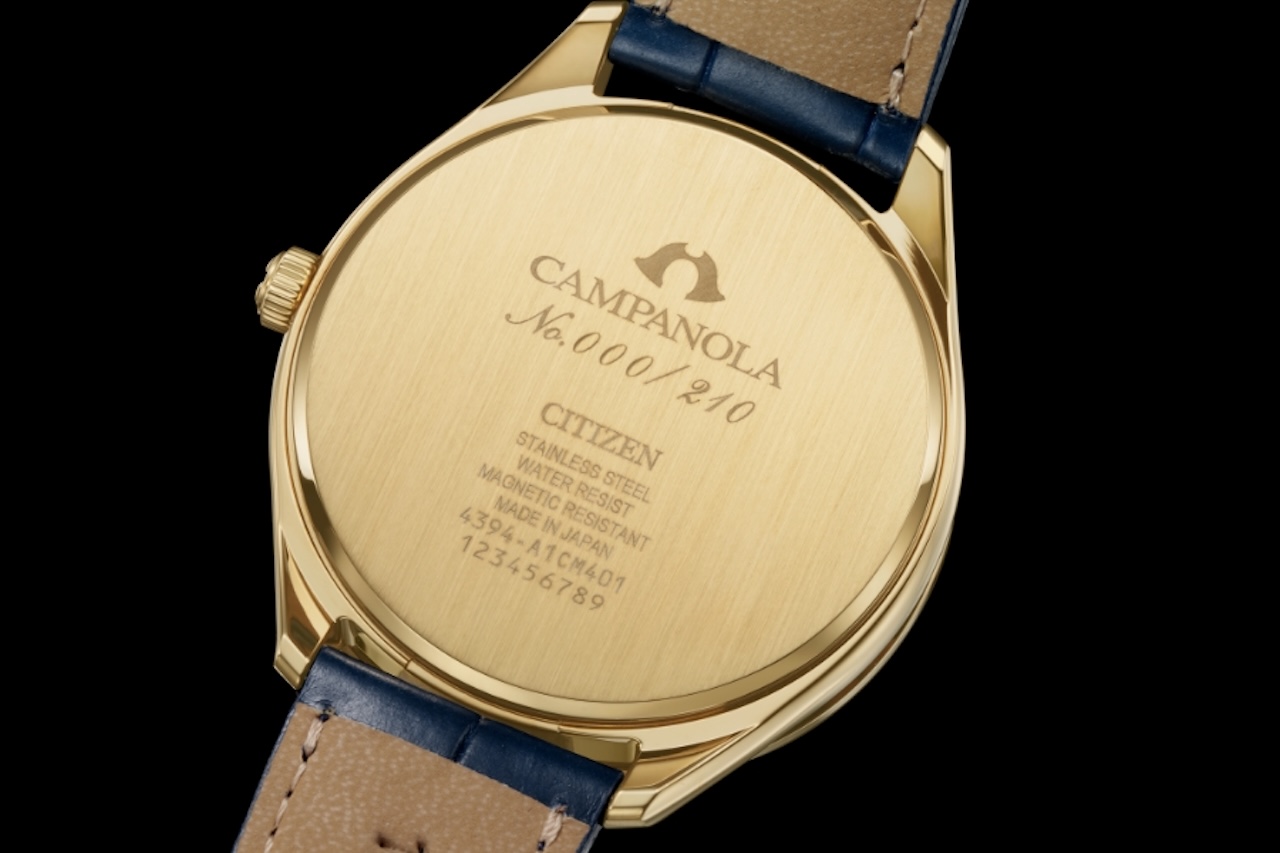
Despite the poetic concept, the AO1032-03L is engineered to Citizen’s usual standard. Its case is stainless steel treated with Duratect Amber, Citizen’s own surface-hardening process that lends the metal a warm gold cast while making it far tougher against scratches and daily wear than untreated steel. The deep-blue dial itself is finished in urushi lacquer, the traditional Japanese lacquerwork that gives it a rich, lustrous depth. It runs on a high-precision quartz movement accurate to about ±20 seconds per month, and it’s paired with a crocodile-leather strap.
| Spec | Detail |
|---|---|
| Model | Campanola AO1032-03L |
| Occasion | 40th anniversary of the Cosmosign |
| Case size | 39mm (12.5mm thick) |
| Case material | Stainless steel with Duratect Amber (gold-tone) coating |
| Dial | Deep blue urushi lacquer, rotating star map (452 stars, 119 nebulae) |
| Movement | High-precision quartz (Cal. 4394), ±20 sec/month |
| Water resistance | 30m |
| Strap | Crocodile leather |
| Limited to | 210 numbered pieces |
| Price | ¥363,000 (~$2,229) |
| Availability | Japan-exclusive |
Why the 40th-anniversary timing matters
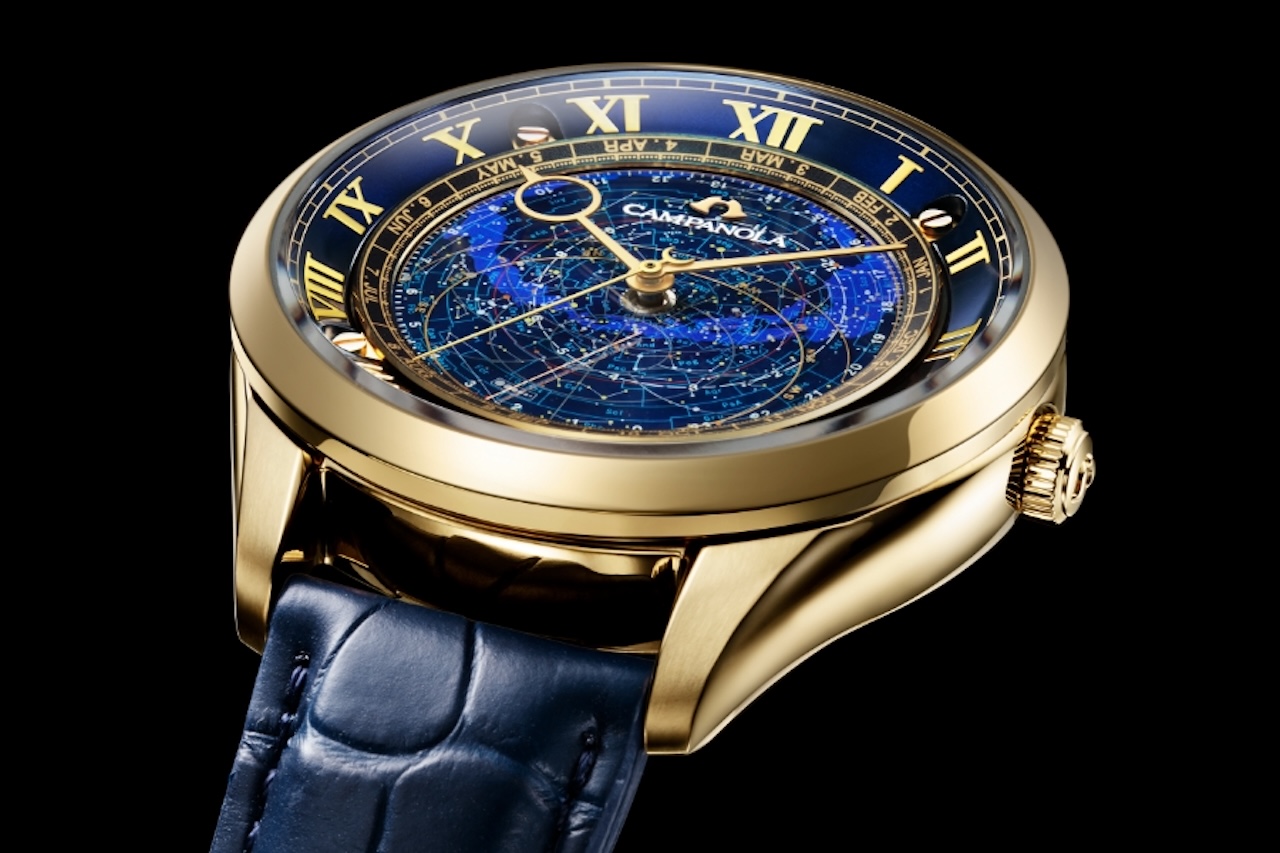 Citizen launched the first Cosmosign in 1986, the world’s first precision constellation-display watch, back when a wristwatch that mapped the stars felt like science fiction. Reviving the concept for the Campanola line four decades later is both a nostalgia play and a statement: it signals that Citizen still owns this niche outright. Very few watchmakers offer a rotating, real-time star map watch at all, and fewer still near this price, and the 210-piece cap gives it the kind of scarcity that tends to draw collector interest.
How to actually get one
This is the frustrating part. The AO1032-03L is a Japan-exclusive, so unless you live there or are visiting, you’ll be working through a proxy buyer, a Japanese retailer that ships internationally, or the grey market once the initial run sells through.
 Expect to pay above the ¥363,000 sticker after service fees, shipping, and import duties, and expect the numbered pieces to move quickly given the anniversary hook. If you’re serious, set alerts with Japan-based dealers now rather than waiting for a wider rollout that almost certainly isn’t coming.
Should you try to get one?
Buy it if you love astronomy, unusual complications, or the idea of a watch that’s a conversation piece first and a timekeeper second. At around $2,229 for a hand-finished, limited-run Campanola, it’s a lot of craft for the money compared with Swiss rivals playing in the same “astronomical watch” space.
Skip it if you want a daily beater or need something you can walk into a US store and buy. This is a Japan-only release capped at 210 pieces, so tracking one down will take effort (and likely a proxy or grey-market seller).
Worth remembering: this is quartz, not a mechanical movement, which will bother purists who equate four-figure prices with an automatic caliber. But that’s rather the point of Campanola: the value lives in the dial artistry and hand-finishing, not the engine. If a rotating star map doesn’t move you, your money buys a lot more conventional watch elsewhere. If it does, nothing else near this price comes close.
A quick refresher on Campanola
Campanola is Citizen’s luxury sub-brand, launched in 2000 with a design philosophy built around the beauty of the cosmos. The name traces back to the church bells of Nola, in Italy’s Campania region, whose ringing once marked the passing of time in the 5th century. Campanola watches are known for being hand-assembled and hand-finished, which is exactly why a “quartz” watch can still carry a four-figure price tag and feel special.


Price: ¥363,000 ($2,262)
Where to Buy: Casio Japan
The AO1032-03L is the kind of release that reminds you why Citizen keeps a luxury arm at all: it’s less about specs on paper and more about carrying a working sliver of the universe on your wrist.
Sign up for our newsletter today.
No ads, no spam, just links to our latest articles!

GMKtec Mini PC, G3 PRO Intel Core i3-10110U (Beats 4300U/N150), 16GB DDR4 RAM (Dual Channel) 512GB Storage Drive, Desktop Computer 4K Dual HDMI/USB3.2/WiFi 6/BT5.2/2.5GbE for Office, Business
(as of July 5, 2026 04:31 GMT -05:00 – More infoProduct prices and availability are accurate as of the date/time indicated and are subject to change. Any price and availability information displayed on [relevant Amazon Site(s), as applicable] at the time of purchase will apply to the purchase of this product.)

KAMRUI AK1PLUS Mini PC Computer, Intel Celeron N5095 (Up to 2.9GHz), 16GB RAM 256GB SSD, Dual 4K Mini Desktop Computer, Support 2.5” SSD Expansion, WiFi, Bluetooth, Ethernet, Business Home Office PC
(as of July 4, 2026 14:37 GMT -05:00 – More infoProduct prices and availability are accurate as of the date/time indicated and are subject to change. Any price and availability information displayed on [relevant Amazon Site(s), as applicable] at the time of purchase will apply to the purchase of this product.)