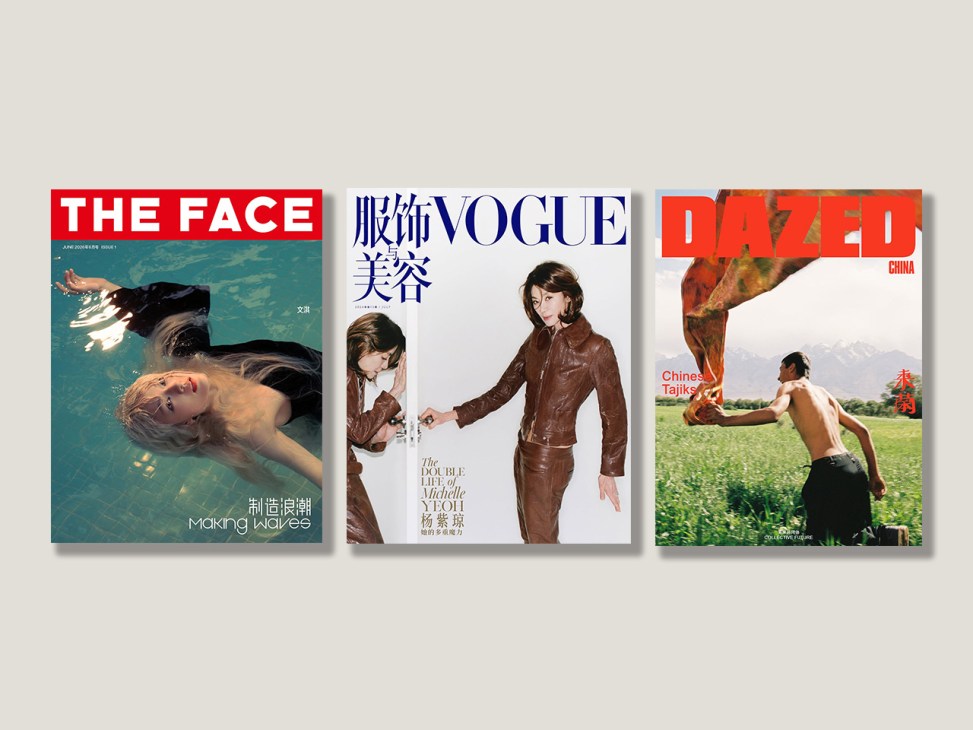
While many fashion magazines in the West are reducing their size or closing entirely, titles such as ‘Vogue Man’, ‘The Face’ and ‘Another’ have turned to China.
Few people would suggest that this is a golden age for magazines but perhaps it is – just not in the places that you might expect. In recent months, Chinese magazines have outshone Western counterparts with their creativity. Fashion editorials such as Vogue Man’s poetic Winter Olympics team shoot by Win Tam, W Magazine’s painterly editorial by Leslie Zhang or Super Elle’s whimsical “neo-Chinese” feature by Wei Huan have caused a stir thanks to their visual lyricism.
While many fashion magazines in the West are closing their doors, streamlining operations or shifting away from monthly release cycles, China’s magazine scene is booming. GQ returned to the country in January after ceasing operations in 2024. In March, The Face announced the closure of its UK operations and, weeks later, its pivot to the East. Another magazine launched a Chinese edition in February and Dazed China followed in June.
“The real drivers of change are economic and social, and both have moved very fast in the past few decades,” says Olivia Chen, co-founder of Shanghai-based design and fashion agency 2034. “In the past, cultural trends moved from West to East: the East would adapt or copy. But now, with Chinese ‘zoomers’ [Gen Z] as the future of this market, they are more confident to question what’s being received and to express themselves differently.”
Having grown fivefold since 2016, China’s luxury goods market is now one of the world’s largest. That momentum, along with predictions that the country will account for 35 to 40 per cent of global luxury spending by 2030, explains why houses such as LVMH, Kering and Hermès have made themselves at home in Beijing since the pandemic.
But investments alone don’t tell the full story. A heavy concentration of Chinese consumers is aged 25 to 35, plus there’s a growing cohort who are even younger. They have had decades of steady economic growth to confidently embrace their own style – one that, in line with the country’s modern diplomacy, doesn’t seek Western approval.
The result is an independent creative bubble, grounded in local references and resources. In a world increasingly homogenised by social media and artificial intelligence, that homespun inspiration feels authentic. It’s a much-needed breath of fresh air in an industry suffering from cover-star fatigue and slop content.
It also helps that many Chinese editions of these magazines, from Vogue and Tatler to Madame Figaro, are locally owned and do not answer to their Western parents. “We’re in an era of emotional engagement,” says Julio Ka Yeung Ng, the other co-founder of 2034. “Magazines need to establish a connection with their consumer through storytelling, image and product perspective. If decision-makers are based in the West, they probably don’t know much about local Chinese taste, culture and social media. In that sense, local ownership brings more legitimacy.”
State control plays a role here too. Political risk-taking is not an option for magazines but it can also be argued that, with this kind of provocation off the table, Chinese titles are being aesthetically daring instead. “I find it incredibly gutsy and inspirational to have so many Chinese creatives pushing a highly distinctive visual language to the outside world, rather than conforming to a Western template,” says Ng. “The fact that foreigners now recognise it is proof that this risk is paying off.”
Chinese consumers are increasingly turning to homegrown brands, including jeweller Qeelin, high-end lifestyle label Shang Xia and jewellery brand Laopu Gold. As China shifts its diplomatic policies toward softer power, advertisers might soon compete more fiercely for space in magazines. “In the coming years, there will be a lot of local contemporary designer brands growing within the Chinese market,” says Ng. “People want something new and they like to shop domestic brands.”
That is a healthy sign for the future of Chinese print. And if this trend holds, the next great print titles might not be written in Paris or Milan but instead in Shanghai or Beijing.