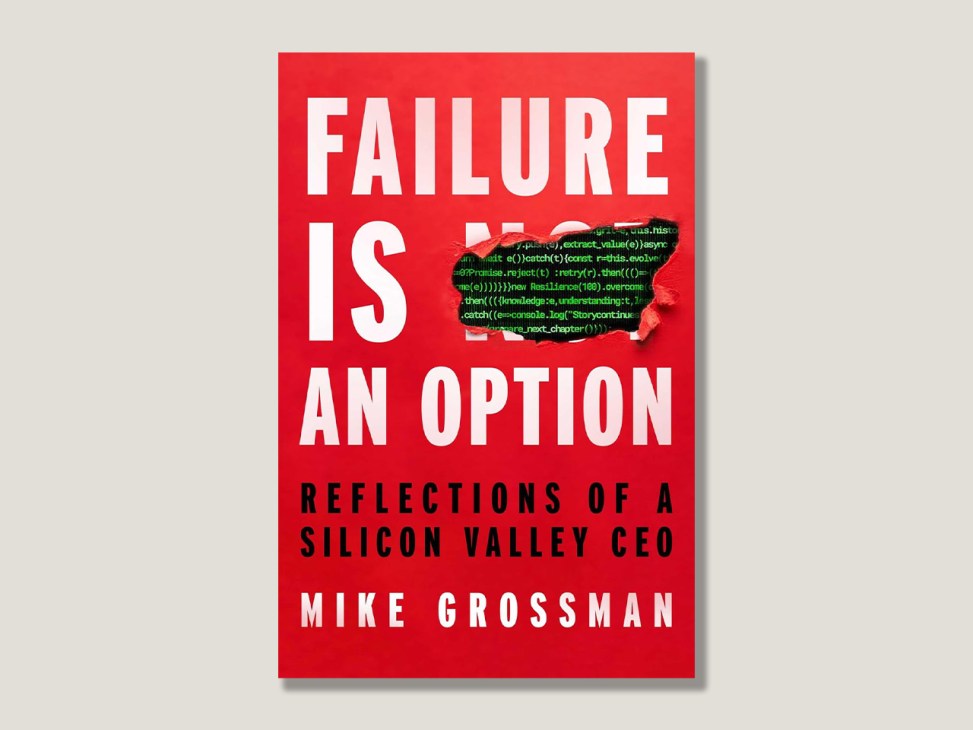
The six-time executive and author of ‘Failure Is An Option: Reflections Of A Silicon Valley CEO’ shares his take on how to grow businesses.
Spend any time in an airport bookshop and you’ll see stacks of brightly coloured books promising to impart the secrets to success. These volumes – presumably, given their proliferation – do pretty well for their authors and publishers, but are of more debatable value to their readers. The success of other people is rarely that interesting or instructive. Failure, on the other hand, is often a better teacher and usually a more compelling story.
By most measures, Mike Grossman is a successful serial entrepreneur: he has been, among other things, a CEO of six venture-backed Silicon Valley technology companies, including Zetta, Inflection and Live Capital. As he cheerfully admits, he has also failed frequently and, occasionally, spectacularly. His latest venture is a contribution to the business shelves: Failure Is An Option: Reflections Of A Silicon Valley CEO.
The book is a collection of thoughts on what went wrong along the way, why it happened and whether there is anything useful to be learned from the experiences. One of its strengths is its humour; it shows that with any success, it is necessary to be able to laugh at your failures. Monocle Radio’s Andrew Mueller spoke with Grossman about the book, how to avoid taking setbacks personally and whether you can truly learn from others’ shortcomings.
Why was it important to write a book about failure?
I wasn’t interested in writing a book that was like everybody else’s. It seemed to me that when I looked at business books, they fell into two categories. The first is how to sell, how to market and how to raise money. The second is biographies or autobiographies, which are all very similar: business starts in great excitement, adversity strikes, people get through the adversity and then there is enormous success. My experience in Silicon Valley has been that there are ups and downs in random sequence. It’s a wild roller-coaster ride. It doesn’t always end in success and there is always failure along the way.
Is there a formative failure that you reflect on in particular?
I have run six venture-funded companies and we [began] experiencing failure from moment one. I started one company [on] the same day that my wife went into labour with our first [child] and we were incredibly excited. I say ‘we’ because I had a business partner and then [that became] two business partners. Within six weeks, it looked like we were going to successfully raise money but, for reasons that I describe in one chapter of the book, it fell apart very quickly. We spent two years in the wilderness, metaphorically, trying to build something [without being] able to raise any money. Eventually, we broke through and started making progress. Those first two years were fun but were more about failure than anything else.
That’s how I entered the entrepreneurial arena. What I found is the condition of doing entrepreneurship. The truth is: companies struggle mightily, even the ones that are successful in the end. You can’t avoid the struggle.
One of the more bracing lessons of the book is that you can do everything right – work hard, assemble a great team – and still fail. What can we take away from that?
Just because things often fail doesn’t mean that they will always fail, and companies can find a way forward. There are opportunities to pivot and pivot again, and eventually, you find a way. One of the things that I have learned is that when things are going well, you should [also] expect them to not go so well. But when things are going badly, if you have a committed team that works hard and is adaptable, you’ll eventually start doing better. Having a realistic view of the challenge is very useful. Once I accepted it as a working condition, I was able to ride the ups and downs much better.
How important is not taking failure personally?
People often identify the outcome with themselves. So if the outcome is good, they feel better about themselves, and if the outcome is bad, they feel worse. But the truth is that you can’t control the outcome, you can control how hard you work. You can control whether you have a great team. You can control whether you’re approaching a problem in a thoughtful way. One of the lessons I have learned is: don’t think of the company as connected to yourself. You’re not your situation, you’re not the company.
At the risk of undermining the premise of your book, can we really learn anything from other people’s failures? Isn’t it human nature that we have to learn everything the hard way?
That’s an interesting question. It reminds me of something that my father told me when I was younger. He said that when I was little, he wanted to teach me all sorts of things. [But] somewhere along the line, he concluded that I needed to experience it all myself or I wouldn’t really understand it. I believe that we ultimately learn the most when we experience things ourselves. Having said that, I thought that it would be interesting to reveal what it feels like to be in this type of entrepreneurial context, failures and all.