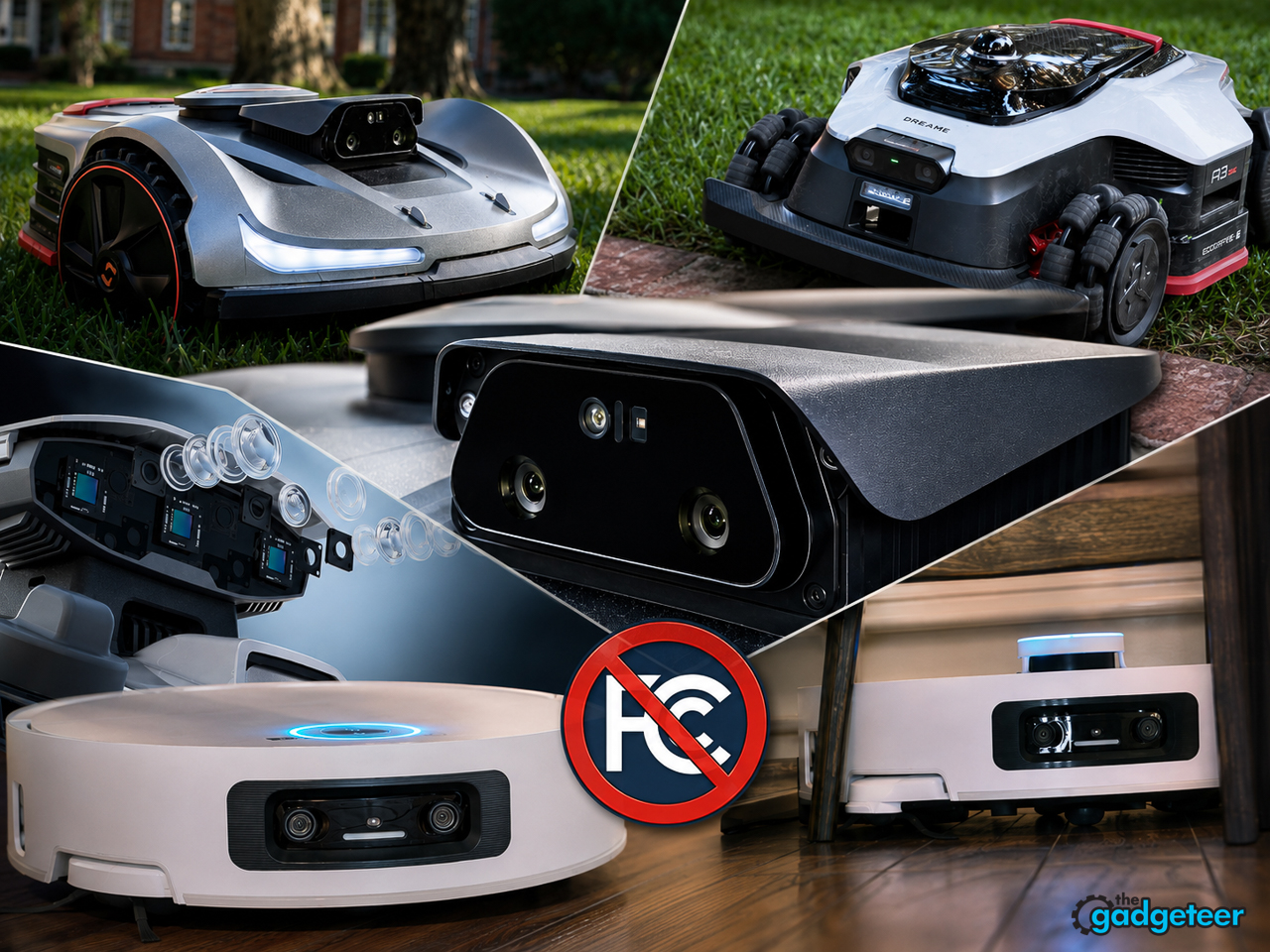
The robot you own didn’t become contraband
The FCC’s new restriction sounds broad, but it doesn’t outlaw the robot vacuum or mower you already own. The real question is whether future foreign-produced models can receive the authorization required to reach US stores.
Your vacuum can still roll off its dock tonight, trace the same lines across the carpet, and return to charge. The uncertainty is about products that haven’t reached the US market yet.
What the FCC actually changed
On July 28, 2026, the FCC added foreign-produced advanced robotic devices to its Covered List. The action followed a National Security Determination from a White House-convened executive branch interagency body, which found that these devices can create unacceptable supply chain and cybersecurity risks.
Equipment on the Covered List can’t receive new FCC equipment authorization. Most electronic devices with radios need that authorization before they can be imported, marketed, or sold in the US, so the change generally blocks new covered models from entering through the normal approval process.
The FCC’s Public Notice DA 26-786 establishes the restriction, while the agency’s consumer FAQ explains the practical effect. Previously authorized models can still be imported, marketed, sold, and used. New foreign-produced models generally can’t receive authorization unless they qualify for Conditional Approval.
Why vacuums and lawn mowers are included
The official definition doesn’t name every consumer product. Instead, it covers a mechanical mobile device that meets all of these conditions:
- It can move, navigate, or avoid obstacles on the ground
- It operates away from a human operator using commands or sensor data
- It weighs more than 4.4 pounds when an applicable dock or ground station is included
- It has a sensor that can perceive its environment
- It supports wired or wireless connectivity of at least 200 kbps in either direction
- It runs software that controls movement, perception, data collection, or remote commands
That description fits many connected robot vacuums. They navigate rooms, map obstacles, connect to Wi-Fi, run autonomous-control software, and usually clear the weight threshold once their docks are counted. FCC media relations director Katie Gorscak confirmed the vacuum coverage to The Verge.
Robotic lawn mowers can meet the same test. PCMag reports that the FCC confirmed the restriction also reaches robot lawn mowers, though coverage still depends on whether a specific model satisfies the complete definition. App connectivity or GPS alone isn’t enough.
Robot vacuums are becoming more capable, connected, and software-dependent. Some can move objects, recognize clutter with cameras, and use docks that do nearly everything but put the machine away. Our coverage of a robot vacuum that picks up socks shows how quickly these devices are becoming more capable, more connected, and more dependent on software.
Which robots aren’t covered
The determination explicitly excludes connected vehicles, rail vehicles, uncrewed aircraft, underwater vehicles, regulated medical devices, mobility aids, and fixed stationary robots such as industrial arms. A device outside those categories still has to meet every technical element before it’s covered.
Some products remain harder to classify. A simple boundary-wire mower without qualifying network connectivity may fall outside the definition. A robotic pool cleaner may also fall outside if it qualifies as an unmanned underwater vehicle, but the category name alone doesn’t settle the legal question.
Delivery robots, security patrol robots, and snow-removal robots aren’t automatically exempt. Each model has to be evaluated against the full definition, its production status, and any Conditional Approval it receives.
What happens to existing products and updates
Your current robot vacuum or mower isn’t illegal, and the FCC isn’t asking anyone to surrender a device. A model that already received FCC authorization can continue to be imported, marketed, sold, and used under this action.
That protection applies to the authorized model, not every product a company might release under the same brand. An FCC ID can help confirm that a specific device received authorization, but it doesn’t guarantee that a future replacement or redesigned model will qualify.
The FCC action doesn’t require manufacturers to shut down apps or cloud services, although companies can still change or discontinue them for other reasons.
A separate FCC action deals with updates. Under waiver DA 26-789, already-authorized covered robots can continue receiving qualifying software and firmware updates that mitigate consumer harm through at least January 1, 2029.
That includes updates that patch vulnerabilities, preserve functionality, or maintain compatibility with operating systems. The waiver addresses Class I and Class II permissive changes under FCC rules. It doesn’t eliminate every other requirement that may apply to a modified device.
Ordinary mobile-app and cloud-service changes generally aren’t affected if they don’t alter a robot’s authorized radio operation. What happens after January 1, 2029 isn’t settled, though the FCC could extend the waiver or take another action before then.
Conditional Approval is the path for new models
Conditional Approval isn’t the same thing as the firmware waiver. A producer of a foreign-produced advanced robotic device can ask the Department of War to determine that a device or class of devices doesn’t pose an unacceptable national security risk. If that determination reaches the FCC, the product can be exempted from the Covered List restriction.
The application asks for details about ownership, manufacturing, design, assembly, component sourcing, software development, testing, foreign-government relationships, security controls, and data practices. The guidance also encourages applicants to describe any US manufacturing commitment and timeline.
Approval can cover a particular device or a class of devices, but it isn’t automatic. Interested entities can submit the requested material to [email protected].
This isn’t a China-only rule
The FCC says the restriction is country-neutral. “Foreign-produced” refers to whether an article qualifies as a domestic end product under 48 CFR 25.101(a), not the nationality printed beside a company’s headquarters.
That means a European or American brand doesn’t automatically escape the rule if its product is foreign-produced. A Chinese-owned company isn’t automatically blocked from every future model either, since a qualifying domestic product or a device with Conditional Approval could still have a path to authorization.
The Roomba example is especially complicated. Shenzhen Picea Robotics acquired 100 percent of iRobot in January 2026, but ownership alone still doesn’t answer whether a particular Roomba model is foreign-produced under the FCC’s incorporated legal test. Production and sourcing details will matter more than the familiarity of the badge on top.
No robot-vacuum or mower manufacturer has been individually added to this category by name. The restriction applies to covered products based on production status, which is why brand-level lists can create more confusion than clarity.
Why the FCC sees connected robots as a risk
The National Security Determination points to incidents involving remote access, surveillance, and control of foreign-produced robots. These aren’t abstract risks when a machine can see a room, hear nearby audio, map a home, or move under remote command.
The cited examples include a vulnerability that reportedly exposed thousands of consumer robots, including cameras, microphones, and home maps. The Guardian reported that one person gained access to about 7,000 robots.
The determination also cites a humanoid-robot flaw that enabled remote takeover and scanning for nearby robots, creating botnet potential. IEEE Spectrum covered that exploit. A separate incident involved an alleged backdoor in robotic quadrupeds that could expose camera feeds and full control, according to Axios.
A compromised connected robot can expose private data and allow someone else to control a device inside the home. That’s part of a broader smart-home tension we’ve been tracking as homes gain more connected devices: convenience grows, but so does the amount of trust placed in software, cloud infrastructure, and whoever controls the update pipeline.
What shoppers should check now
Before buying, verify the specific model rather than trusting broad claims about a brand or product category.
- Look for an FCC ID tied to the exact model
- Check whether the product is already officially sold in the US
- Read the manufacturer’s support and warranty terms
- Confirm that useful basic functions work without cloud access
- Treat future US launch dates as uncertain until authorization is clear
- Watch for statements about Conditional Approval or domestic production
- Be cautious with imports that lack US authorization
An FCC ID confirms that a particular model received authorization, but it doesn’t promise permanent cloud support or approval for a successor. Keep the model number, FCC ID, and purchase records in case you need to distinguish your device from a later revision.
What still isn’t clear
Implementation will determine how disruptive the rule becomes. Several practical questions remain:
- How quickly Conditional Approval applications will be evaluated
- Which consumer robots will be formally identified as inside or outside the definition
- How warranty replacements, refurbished units, and materially revised models will be treated
- Whether manufacturers can adapt existing authorized platforms without triggering a new authorization
- How many companies will pursue domestic production instead of Conditional Approval
The answers will determine whether US buyers see a smaller selection, delayed launches, or a production shift. For now, any confident prediction about which brands will disappear goes beyond what the FCC has established.
The bottom line
The FCC didn’t ban the robot vacuum in your hallway or the mower charging beside your garage. It created a barrier for new foreign-produced models that meet its advanced-robot definition and need authorization to enter the US market.
Previously authorized models can still be sold and used, and qualifying software and firmware updates can continue through at least January 1, 2029. Future models have a path through domestic-production status or Conditional Approval, but neither route is guaranteed.
That’s why the real impact won’t show up as agents knocking on doors for Roombas. It’ll show up in the next product cycle, when some overseas robots arrive late, change where they’re produced, or never reach US shelves at all.
Sign up for our newsletter today.
No ads, no spam, just links to our latest articles!
![[MINI SIZE. ULTRA PORTABLE CHARGER]: Roughly the size of an AirPods Pro case, this smallest power bank packs 10,000mAh of long lasting power into a tiny, nano footprint. Easily slide this ultra slim, credit card size charger into your skinny jeans, a...](https://m.media-amazon.com/images/I/41rATpm6dyL._SL160_.jpg)
Now retrieving an image set.
INIU Portable Charger, Ultra Mini 10000mAh 45W Fast Charging with Detachable Cable, Flight-Safe Travel USB C Power Bank External Phone Battery Pack for Xiaomi iPhone 17 16 Samsung S26 Google iPad etc
(as of July 13, 2026 18:57 GMT -05:00 – More infoProduct prices and availability are accurate as of the date/time indicated and are subject to change. Any price and availability information displayed on [relevant Amazon Site(s), as applicable] at the time of purchase will apply to the purchase of this product.)

Now retrieving an image set.
DEWALT Heavy Duty 3-in-1 Mini Stylus Pocket Pen, Tablet Pens for iPad, EDC Touch Screen Pens, Ballpoint w/Touchscreen Tip, Keypad Tip, Compatible iPhone Stylus Pen, Extra Ink Cartridge
(as of July 13, 2026 18:57 GMT -05:00 – More infoProduct prices and availability are accurate as of the date/time indicated and are subject to change. Any price and availability information displayed on [relevant Amazon Site(s), as applicable] at the time of purchase will apply to the purchase of this product.)