Sitting by the pool at Hotel Esencia, wedged between dense tropical forest and the Caribbean Sea, it’s hard to believe that we’re only a 90-minute drive – past walls shielding all-inclusive mega resorts and water parks – from Cancún Airport, Mexico’s busiest hub for international travel. From there, most visitors make their way straight to the pool bar at their hotel in Cancún or they continue on to Playa del Carmen or Tulum, a bohemian-beach-town-turned-Instagram-trap. But away from the high-rises and hidden in the jungle away from the high-rises is where you’ll find the 12 hectare estate of Hotel Esencia.
Cancún became a spring-break destination in the 1990s, drawing thousands of annual partygoers ever since. Tulum only started attracting real tourist traffic in the early-to-mid 2000s, but has since become overdeveloped, with a coastline fringed with open-air beach clubs and its own international airport. Some three million travellers flood into the area each year. While some view this as a success story, others see it as a calamity – a once-pristine shoreline ravaged by overtourism.
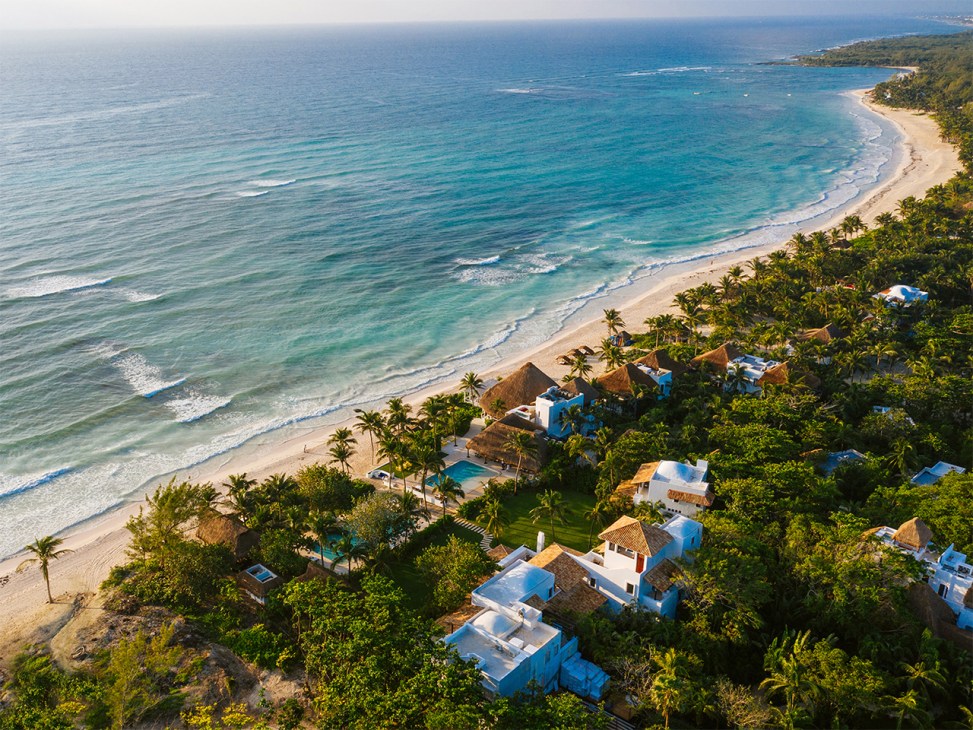
After an hour at Hotel Esencia, listening to birds chirping in the jungle and waves crashing just feet away, the spring-breakers and cookie-cutter hotel towers are a distant memory. “When I first discovered the Tulum area and Playa del Carmen 20 years ago, it was up-and-coming,” says owner Kevin Wendle, who began his search for property in Tulum but was unable to find anything suitable. “I thought, ‘Maybe I’ll go second best.’” In 2014, he came across a home-turned-hotel on an immaculate beachfront which once belonged to an Italian duchess. His lack of luck in Tulum ended up “being a blessing”. “I found a lick of beach that I’ve managed to protect by collaborating with our neighbours,” he says. Over 18 months, he transformed the property into a luxury offering with a handful of casitas overlooking the beach or tucked into the jungle.
The hotel is luxurious but far from flashy. White-washed rooms are decorated with handmade rugs and mid-century chairs, along with pieces by Studio Giancarlo Valle and Ceramic Suro. As development rolled on, Wendle made a few changes here and there – adding a gym, more casitas and new F&B offerings, that also acquired more land. But the feeling of the space largely remained the same. “Where our improvements have come from is me learning as a hotelier,” says Wendle. The evolution has been incremental and intentional. While there have been some bigger additions, such as the spa and a Beefbar restaurant, many changes have been as small as “let’s remove these faucets, sell them and replace them.”
Pool Villa
1 / 4


Wendle has seen many hoteliers in the area open a business only to overhaul it a decade later. Thankfully, he doesn’t have investors to answer to, and has his heart set on providing the quality and attention to detail that ensures his hotel stays unchanged and proudly unique. “You return [to a hotel you used to visit] and think: What happened? It was so great 10 years ago,” he says. “That is something that is never going to happen here.”
Many of Hotel Esencia’s guests are returning visitors or people in-the-know. “When I launched Esencia, our clients wanted to go to Tulum because of the buzz around it,” says Wendle. But as the town’s restaurants became overcrowded and condos replaced nature, visitors decided to stay put on the hotel’s premises. “Clients were coming from Europe and I thought: How do I keep them here?” So he upgraded the offerings. When the hotel welcomed a brick pizza oven, it also welcomed a pizzaiolo from Naples. When the kitchen began to offer sushi, he enlisted guidance from the owners of a well-known spot in Miami.

To help with the initial rebranding of the hotel, Wendle tapped the talent of Juan Carlos Gutiérrez. Born in Mexico, Gutiérrez had been working as a graphic designer at Chanel in New York. Having always had a passion for food, he was also tasked with reimagining the restaurant menu (and, at one point, was the executive chef). Today, he is the hotel’s artistic director. “Kevin has a [new] point of view – there’s always change and innovation. I am more old-world; I like things to be the same,” says Gutiérrez. “My goal is to create a place where [guests] feel at home.” Details are what guide this aesthetic. “Everything has to be handmade or custom-made, not picked from a catalogue. It needs to have substance to it.” So many hotels, he adds, “don’t have a story to tell.”
But a large part of Hotel Esencia’s story is about the Riviera Maya before it became a playground for holidaymakers. Knowing how Cancún, Playa del Carmen and Tulum have developed, would Wendle open here again? His answer is unequivocally yes. Beyond the zip lines and mega resorts, pockets of natural beauty remain. There are cenotes and nature reserves within driving distance, and the hotel is a short walk from a secluded lagoon where manatees swim. “We have all this Mayan heritage around us, and that’s not going to change,” says Wendle. Being close to Cancún Airport has its benefits too. With nonstop flights to major cities such as New York and London, it’s incredibly easy to access. “You don’t need a connection, you don’t need a boat. You can just arrive.”