Countries with ageing populations are busily searching for ways to help their people age gracefully. Singapore has a plan in place that’s proceeding in leaps and bounds.
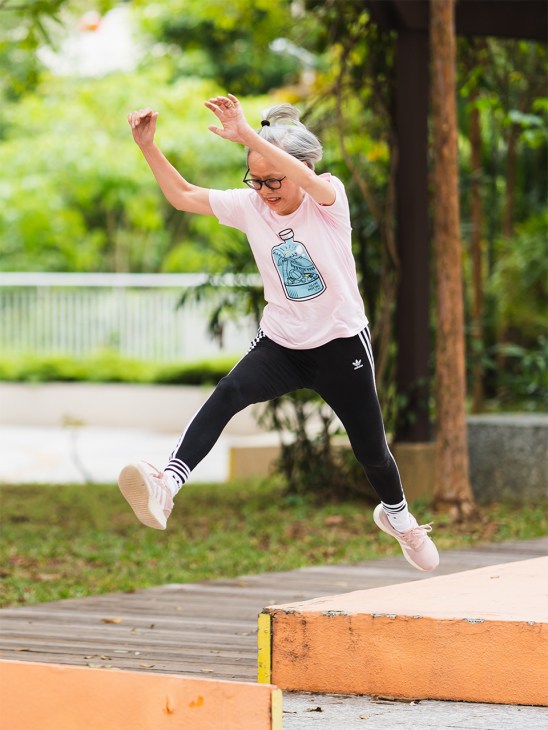
In a playground beneath a Housing & Development Board estate in Singapore, a group of people in their sixties and seventies crawl on all fours across concrete, gripping rails and climbing low walls. The air is already heavy with heat and everyone moves carefully but deliberately. To a passer-by, it might look unusual. To the group, it’s just a regular morning geriatric parkour session.
In a country where more than one in five citizens is now aged 65 or older, the unexpected practice reflects a wider question Singapore has tried to answer for decades: how can people remain active, independent and connected as they age?
For Tan Shie Boon, former parkour athlete, the answer begins with exercise. Shie Boon founded Movement Singapore in 2022 with a philosophy inspired by the Yamakasi collective – the French group often credited with creating parkour. His approach is less about acrobatics and more about spatial awareness: crawling, climbing, balancing and learning to move through an environment with control and confidence. The principle behind Movement Singapore is simple: “If you don’t move your body, you will lose your function.”
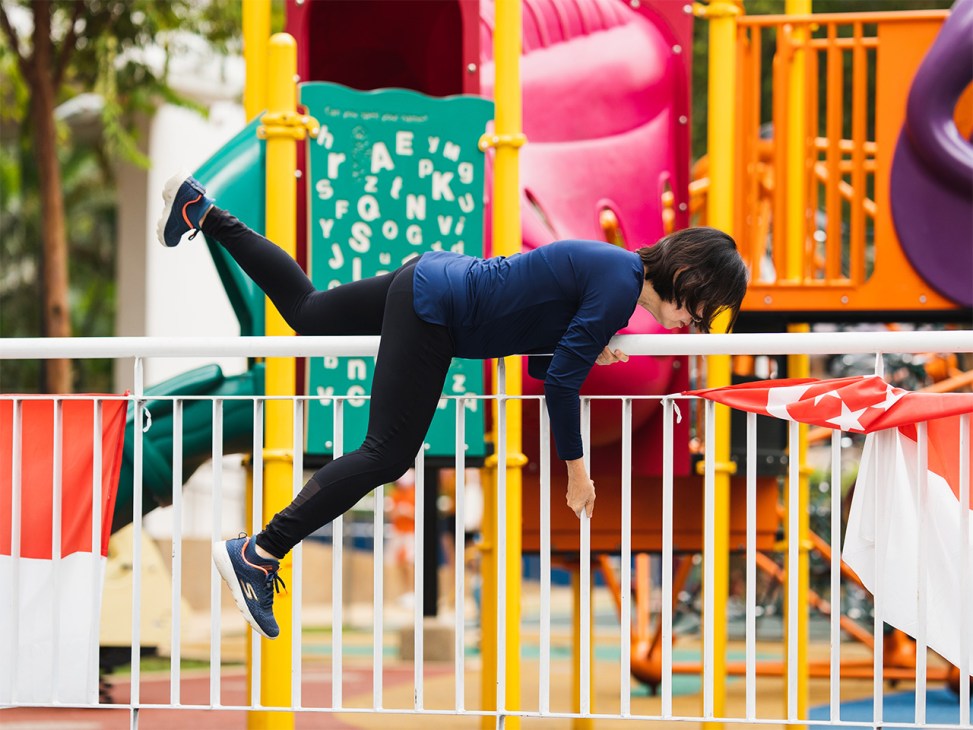
Movement Singapore started with one 64-year-old student. Today, Shie Boon teaches 35 people ranging from their late forties to 75, most of them women. In four years, the group has recorded only one significant injury – a wrist fracture – and the student returned.
Sessions start simply: a warm-up, circuits and a sequence of movements across rails, walls and slopes. But Shie Boon leaps beyond fitness. He calls it the “parkour vision”: learning to see the city differently, not as a series of obstacles but as a landscape of possibilities. “You start seeing opportunities everywhere you go,” he says.
Tian Chu joined four years ago after friends encouraged him to try parkour. Already an active scuba diver and skier in his sixties, the movement changed his relationship with the city that he has always lived in, making him notice surfaces, obstacles and possibilities previously ignored. “A lot of the exercises we do mimic real-life examples,” he says. “When you cross a wall, when you run up a slope, it asks you whether you have the ability. And I think this gives you confidence.”
Among the skills that Chu has learned, the lesson that has stayed with him is how to fall safely. Boon teaches students to tuck their chin towards their chest when they fall, a small adjustment that can prevent a much more serious injury. Parkour has found a natural home in Singapore, where ageing has long been considered a question of urban design as much as healthcare. The city-state has spent decades designing neighbourhoods that foster healthy ageing.
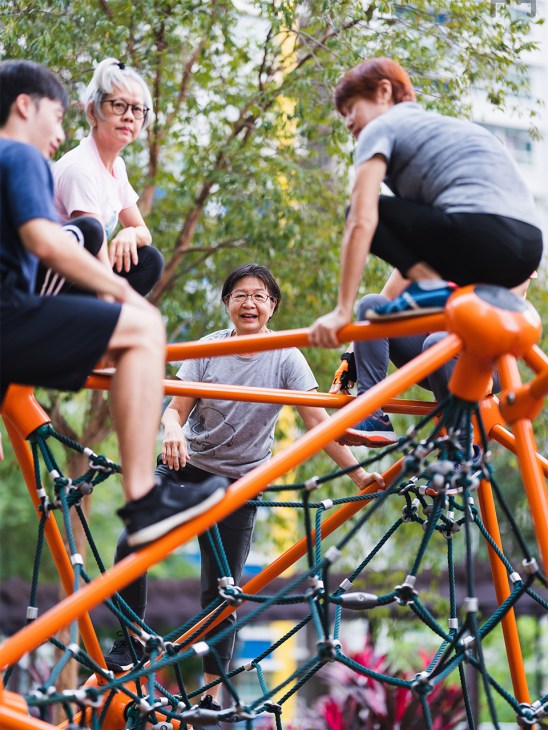
Eugene Lau, director at Singapore’s Urban Redevelopment Authority, says that the city-state’s planning philosophy has long been built around independence and connection. “We focus on creating neighbourhoods where people can be active, independent and able to age in place while connected to the community they are familiar with,” he says. In practice, that means barrier-free access, sheltered walkways with no gaps and public spaces conceived as what Lau calls a “community living room” – an extension of the home where residents can gather throughout the day.
By 2030, Singapore aims for every resident to live within a 10-minute walk of a park. When Lau heard about seniors repurposing rails and ramps of public spaces for parkour training, he saw it as another example of how the city’s public areas are changing. “Public space is no longer just about providing seats for the elderly to sit down,” he says. “They are no longer content with that.”
While parkour will not solve the challenges of an ageing population on its own, it could be one piece in the larger puzzle of helping people to age gracefully. In the early morning shadow of a housing block, these elderly urban gymnasts offer a more flexible image of growing older: one that fast-ageing cities elsewhere might do well to jump on.
Joana Moser is a radio researcher with Monocle. Cartwheel into the Quality of Life Survey here. For more opinion, analysis and insight, subscribe to Monocle today.