Lisbon is packed with history, culture, and all kinds of cool experiences that could keep you busy for days. But it also makes a fantastic home base for exploring the nearby towns and beaches. A short trip is all it takes to reach some seriously amazing places just waiting to be explored.
From charming coastal towns to UNESCO World Heritage sites, these nearby destinations boast a diverse mix of stunning landscapes, historic landmarks, and rich cultural experiences that make up for the best day trips from Lisbon.
Having lived in Lisbon since 2016, I have had the opportunity to extensively explore the surrounding areas and gain insight into the most rewarding day trips. Here are my top picks, plus the detailed logistics on how to make them happy!

Sintra’s fairytale palaces, the rugged cliffs of Cabo da Roca, and Cascais’s seaside charm are all within reach of Lisbon. This guided day trip lets you visit them all without juggling trains or buses.
How to travel from Lisbon
First, some logistics. From Lisbon you have a few different transport options into the region.
For day trips to Sintra and Cascais, trains are the easiest and most budget-friendly option. Tickets are cheap (usually just a few euros) and trains run frequently throughout the day. For schedules and ticket bookings, check the official Portugal Rail website, Comboios de Portugal or Trainline.com.
Other places close to Lisbon, such as Costa da Caparica, Arrábida, and Setúbal, are easiest to reach by city bus. One unified bus company, Carris Metropolitano, now serves the whole greater Lisbon area. (Old travel guides may still mention 3-digit bus numbers. The correct new lines are 4 digits.)
Places further afield, like Óbidos or Nazaré, can be best reached using the comfortable and modern national coach buses from Rede Expressos. Journeys can be over an hour, so it’s worth checking schedules in advance to plan your trip efficiently. Most coaches leave from the Sete Rios or Oriente bus stations.

To explore at your own pace it can be worth renting a car, especially if you want to leave the capital for a few days. This is ideal for road-tripping along the coast, visiting the wineries of Setúbal, or exploring the rolling landscapes of the Alentejo region. Don’t miss my tips for renting a car in Portugal.
If you’re short on time and not in the mood to plan, you can always hop on a tour. I’ll mention easy tour options throughout this guide!
1. Sintra

Sintra is easily the most popular day trip from Lisbon, thanks to its stunning gardens, palaces, and mountaintop Moorish castle.
The most important thing to know about this must-do day trip from Lisbon is that there is a lot to see. Make sure you get an early start so you have plenty of time to explore. The sights are somewhat spread out and it’s easy to underestimate just how many hours you can spend in Sintra.
It’s possible to visit Sintra independently by taking the train from Lisbon and using local shuttle buses there. I recommend leaving before 9 a.m. so you can have a proper full day in Sintra. However, given the many sights, it can be a lot more efficient to visit Sintra on a tour.
The town of Sintra itself is cute with lots of medieval architecture and set amongst green mountains, but the real reasons to visit are the sights among the surrounding forests.


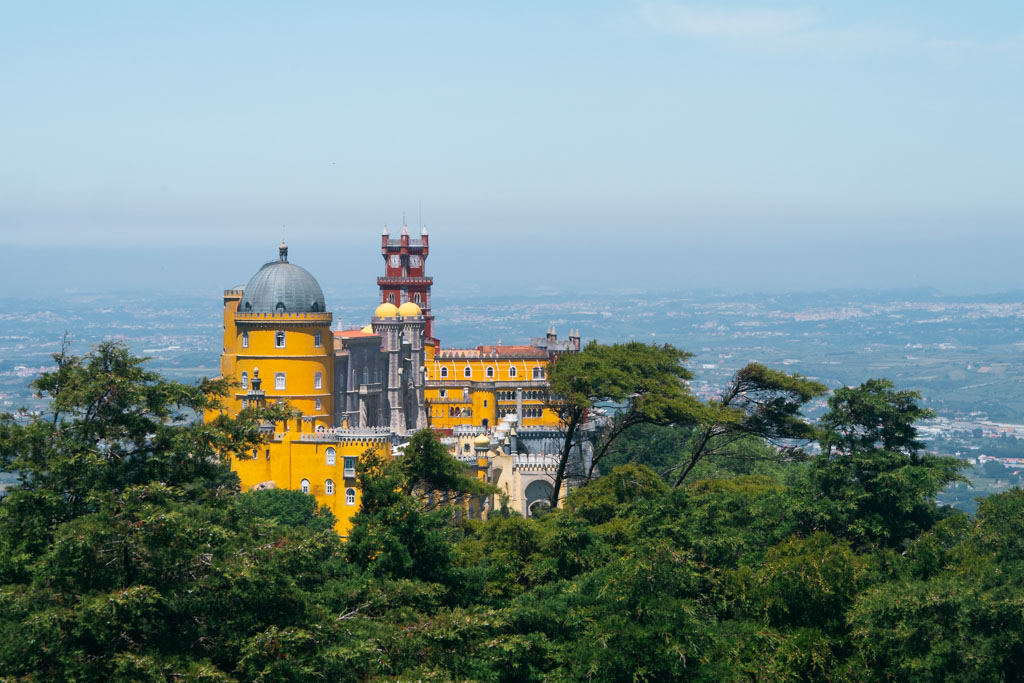
The Palácio Nacional da Pena is a must-see, as is the medieval Castelo dos Mouros, which offers great views of the Atlantic coastline. The Quinta da Regaleira is a wonderful place to explore as well; an eccentric and magical garden filled with cave tunnels, interesting romantic architecture, and a mysterious stone well.

Honestly, there’s a lot more to see in Sintra. You could easily spend three days there if you want to see it all! I actually think you can spend 3 days there if you want to see it all!
But to see the absolute highlights, I recommend this small group tour which covers the Pena palace, the castle, and the Regaleira gardens.
Before you leave Sintra, be sure to grab a travesseiro pastry and a queijada tart at Casa Piriquita, a bakery that has been open since 1862.
How to get around Sintra:
- By train: catch the direct train to Sintra from Rossio railway station in central Lisbon. It takes about 40 minutes. It’s then about a 20-minute walk to the old town of Sintra from where you can arrange further transportation.
- By car: drive to Sintra via the A37. It takes about 50 minutes depending on traffic.
- By tour (easiest option): This full-day tour covers Quinta da Regaleira, Pena Palace, and Sintra’s old town.
How much time do you need? The drive from Lisbon to Sintra takes about 30 to 40 minutes by car. If you’re taking public transport, such as the train, it typically takes around 40 minutes.
2. Óbidos

With its many restored buildings with flowers hanging from balconies, Óbidos is one of the prettiest towns you can visit in Portugal. Its cobbled streets, white cottages covered in colorful wallflowers, and a still-intact outer castle wall make it an utterly romantic place.
It’s a lot further from the capital than Sintra (it takes about 80 minutes to drive to), but it’s still one of the best day trips from Lisbon.
Óbidos is an old medieval town that was given to Queen Isabel de Aragon as a wedding gift from her husband King Dinis in the 13th century. It continued to pass between royal families until the 19th century. The town was once enclosed by a stone wall that dates back to the medieval period and you can still walk along what’s left of it today.

Interestingly, the history of Óbidos is closely tied with literature. In fact, the town is a UNESCO City of Literature, so it has some interesting bookstores. One of the most impressive is the Livraria de Santiago, which is within the 18th-century São Tiago church.
Try some ginjinha (a sour cherry liqueur originating in Obidos) or have a cold beer at a plaza. The best way to get to know Obidos is to just wander around and get a bit lost along the cobblestone streets.

How to get around Óbidos:
- By bus: catch a Rodoviaria do Oeste bus from the Campo Grande bus station (you can see the schedule online and buy your ticket at the station).
- By car: Obidos is about 75 minutes from Lisbon. You can get there via the A8 if you’re driving.
- By tour (easiest option): Organized tours starting in Lisbon are also available. These combine Obidos with other places like the religious sanctuary of Fatima and Nazaré, the site of the world’s tallest waves and surfing world records. Check this group tour on GetYourGuide.
How much time do you need? The drive from Lisbon to Óbidos takes around 1 hour to 1 hour 15 minutes by car. If you’re taking a bus, it usually takes about 1.5 to 2 hours.
3. Serra da Arrábida & Sesimbra


The Serra da Arrabida is a small mountain range that extends above the bay of Setúbal south of Lisbon. There’s a mix of lush coast, green woodland, and shrubland making it an interesting place to hike.
There are some public transport links to the towns of Sesimbra or Setúbal, but you won’t get to many other places by bus.
If you’re just going on a day trip, it’s worth hiring a car for a day and going on a mini Portugal road trip to make the most of your time.
Some of the most gorgeous beaches near Lisbon can be found here, such as Galapinhos Beachand the well-hidden but wonderful Ribeiro do Cavalo beach, where the rugged cliffs may remind you of the beaches in the Algarve.
There are lots of hiking trails too, which are clearly marked. If you want to check some routes out beforehand or download a map, I’d recommend using AllTrails.

While in Sesimbra, visit the 17th-century Fortaleza de Santiago, and don’t skip the Museo do Mar (Museum of the Sea) within the fort if you want to find out about the town’s history. There’s a Moorish castle above the town too, which dates to the 10th century.
It’s worth having some freshly caught grilled sardines while you’re there. The town also has lots of watersport tours on offer, like diving and kayaking.
The Arrabida National Park is filled with hidden beaches, caves, and coves. Although the weather is pretty cold even in summer, if you squint your eyes some of the sandy beaches may look like tropical hideaways.
The coast here is perfect for sea kayaking, having calm waters and many interesting rock features. I’ve done this kayaking trip starting in Sesimbra and think it’s one of the best outdoor activities you can do near Lisbon. The guided trip takes you to some secret spots and includes lunch at the gorgeous Ribeiro do Cavalo beach.


How to get around Serra da Arrábida & Sesimbra: Aside from limited public transport, many of the stunning beaches, hiking trails, and hidden gems are tucked away and not easily reachable by bus, so renting a car is your best bet.
If you’re feeling adventurous, renting a bike or scooter is a great way to zoom around and soak in the views on the scenic roads and trails.
How much time do you need? It takes approximately 45 minutes to drive from Lisbon to Serra da Arrábida and about 40–50 minutes to reach Sesimbra by car.
4. Setúbal

The small city of Setúbal, located south of Lisbon along the Sado River estuary, makes for a fun day out from Lisbon.
If it’s your first time in Lisbon, it might not be at the top of your list—most visitors are likely to head straight for iconic spots like Sintra first. But if you have an extra day to spare, it’s a lovely and not-touristy place to go.
Located near a ferry terminal and port, the town is a mix of historical streets and some more commercial areas. It’s a real Portuguese city with some beautiful parts and some industry (further to the east).

I recommend hiking up to the São Filipe fort, from where you get wonderful views of the bay. Much like Sesimbra mentioned earlier, Setúbal makes for a great waypoint towards the beautiful cliff-backed beaches of the Arrabida National Park, with Galapinhos Beach being a real highlight here.
Setúbal is especially lively on Sundays, when crowds gather in the many seafood restaurants to gorge on “choco frito” (Portuguese for fried cuttlefish, not fried chocolate as I had briefly and foolishly thought!).
Best of all, it’s worth coming to Setúbal for the water activities. It’s a great place for stand-up paddleboarding as well as dolphin-watching tours. Several shoals of playful bottlenose dolphins have made the Sado Estuary their permanent home, so on the dolphin-watching cruises you are virtually guaranteed to see them.

How to get around Setúbal: You can take a train from Lisbon to Setúbal, which departs from Roma-Areeiro station. Or you can catch bus 4725 from Sete Rios station or bus 4720 from Oriente station. In any case, it will take about an hour to get to Setúbal.
If you have your own transportation, you could stop by the charming hilltop town of Palmela, which overlooks a nature valley with several historical windmills.
How much time do you need? The drive from Lisbon to Setúbal typically takes around 45 minutes to 1 hour, depending on traffic and your starting point in Lisbon. It’s also around an hour if you choose public transportation, such as the train.
5. Costa da Caparica

Most travel guides will recommend Carcavelos Beach for some beach time because it is easily reached by commuter train from central Lisbon. Unfortunately, it does get absolutely packed in summer, which is why I much prefer the beaches at Costa da Caparica, south of the river.
The town of Caparica itself is not so noteworthy, being a somewhat ho-hum seaside resort with several older apartment blocks, though it does have its charm in places. That said, the beach here is arguably the widest, longest, and nicest near Lisbon. Even on the busiest summer days, there’s plenty of space if you’re willing to walk a bit.
A local might get it down to about 45-60 minutes, but as a tourist you’ll likely need about 90 minutes one way to get there (including waiting times), which is why it’s ideally done as a day trip.
The main way to get to Caparica is to catch a ferry to Cacilhas from the Cais do Sodré station in central Lisbon. There you can hop on bus 3022 or bus 3011. There’s also a direct bus from Lisbon, the 3710, but it gets busy in summer and the departure stop is harder to find.
The beaches near Caparica town are great for swimming and for surfing, with the waves being suitable for beginners (you can book a class here). But if you have your own transportation (or sufficient patience with public transportation), the beaches further south along the Costa da Caparica are the real gems.

I highly recommend Fonta da Telha, a wild and wide beach backed by limestone cliffs. The new bus line 3012 will take you there directly, but this bus only goes the full way to the beach during summer, otherwise it terminates at Charneca de Caparica.
Even further south you can go to the Lagoa de Albufeira, a beach with a small town very scenically located beside a lagoon. I only recommend this off the beaten path place if you have your own car.

How to get to and around Costa da Caparica: You can take a train from Lisbon to Costa da Caparica, which departs from Cais do Sodré station. The journey takes around 25 minutes. Alternatively, you can catch the bus 153 from Cais do Sodré to Costa da Caparica, with a travel time of about 30 minutes.
If you have your own transportation, you could make a stop in Almada, a nearby town offering great views of Lisbon and the Tagus River, as well as historical sites like the Christ the King statue.
How much time do you need? The drive from Lisbon to Costa da Caparica takes around 20 to 30 minutes by car. If you’re taking the train, it typically takes about 25 minutes from Cais do Sodré to Costa da Caparica.
6. Cascais

I was once at a rooftop party in Lisbon where the DJ had slick hair and wore a preppy shirt with the collar up, and one of my Portuguese friends said, “Oh, he’s definitely from Cascais.”
Cascais is indeed a bit of a posh place, having started its life in the 19th century as a resort for the Portuguese nobility.
Today, it’s still where the well-off Portuguese and foreign expatriates live in order to be close to its golf courses, marina, and international schools. However, far from being some kind of exclusive place, Cascais town has plenty of down-to-earth charm and makes for a wonderful and easy day trip from Lisbon.
The Marechal Carmona Park is a great place for a stroll or picnic. Also worth a look is the Museu Condes de Castro, a whimsical early-19th-century mansion along the river filled with paintings and decorations from cultures around the world. The oceanfront cliffs at Boca do Inferno are worth a look, and several small beaches can be enjoyed as well.


To get there, all you need is to catch the train from Cais do Sodre station in central Lisbon and ride it until the final stop. The ride takes about 40 minutes.
With its palm-lined streets and many inviting restaurants, Cascais makes for a pleasant and surprisingly unpretentious escape from the city.
How to get to and around Cascais:
- By train: Take the direct train from Cais do Sodré (40 min). The station is in the town center, near beaches and attractions.
- By car: Drive via the A5 (35–40 min). Parking can be difficult, especially in summer.
- By tour (easiest option): Check out this day trip from Lisbon, which also stops by Cabo da Roca and Sintra.
How much time do you need? The drive from Lisbon to Cascais takes around 30 to 40 minutes by car. If you’re taking the train, it usually takes about 40 minutes from Cais do Sodré station to Cascais.
7. Berlengas Islands

The Berlengas Islands are made up of three different islands, but you can only visit one: Berlenga Grande. The one drawback of this day trip is that it does require forward planning.
As only 350 visitors are allowed on the island each day, you’ll want to grab your ticket in advance (especially if you’re visiting in peak season) or hop on a guided tour to make the trip easier.
The island is just 1.5km long, so a day trip is enough time to explore. You can hike around the island, visit the old fortress, laze on the beach, or scuba dive in the Natural Reserve of the Berlengas. There’s a lighthouse on the island too, the Berlenga Lighthouse, that is still in use today.
The only way to get to Berlenga is by boat, and most embark from Peniche.
It’s worth staying a night in Peniche, so you can explore the coast and jump on a boat early the next morning. The boat ride takes about an hour, and if you’re short on time, half a day is enough to explore this little island.
Peniche is a small town where most people come to surf. The waves are much friendlier to amateurs than the gigantic swells that crash on the shores of Nazaré. But even if you’re not a surfer, there are plenty of spots for swimming and sunbathing.
How to get to and around Berlengas Islands: To reach the Berlengas Islands, drive or take a bus from Lisbon to Peniche (about 1.5 to 2 hours), then hop on a ferry to the islands, which takes around 30-40 minutes.
Once on the island, you can explore on foot, as there are no cars. You can also join this guided tour to discover the fort, caves, and scenic trails.
How much time do you need? It takes about 2 to 2.5 hours from Lisbon to the Berlengas Islands, including 1.5 to 2 hours to reach Peniche and a 30-40 minute ferry ride.
8. Évora

Évora is an ideal day trip for foodies and history fans. Some of the best-preserved Roman ruins in Portugal are in Évora. One of the most well-known is the Roman temple, a 1st-century marble temple that’s now a ruin.
Another history hotspot in Évora is the Bone Chapel, a section of the São Francisco church. It was constructed in the 17th century and it’s pretty spooky. On the inside of the church, many of the walls were built using human bones. The skulls stick out amongst the cement and give the whole place an eerie feel.
Evora is also known for its wine. Get a bit tipsy at Cafetaria Pateo de Sao Miguel before jumping on the bus back to Lisbon.
You can get to Evora from both the Sete Rios and Oriente bus stations. There are buses quite frequently, and you can check for schedules and up-to-date prices on the Rede Expressos website.


How to get to and around Évora: To get to Évora from Lisbon, take a bus or drive, which takes about 1.5 to 2 hours. Once in Évora, the town is easy to explore on foot, as most attractions are within walking distance.
You can also rent a bike or take a local taxi to reach nearby sites like the Roman Temple or the Chapel of Bones.
How much time do you need? It takes about 1.5 to 2 hours to get from Lisbon to Évora by car or bus.
9. Nazaré

Known for its unusually tall waves, this coastal fishing town was put on the map in 2011 when Garrett McNamara, a professional American surfer, conquered a 24-meter wave near the lighthouse off North Beach.
The annual competitions have achieved international fame ever since. The top 3 Guinness World Records for the largest waves ever surfed were all recorded in Nazaré, with the current world record standing at 28.6m, achieved in 2024 by Sebastian Steudner while riding one of Nazaré’s monster waves.
The town itself won’t keep you busy for too long, but it’s great to see the waves crashing onto the shore, especially around October and November when they’re often at their strongest. The best spot to watch from is the lighthouse, which has a big platform-like area.

There’s a long stretch of beach along the front of the town, and you can sometimes swim there if the sea is calm that day — but if you’re looking to lounge and snorkel, there are other beach destinations.
You can take the funicular between the two parts of the town, one of which sits high above the coast and has some pretty spectacular views of the beaches below.
How to get to and around Nazaré: From Lisbon, you can drive to Nazaré in about 1.5 to 2 hours, or take a bus from Sete Rios station. Once there, the best way to explore is on foot, especially around the beach and old town.
To reach Sitio, the clifftop area with stunning views, take the funicular or drive up. If you want to explore the coastline, renting a bike or scooter is a great option.
How much time do you need? It takes about 1.5 to 2 hours to get from Lisbon to Nazaré by car or bus.
10. Cacilhas

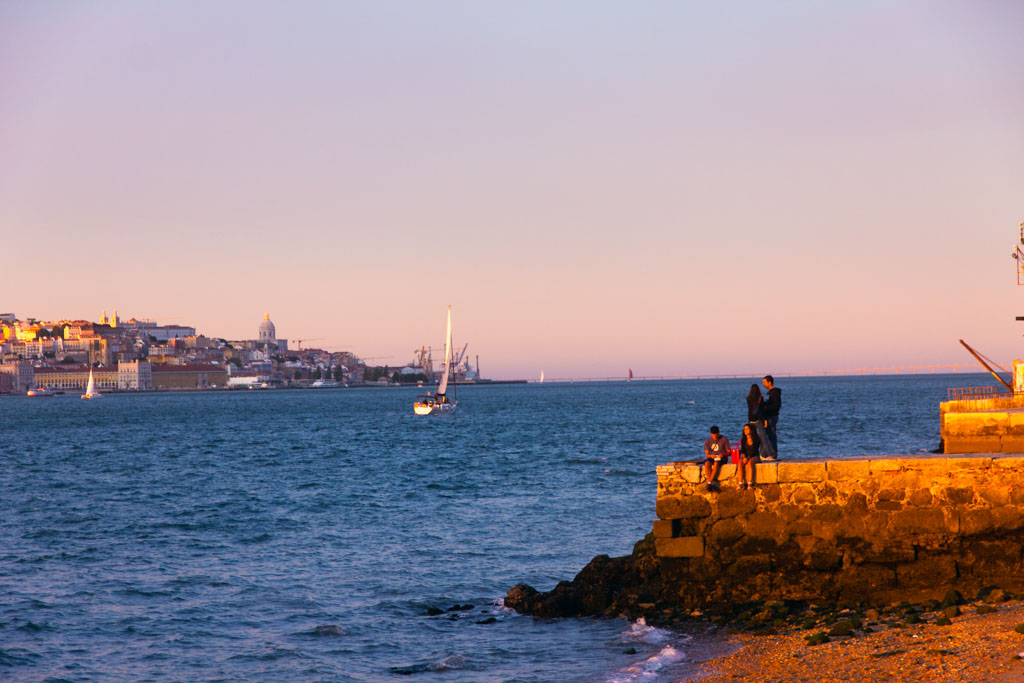
Cacilhas is a neighborhood on the south bank of Lisbon, giving you great views of the city and the 25th of April Bridge.
Walk along the Tagus River and stop for a lunch of freshly grilled fish at a local restaurant. Near the ferry station, there are mainly fresh seafood restaurants, like Ponto Final.
If you’re looking for variety, one of the best food spots in town is the Rua Candidos dos Reis, a street lined with restaurants and ice cream shops.
There’s a free panoramic lift you can go up to see the city and town from a different perspective. Fancy a good coffee and seeing some art? Then head to Casa da Cerca, it’s just a five-minute walk away from the lift and they have contemporary art exhibitions, a cafe, and a cute terrace.
The great thing about Cacilhas is that it’s just a 10-minute ferry ride away from Lisbon. You can easily catch the ferry from Cais do Sodre station.
How to get around Cacilhas: Cacilhas is small and easy to explore on foot. You can stroll along the waterfront, enjoy the views, and pop into local cafes. For a quickd trip to Lisbon, hop on the ferry for a scenic ride across the river. Another fun way is to rent a bike or scooter to explore a bit further along the coast.
How much time do you need? It takes about 10-15 minutes to get from Lisbon to Cacilhas by ferry.